
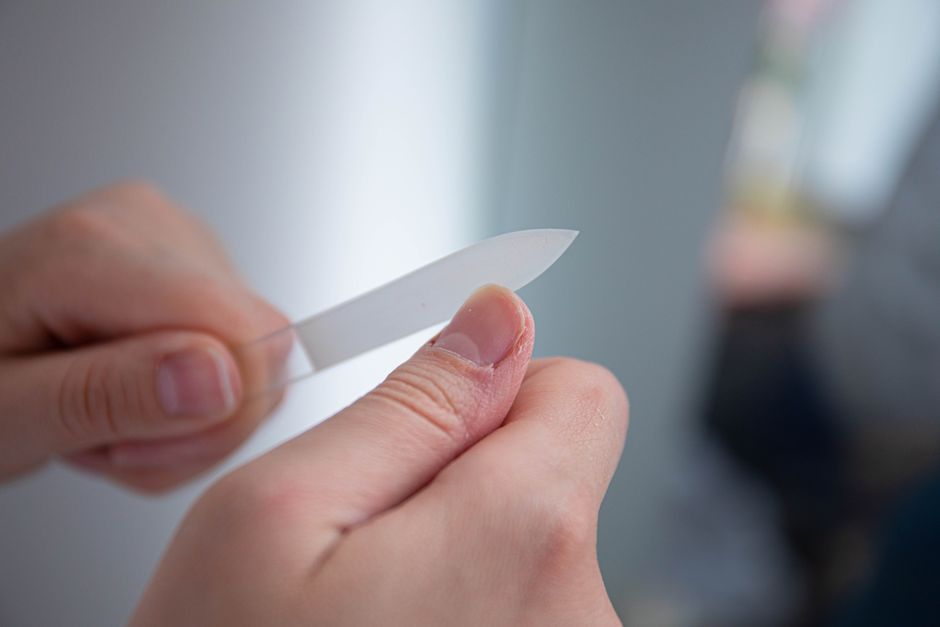
A split fingernail is a tear in the nail plate, the hard layer of keratin that covers the fingertip. You can repair a split nail at home by keeping the tear from spreading, protecting it while it grows out, and fixing the dryness that usually caused it. The nail will not fuse back together — a split does not heal like skin. Instead, you hold the edges together and let the damaged section grow off, which can take several months for a fingernail.
What Actually Causes A Fingernail To Split?
Most splits come from one of two things: repeated wet-dry cycling, or physical force on a nail that was already weak.
Nail plate cells are held together by bonds that weaken when the nail absorbs water and then dries out. Do this often enough — washing dishes, cleaning, frequent handwashing — and the layers can separate. The result is a split that runs lengthwise from the tip, called onychorrhexis, or a peeling split at the free edge.
Trauma is the other common cause. Catching a nail on a drawer, typing hard, or using nails as tools puts stress on a point that was never designed to take it.
A few medical conditions can also cause brittle, splitting nails. Iron deficiency, hypothyroidism, and low zinc intake have all been associated with nail changes in the medical literature. Psoriasis and fungal infections can change nail structure too. If several nails split in the same pattern and nothing you do helps, that pattern is worth mentioning to a doctor rather than treating with home remedies alone.
How To Repair A Split Fingernail At Home
The goal is simple: stop the split from traveling further down the nail bed, and keep it from catching on things while new nail grows underneath.
Start by cleaning the nail gently. Pat it dry. Do not soak it — extra water weakens the nail further right when you need it strongest.
For a small split at the free edge, a thin layer of clear nail polish or nail glue can hold the edges together. Some people use a small piece of teabag paper as a patch, glued over the split and then buffed smooth. This is a widely used home technique, though there is no strong clinical trial evidence that it changes how the nail grows out. It mainly prevents the split from catching and tearing further.
Keep the nail short. A shorter free edge means less leverage on the split every time you use your hand. File in one direction rather than sawing back and forth, which can worsen peeling.
If the split reaches into the quick — the pink tissue under the nail — or if there is bleeding, pain, or redness, that is a different situation. Do not try to glue it. Keep it clean and covered, and see a doctor. An open split near the nail bed can let bacteria in.
Should You Cut Or File A Split Nail?
File it, in most cases. Cutting a split with clippers can create a new crack where the blade presses down, especially on a nail that is already brittle.
Use a fine-grit file and work in one direction from the side toward the center. Stop before you reach the split itself. Then trim the free edge short enough that the split has less chance to catch.
If the split is deep and the nail is lifting, clippers may be the safer choice. Trim straight across, then round the corners slightly so they do not snag.
One detail worth knowing: nail hardeners and strengtheners are not the same thing. Hardeners add a rigid coating that can make a brittle nail more likely to crack under force. Strengtheners add moisture and flexibility. For a nail that splits easily, flexibility usually matters more than hardness.




How Long Does A Split Fingernail Take To Grow Out?
Fingernails grow about 3 to 3.5 millimeters per month, according to dermatology references. A toenail grows much more slowly, closer to 1 millimeter per month.
That means a split near the tip may take a few weeks to grow off. A split that reaches the base of the nail can take several months, because you have to grow out the entire damaged section.
There is no way to speed up nail growth that has been proven in clinical trials. Nail growth rate is largely set by genetics, blood flow, and overall health. Biotin supplements are heavily marketed for nail strength, but the evidence is weak for people who are not deficient. Some small studies have shown benefit in people with brittle nails, but results have not been consistent, and biotin can interfere with certain lab tests, including thyroid and cardiac tests. Talk to a doctor before starting it.
What Helps Brittle Nails Stop Splitting?
Moisture is the single most useful thing you can control. A nail that holds water in its layers bends instead of cracking.
Apply a thick moisturizer or a product containing urea, lanolin, or alpha hydroxy acids after every hand wash and before bed. Some dermatologists recommend ointments over lotions because they hold moisture in better.
Wear gloves for wet work. Dishes, cleaning products, and long soaks all pull moisture out of the nail after the initial swelling. Cotton-lined rubber gloves are the practical option.
Keep nails trimmed and shaped. Avoid using them as tools to open cans, peel labels, or pry things apart.
If you want to review diet, the nutrients most tied to nail health in the medical literature are iron, zinc, and B vitamins. Protein matters too, since nails are made of keratin. A varied diet usually covers these. Supplements are worth discussing with a doctor only if you have a diagnosed deficiency or a symptom pattern that suggests one.
When Should You See A Doctor About A Split Nail?
Most splits are a nuisance, not a medical problem. A few signs mean it is worth getting checked.
- The split reaches the nail bed, or there is bleeding or pain
- The area around the nail is red, swollen, warm, or draining pus
- Several nails split in the same way with no obvious cause
- The nail is separating from the nail bed, changing color, or thickening
- A dark streak appears under the nail and does not grow out
- The split keeps returning in the same spot
A dark streak under a single nail that does not move as the nail grows deserves prompt attention. It is usually benign, but it can be a sign of a serious skin cancer called subungual melanoma, and it should be evaluated rather than watched at home.
Repeated splitting across many nails can also point to a thyroid problem, anemia, or another systemic issue. Those are diagnosed with blood tests, not by looking at the nail alone.
Frequently Asked Questions
Can a split fingernail heal itself?
No. A split does not fuse back together the way skin does, because the nail plate is dead keratin with no living cells to repair it. The split has to grow out, which takes weeks to months depending on how far down it starts.
Is it bad to put super glue on a split nail?
Nail glue made for cosmetic use is generally fine on the free edge of the nail, but household super glue is not designed for skin contact and can irritate the surrounding tissue. Do not use any glue if the split reaches the nail bed or the skin is broken.
Does biotin help split nails?
The evidence is weak for people who are not biotin deficient, and results across studies have been inconsistent. Biotin can also interfere with thyroid and cardiac lab tests, so it is worth asking a doctor before starting it.
How often should I moisturize to prevent splitting?
Apply a thick moisturizer or nail ointment after every hand wash and again before bed. Frequency matters more than the specific product — the goal is keeping the nail from drying out between washes.
