
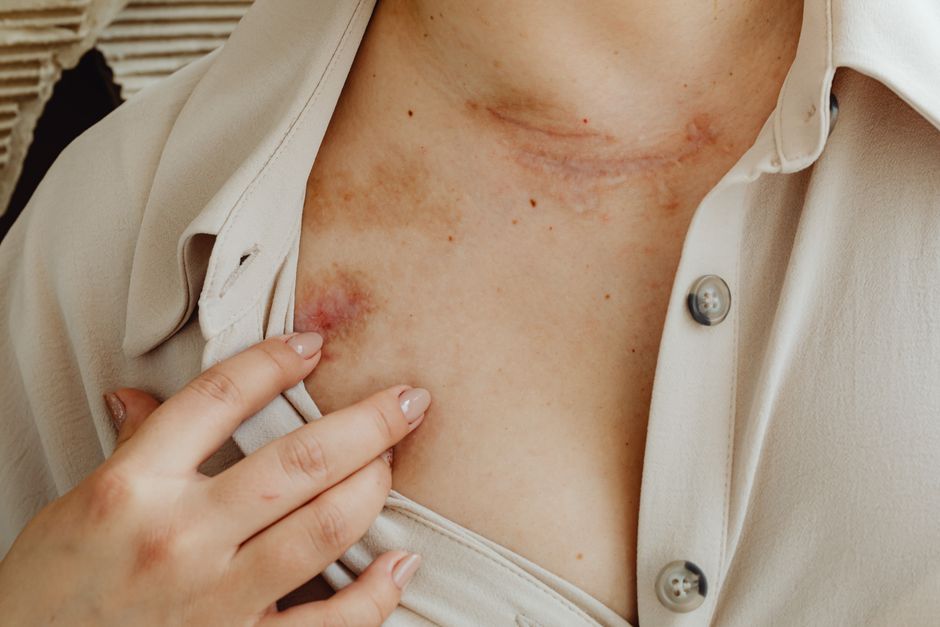
Scar redness comes from blood vessels your skin grew during healing, not from the scar tissue itself. That is why most red or pink scars fade on their own over months, and why treatments that target those vessels — silicone, pressure, pulsed dye lasers — work better than creams that only moisturize. No topical product removes a scar. What they can do is change how red it looks, and how fast that redness fades.
Why Do Scars Stay Red?
When skin is injured, the body repairs it in phases. The inflammatory phase brings immune cells to the wound. The proliferative phase builds new tissue. During that second phase, the body grows new capillaries into the healing area to supply oxygen and nutrients. Those tiny vessels are what you see as redness or pinkness.
This is called erythema, and it is a normal part of wound healing. A red scar is not automatically an abnormal scar.
Over time, most of those extra vessels are pruned away as the tissue matures. The scar flattens and shifts toward the color of surrounding skin. This remodeling phase is slow. It can take many months, and for some people longer than a year. Scars on the chest, shoulders, and back tend to stay red longer than scars on the face, because that skin is under more tension.
Two things can keep a scar red past the normal window. One is persistent inflammation — from friction, sun exposure, or repeated irritation. The other is a scar that has become hypertrophic or keloidal, where excess collagen keeps the tissue raised and active. Those scars behave differently and often need medical treatment rather than drugstore products.
Skin tone matters too. In people with darker skin, the same injury can leave both redness and brown discoloration, called post-inflammatory hyperpigmentation. Those are two separate problems, and they do not respond to the same treatments. A product that fades brown pigment will do nothing for red vessels, and vice versa.
Do Scar Creams Actually Reduce Redness?
Silicone is the one topical with real support behind it. Silicone gel and silicone sheets create a semi-occlusive barrier over the scar. This is thought to increase hydration and slightly change the pressure and oxygen environment at the surface, which may calm the signals that keep collagen production turned up.
What does the evidence show? Silicone has been studied more than any other over-the-counter scar product, and reviews generally find it can improve scar appearance, including color and thickness, particularly in newer scars. The effect is modest. It is not a dramatic eraser. And most of the research has looked at raised or hypertrophic scars, not flat red ones.
Timing matters. Silicone appears to work best on scars that are still maturing — weeks to a few months old — rather than on scars that are years old.
Now the honest part about everything else:
- Vitamin E is widely sold for scars. The evidence does not support it for redness, and some people develop contact dermatitis from it. A study often cited on this found vitamin E did not improve scar appearance and caused irritation in a portion of participants.
- Onion extract gel has some small studies behind it, mostly for raised scars. Results are mixed and the effect on redness specifically is not well established.
- Aloe vera, cocoa butter, and shea butter moisturize. Moisturized skin heals in a better environment, which may help a scar look less dry and tight. There is no good evidence they reduce redness.
- Sunscreen is not a scar treatment, but it matters. UV exposure darkens healing skin and can make a scar more visible. Daily sun protection over a healing scar is one of the few things almost every clinician agrees on.
One clarification worth making: keeping a wound moist during healing does help it close with less scarring. That is a wound-care principle, not a scar-cream claim. Once the wound has closed and a scar has formed, the rules change.
What About Silicone Sheets vs. Silicone Gel?
Both forms deliver silicone. Sheets adhere to the skin and add a mild pressure and occlusion effect, which may be useful for raised scars. Gels dry into a thin film and are easier to use on joints, the face, and hairy areas where a sheet will not stay put.
There is no strong evidence that one form beats the other. The practical difference is adherence — which one you will actually use consistently. Most clinicians suggest using it daily for several months, since scar maturation is a slow process and short trials do not tell you much.
If a scar is raised, firm, and still growing after several months, that is a reason to see a dermatologist rather than keep experimenting with creams.





How Do Lasers Reduce Scar Redness?
Pulsed dye laser is the treatment most studied for red scars. It emits light at a wavelength absorbed by hemoglobin, the oxygen-carrying protein in red blood cells. The light energy converts to heat inside the small vessels, damaging them. The body then clears them away. With fewer vessels, the scar looks less red.
This is a targeted approach, and it works on the actual cause of the color rather than the surface. Research on pulsed dye laser for scar erythema generally shows improvement in redness, including in scars that are still maturing. It is used for both flat red scars and raised ones.
What it does not do is erase the scar. The texture and the boundary of the scar remain. The goal is color and, in some cases, improved pliability.
Other options a dermatologist may consider:
- Intense pulsed light — broader wavelength range, sometimes used for redness, generally considered less precise than pulsed dye laser for this purpose.
- Fractional laser — targets texture and surface irregularities more than redness. Sometimes combined with other treatments.
- Intralesional corticosteroid injections — used for hypertrophic and keloid scars to flatten them. Not a redness treatment.
- Pressure therapy and silicone — often used alongside laser, especially after burns or surgery.
Laser treatment usually requires multiple sessions spaced weeks apart. Results vary by scar type, skin tone, and how old the scar is. Darker skin tones need an experienced practitioner, because laser settings that work well on lighter skin can cause pigment changes on darker skin. This is a real risk, not a theoretical one.
Cost is a practical barrier. Laser scar treatment is often considered cosmetic by insurers and may not be covered. That is a coverage question, not a medical one, and it varies by plan and by whether the scar causes functional problems.
What Actually Works, In Order
If you want a realistic sequence for a scar that is still red:
- Protect it from the sun. This is the cheapest and most consistently recommended step.
- Use silicone if the scar is new and you want to try a topical. Give it months, not weeks.
- Skip vitamin E unless your clinician specifically recommends it.
- See a dermatologist if the scar is raised, growing, painful, or itchy, or if it has stayed red well past the expected maturation window.
- Ask about pulsed dye laser if redness is the main concern and topicals have not helped.
One thing to be clear about: no cream currently on the market has been shown to remove a scar or return skin to its original state. Products marketed that way are overstating what the evidence supports. The realistic goal is a scar that is flatter, softer, and closer in color to the surrounding skin — not invisible.
Does Time Do Most Of The Work?
For many people, yes. Most surgical and traumatic scars fade substantially over the first year as the extra blood vessels regress and collagen reorganizes. If you do nothing at all, a red scar will often become much less noticeable.
That does not mean treatment is pointless. It means the baseline is already improvement, and any treatment is working alongside that natural process. It also means judging a product after two weeks tells you nothing. Scar timelines are measured in months.
The exceptions are scars that do not follow the normal path — keloids, which grow beyond the original wound boundary, and hypertrophic scars, which stay raised. These are more likely to need medical management. Keloids in particular have a high rate of recurrence, and treatment usually involves multiple approaches rather than one.
Frequently Asked Questions
Do scar creams really work?
Silicone gel and sheets have the most evidence and can modestly improve scar appearance, especially on newer scars. Most other over-the-counter scar creams lack good evidence for reducing redness.
How long does it take for a red scar to fade?
Most scars fade gradually over many months, often improving noticeably within the first year. Scars on high-tension areas like the chest and back tend to stay red longer.
Is laser treatment safe for dark skin?
Pulsed dye laser can be used on darker skin, but the risk of pigment changes is higher and results depend heavily on the practitioner’s experience. This is a procedure to have done by a dermatologist familiar with treating darker skin tones.
Can vitamin E oil reduce scar redness?
The evidence does not support vitamin E for scar redness, and it can cause skin irritation in some people. Silicone is the better-supported topical option.
