
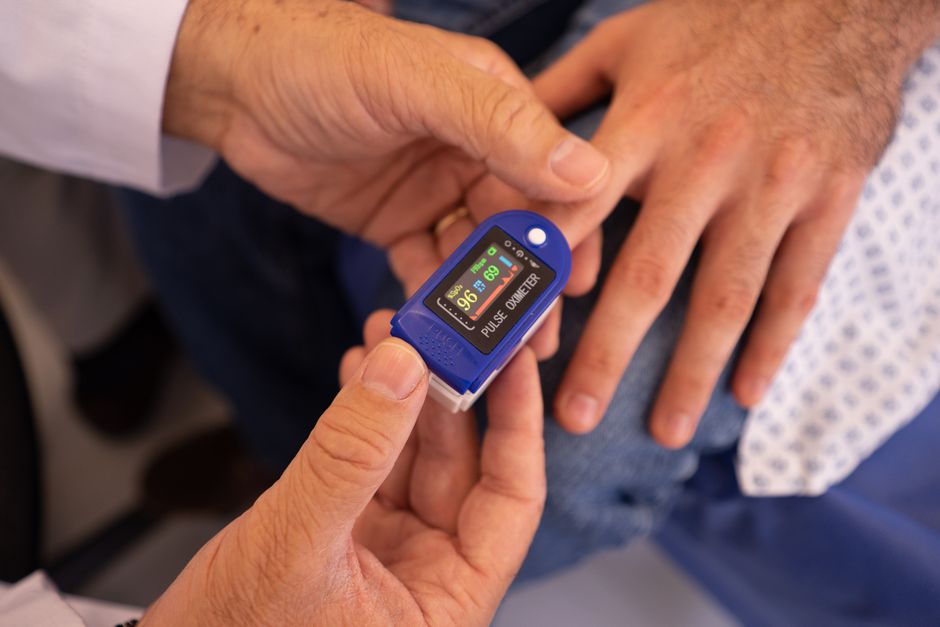
You place a small plastic clip on your fingertip, press a button, and within seconds see two numbers. One is your oxygen saturation, typically called SpO2. The other is your pulse rate. Reading oxygen levels on a pulse oximeter means understanding what these numbers actually tell you — and what they do not. SpO2 between 95% and 100% is normal for most healthy people. Below 92% is a reason to call a doctor. Below 90% is an emergency. The pulse number should match how your heart feels. That is the short answer. The rest of this article explains the details you need to know.
What Do the Two Numbers on a Pulse Oximeter Mean?
Every pulse oximeter shows two numbers. The larger one is usually your oxygen level. The smaller one is your pulse rate. Some devices label them clearly. Others just show numbers. Look for the percentage sign next to the top number. That is your SpO2.
SpO2 stands for peripheral capillary oxygen saturation. It measures how much oxygen your red blood cells are carrying compared to their full capacity. 100% means fully saturated. 95% means 95 out of every 100 oxygen-carrying spots are filled. This number matters because your organs need oxygen to function. Low levels mean your body is struggling to get enough oxygen to your brain, heart, and other tissues.
The pulse number is your heart rate in beats per minute. A normal resting heart rate for adults is 60 to 100 beats per minute. Athletes often run lower. If your heart rate is above 100 at rest, that is called tachycardia. Below 60 can be normal for some people but worth mentioning to a doctor if you feel dizzy or tired. The pulse reading helps you see if your heart is working harder than usual to pump oxygen through your body.
How To Read Oxygen Levels On A Pulse Oximeter Correctly
Getting an accurate reading depends on how you use the device. Most people clip it on and expect instant perfection. That is not how it works. Follow these steps for a reliable number.
First, remove any nail polish or artificial nails. Dark colors like red, blue, or black can block the light the oximeter uses. Clean hands help too. Cold fingers give falsely low readings. Warm your hands if they feel cold.
Second, sit still for at least 30 seconds before taking a reading. Movement creates artifacts. The oximeter measures light absorption through your tissue. If you move, the light path changes and the number jumps around. Rest your hand on a flat surface at heart level.
Third, wait for the number to stabilize. The first number you see may not be correct. Watch the waveform or bar graph if your device has one. A steady wave means a steady reading. Wait 10 to 15 seconds after the number stops changing. That is your real oxygen level.
Fourth, take multiple readings. One number is a snapshot. Three readings over a few minutes give you a trend. If all three are similar, you have a reliable baseline. If they vary widely, something is interfering with the measurement.
What Is a Normal Oxygen Level and When Should You Worry?
Normal oxygen levels for a healthy person at sea level range from 95% to 100%. Below 95% is not automatically dangerous, but it deserves attention. Here is a general guide to what different levels mean.
| SpO2 Level | What It Means | What To Do |
|---|---|---|
| 95% – 100% | Normal for healthy adults | No action needed |
| 91% – 94% | Borderline low, called hypoxemia | Monitor closely. Call your doctor if it stays low or you have symptoms like shortness of breath |
| 86% – 90% | Moderately low | Seek medical attention promptly. This is not normal |
| Below 86% | Severely low | Call 911 or go to an emergency room immediately |
These numbers apply to people without chronic lung conditions. If you have COPD or another lung disease, your doctor may have told you a different target range. Some people with COPD live normally at 88% to 92%. Do not compare yourself to general guidelines if you have a specific medical condition. Follow your doctor’s advice.
Symptoms of low oxygen include shortness of breath, confusion, rapid breathing, chest pain, and bluish lips or fingertips. Do not rely only on the oximeter. If you feel bad but the number looks okay, trust your body. Pulse oximeters can be wrong.



What Makes a Pulse Oximeter Reading Inaccurate?
Pulse oximeters are not perfect. They use light to measure oxygen saturation. Anything that interferes with light absorption or blood flow can give a false number. Here are the most common problems.
Poor circulation is a big one. Cold hands, low blood pressure, or conditions like Raynaud’s disease reduce blood flow to your fingers. The oximeter needs good blood flow to measure accurately. Warm your hands or try a different finger. The middle finger and index finger usually give the best readings.
Dark skin color has been shown to affect accuracy. Research from 2020 and 2021 found that pulse oximeters overestimate oxygen levels in people with darker skin. A person with dark skin might see 95% on the screen when their true level is 92%. This is a known problem. Current research suggests manufacturers are working on better sensors, but as of 2026, this bias still exists. If you have dark skin, be extra cautious. If your reading is borderline low, treat it as potentially worse than it shows.
Movement is another common error. If you are walking, talking, or shaking, the reading will bounce around. Some newer oximeters have motion-resistant technology, but most basic models do not. Sit still. Breathe normally. Do not hold your breath.
Other factors include bright ambient light, thick calluses on fingers, and carbon monoxide poisoning. Carbon monoxide binds to hemoglobin and tricks the oximeter into showing a falsely high number. If you suspect carbon monoxide exposure, do not trust the oximeter. Get fresh air immediately.
How To Track Oxygen Levels Over Time
A single reading is useful. A trend over time is more useful. If you are monitoring a condition like COVID-19, pneumonia, or COPD, keeping a log helps you and your doctor see changes early.
Take readings at the same times each day. Morning and evening are good starting points. Write down the number and note how you feel. Did you just walk up stairs? Are you resting? Context matters.
Some people experience what is called “silent hypoxia.” This happens when oxygen levels drop but you do not feel short of breath. It is dangerous because you may not know something is wrong. Tracking your oxygen level regularly can catch this early. If you see a gradual decline over a few days — from 97% to 95% to 93% — call your doctor even if you feel fine.
Do not obsess over small fluctuations. Oxygen levels change throughout the day. A drop from 98% to 96% is normal. A drop from 96% to 92% is not. Look for patterns, not single points. If you see a consistent downward trend, that is the signal to act.
Common Misconceptions About Pulse Oximeters
Many people think a pulse oximeter measures how well their lungs are working. It does not. It measures how much oxygen is in your blood. Your lungs could be fine but your blood oxygen could be low due to heart problems, anemia, or other issues. The oximeter gives one piece of information, not the whole picture.
Another myth is that 100% is always better. For most people, 98% to 100% is normal. But if you are breathing supplemental oxygen, hitting 100% consistently might mean you are getting more oxygen than you need. Too much oxygen can damage lung tissue over time. Follow your doctor’s prescribed flow rate. Do not crank it up to hit 100%.
Some people believe the device works instantly. It does not. The sensor needs time to detect a consistent pulse and calculate saturation. If you clip it on and immediately read the number, you are likely seeing an old reading from the last use or a random number. Wait for stability.
A final misconception is that any finger works equally well. The thumb and pinky finger often give less reliable readings. The index and middle fingers are best. If you have trouble getting a reading on one hand, try the other. Dominant hands sometimes have thicker skin that reduces accuracy.
When To Trust Your Symptoms Over the Device
Pulse oximeters are tools, not doctors. They can give false reassurance or false alarm. The most important rule is this: if you feel bad, act like something is wrong even if the number looks good.
Shortness of breath, chest tightness, dizziness, or confusion are real symptoms. Do not ignore them because a machine says 97%. The machine can be wrong. Your body is not.
Conversely, if the number is low but you feel fine, do not panic immediately. Check your technique. Warm your hands. Try a different finger. Take another reading after a minute of stillness. If the number stays low and you have no symptoms, call your doctor for advice. Do not drive yourself to the emergency room based on one reading unless it is below 90%.
Current research suggests that pulse oximeters are most useful for tracking trends in people with known conditions. For healthy people checking randomly, they often cause unnecessary worry. Use the device as one piece of information, not the final word.
Frequently Asked Questions
What is a normal oxygen level on a pulse oximeter?
A normal oxygen level for a healthy person at sea level is 95% to 100%. Levels below 92% require medical attention.
Can nail polish affect a pulse oximeter reading?
Yes, dark nail polish like red, blue, or black can block the light and cause a falsely low reading. Remove nail polish before using the device.
How long should I wait for an accurate pulse oximeter reading?
Wait at least 10 to 15 seconds after the number stops changing. Keep your hand still and at heart level for the most accurate result.
Why does my pulse oximeter give different readings on different fingers?
Blood flow varies between fingers. The index and middle fingers usually give the most consistent readings. The thumb and pinky are less reliable.
