
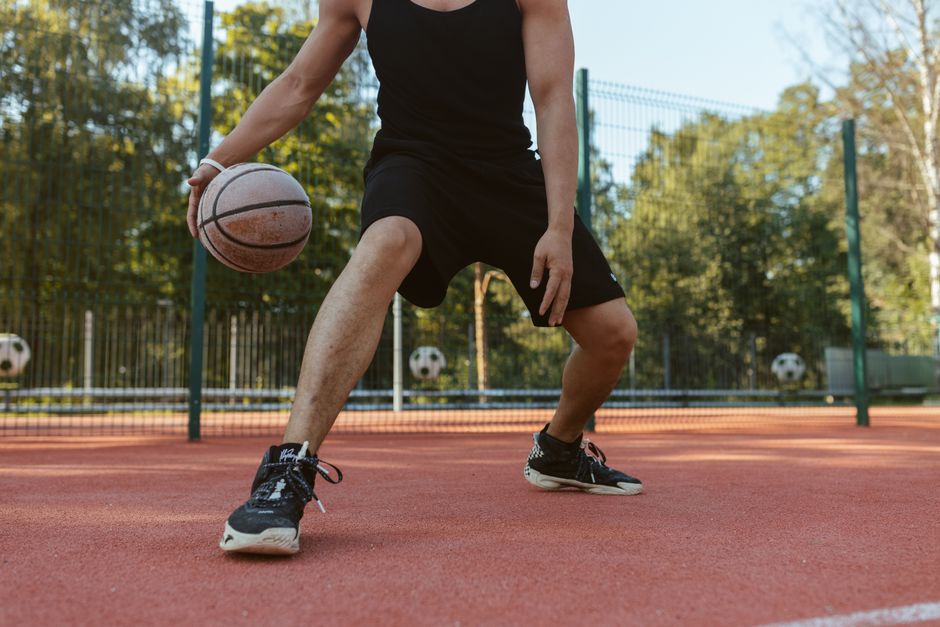
Practicing basketball alone is one of the best ways to improve your game. You control the pace, the intensity, and what you work on. A structured routine with specific drills can build your ball handling, shooting form, footwork, and conditioning without needing another player.
Why Solo Practice Is Essential for Basketball Skill Development
Solo practice is where muscle memory is built. When you repeat a shooting motion or a dribble move hundreds of times, your body learns the movement pattern. This is why professional players spend hours in empty gyms.
Playing in games is about reaction. Solo practice is about repetition. Both matter, but you cannot build reliable technique during a game. Games move too fast. You need quiet, focused time to correct your form and lock in proper mechanics.
Another advantage is efficiency. In a 60-minute solo session, every minute is active. You do not wait for a pass or stand on defense. That concentrated volume of touches accelerates skill growth faster than several pick-up games.
How To Practice Basketball Alone Drills Routines: The Core Structure
A good solo routine has three parts: ball handling, shooting, and conditioning. You should start with ball handling to warm up your hands and wrists. Then move to shooting to build rhythm while your legs are fresh. End with conditioning to simulate game fatigue.
Here is a sample 60-minute routine that covers all three areas. Adjust the time based on your current fitness level.
- Warm-up (5 minutes): Light jogging around the court, arm circles, and dynamic stretching of the legs and hips.
- Ball handling (15 minutes): Stationary dribbling drills focusing on control and speed.
- Form shooting (10 minutes): Close-range shots to reinforce your shooting mechanics.
- Movement shooting (20 minutes): Dribble pull-ups, spot-up threes, and off-screen shots.
- Conditioning (10 minutes): Full-court sprints or suicides to finish strong.
This structure keeps you honest. You do not skip the boring parts. Ball handling is not glamorous but it is foundational. Without solid handles, you cannot create space for your shot.
Essential Solo Ball Handling Drills
Ball handling is the most trainable skill in basketball. You can improve it faster than shooting because it relies on repetition and hand-eye coordination. These drills require only a ball and a flat surface.
Stationary dribble series (10 minutes): Stand with your feet shoulder-width apart. Dribble the ball as hard as you can with your right hand for 30 seconds. Switch to your left hand for 30 seconds. Then alternate hands for 30 seconds. This builds hand strength and control.
Figure-eight dribble (5 minutes): Spread your legs slightly wider than your shoulders. Dribble the ball in a figure-eight pattern around and between your legs. Go slow at first. Speed comes only after your hands know the path. This drill improves coordination and ball feel.
Crossover and between-the-legs (10 minutes): Stand in a triple-threat position. Perform a crossover dribble from right to left. Then immediately do a between-the-legs dribble back to your right hand. Repeat for one minute. Rest for 30 seconds. This mimics the moves you use to beat a defender in a real game.
Do not look at the ball during these drills. Your eyes should be up, scanning an imaginary court. This trains your peripheral vision and keeps you aware of open teammates.

Shooting Drills You Can Do Without a Partner
Shooting form is personal but the fundamentals are universal. Your elbow should be under the ball. Your shooting hand should be relaxed but firm. Your guide hand should not push the ball. Your legs should provide the power.
Form shooting (10 minutes): Stand one to two feet from the basket. Shoot with one hand only, focusing on the flick of your wrist and the spin on the ball. Do 50 makes. Then add your guide hand and shoot from the free-throw line. This drill eliminates bad habits because it forces you to isolate your shooting motion.
Spot-up shooting (15 minutes): Choose five spots on the floor: the left wing, left elbow, top of the key, right elbow, and right wing. Shoot five shots from each spot. Track your makes. This is not about volume. It is about consistency from game-relevant positions.
Dribble pull-up (10 minutes): Start at the three-point line. Dribble hard toward the elbow, plant your feet, and rise into your shot. This mimics a real game scenario where you must create your own shot. Do 10 makes from each elbow.
Shooting off the dribble is harder than spot-up shooting. Your legs are moving, your balance shifts, and your arms must stay steady. Practice this even if it feels awkward at first. Game shots are rarely wide-open catches.
Finishing Drills at the Rim
Layups and close-range finishes are the highest-percentage shots in basketball. Yet many players neglect them in practice. Use a chair, cone, or towel to simulate a defender.
Mikan drill (5 minutes): Stand under the basket with the ball in your right hand. Jump off your left foot and lay the ball up with your right hand. Catch it in the air and repeat on the left side. Alternate sides for five minutes. This drill builds touch and footwork around the rim.
Power layup drill (5 minutes): Start at the free-throw line with the ball. Take two strong dribbles to the basket. Jump off two feet and finish with a power layup. This builds strength and helps you finish through contact.
Do not just use your dominant hand. Your off-hand finishing must be practiced daily. In a real game, defenders will force you to your weak side. If you cannot finish left-handed, you become predictable and easier to guard.
Conditioning Drills to Simulate Game Speed
Basketball is a stop-and-start sport. Your conditioning must match that pattern. Long-distance running helps your aerobic base but does not prepare you for the explosive bursts of a game.
Suicides (10 minutes): Run from the baseline to the free-throw line and back. Then to half-court and back. Then to the opposite free-throw line and back. Then to the opposite baseline and back. Rest for one minute between sets. Do five sets. This mirrors the sprint-and-rest pattern of real play.
Full-court dribbling sprints (5 minutes): Dribble the ball at full speed from one baseline to the other. Do a crossover at half-court and continue. Walk back to the start. Repeat for five minutes. This combines conditioning with ball handling under fatigue.
Conditioning is where many players quit early in practice. Push through it. Fatigue is when your form breaks down. Practicing while tired teaches your body to maintain technique even when your legs are heavy.
How To Track Your Progress and Stay Motivated
You cannot improve what you do not measure. Keep a simple log of your makes and misses. Write down your free-throw percentage, your three-point makes from each spot, and your dribble drill time.
Set specific goals. Instead of saying “I want to shoot better,” say “I want to make 8 out of 10 free throws in my solo practice.” Track this weekly. If you hit your goal, increase the difficulty. If you miss it, adjust your form or your practice volume.
Video recording is a powerful tool. Set your phone on a tripod or against a wall. Film your shooting form from the side and from the front. Compare it week to week. You will often see flaws that you cannot feel in the moment, such as a drifting elbow or a low release point.
Do not let a bad practice session discourage you. Progress is rarely linear. Some days the ball will not fall. Focus on the quality of your reps, not just the number of makes. A well-executed miss teaches you more than a lucky make.
Frequently Asked Questions
How long should a solo basketball practice session last?
Sixty minutes is a solid length for most players. Shorter sessions of 30 minutes still help if done consistently, but an hour allows enough time for ball handling, shooting, and conditioning.
Can I improve my basketball skills without a hoop?
Yes, ball handling and footwork drills require only a ball and flat ground. Shooting improvement does require a hoop, but your dribbling and coordination can improve significantly without one.
How many days per week should I practice alone?
Three to five days per week is realistic for most players. Consistency matters more than intensity, so choose a schedule you can actually maintain long-term.
What is the most important drill for solo practice?
Form shooting is the most important because it builds the foundation for every other shot you take. If your mechanics are broken, extra volume will only reinforce bad habits.
