
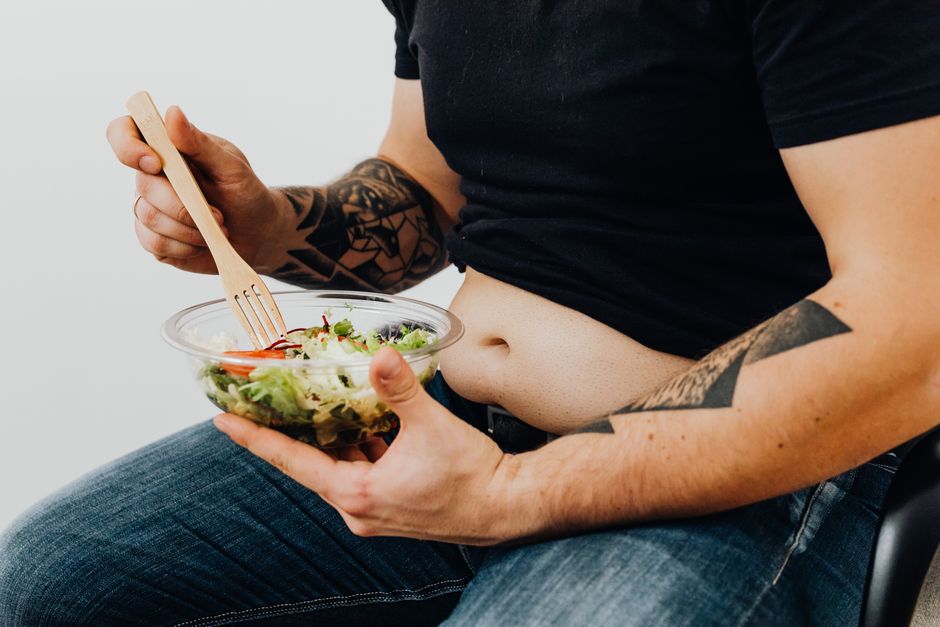
You can lose belly fat without losing weight because the number on the scale is not a direct measure of body fat. When you add muscle while trimming fat, your weight can stay nearly the same while your waist gets smaller. The scale measures everything at once — fat, muscle, bone, water, and the food in your gut — so it can hide real changes in body composition.
This is not a loophole. It is how body recomposition works, and it is a realistic goal for many people, especially those who are new to strength training or carrying extra fat to begin with.
Can you actually lose belly fat and stay the same weight?
Yes, and the physiology behind it is well established. Fat and muscle are different tissues with different densities. Muscle is denser than fat, meaning a pound of muscle takes up less space than a pound of fat.
If you lose fat and gain muscle at roughly the same rate, your body weight barely moves. But your shape changes. Your waistband loosens. Your clothes fit differently. This is why body composition matters more than body weight for health and appearance.
Body recomposition is most achievable in two groups: people who are new to resistance training, and people carrying more body fat. For someone who has trained for years and is already lean, losing fat while gaining muscle at the same time becomes much harder. In that case, most people need to pick a phase — either a slight calorie deficit to lose fat or a slight surplus to build muscle.
One clarification worth making: spot reduction does not work. You cannot target belly fat by doing crunches or wearing a waist trainer. Fat is mobilized from stores across the body under hormonal control, not from the muscle you happen to be working. Ab exercises build the muscles underneath, but they do not strip fat from the surface.
Why does belly fat matter more than other fat?
Not all fat behaves the same way. Visceral fat — the fat stored deep inside the abdomen around your organs — is more metabolically active and more strongly linked to health problems than the fat you can pinch just under the skin.
Visceral fat is associated with higher risk of type 2 diabetes, heart disease, and inflammation. Subcutaneous fat, the kind you can grab, is less harmful in comparison. This is why waist circumference is used in clinical settings as a marker of health risk alongside BMI.
The good news is that visceral fat tends to respond well to lifestyle changes. Some research suggests visceral fat can be reduced relatively quickly with consistent exercise and improved diet, sometimes before changes show up on the scale. The belly may look smaller because internal fat is shrinking, even while total body weight holds steady.
How do you build muscle while keeping fat loss going?
Resistance training is the foundation. Without a reason to hold onto or build muscle, the body has no signal to preserve it. Lifting weights, using resistance bands, or doing bodyweight strength work all count, as long as the muscles are challenged over time.
The key principle is progressive overload — gradually increasing the weight, reps, or difficulty. Muscles grow when they are asked to do more than they are used to. Two to three full-body sessions per week is a reasonable starting point for most people, though the right amount depends on your starting point and recovery.
Protein intake supports this process. The general guidance for adults doing resistance training is roughly 1.2 to 1.6 grams of protein per kilogram of body weight per day, though individual needs vary. For a 70 kg (about 154 lb) person, that works out to roughly 84 to 112 grams daily. Spreading protein across meals seems to support muscle protein synthesis better than eating it all at once.
Sleep and recovery are not optional extras. Muscle is built during recovery, not during the workout itself. Chronic short sleep is associated with poorer body composition outcomes and increased appetite, partly through effects on hunger hormones.
-
 How to Reduce Belly Fat Without Losing Weight? Ways That Actually Help
-
Will Weight Training Burn Belly Fat? Here’s What to Know
-
How to Bulk Without Gaining Belly Fat? Tips You Can Try
-
How to Hide Belly Fat Without Shapewear? Easy Steps to Follow
-
Cardio Slim Tea Reviews & Complaints Research Analysis 2026.




What should you eat to lose belly fat without dropping weight?
You do not need a dramatic calorie cut to lose fat. A modest deficit — small enough to allow muscle retention — combined with high protein and strength training is the approach most consistent with body recomposition.
If you cut calories too aggressively, you risk losing muscle along with fat. That can lower your resting metabolic rate slightly and make the scale drop faster than your waist does. Slow and steady tends to preserve more muscle.
- Prioritize protein at each meal — eggs, fish, poultry, legumes, dairy, or tofu.
- Build meals around vegetables and fiber, which support fullness and gut health.
- Choose whole carbohydrates like oats, beans, and whole grains over refined versions most of the time.
- Limit liquid calories — sugary drinks add energy without helping you feel full.
- Do not eliminate entire food groups unless medically necessary; sustainability matters more than perfection.
No single food burns belly fat. Claims about specific foods melting fat are marketing, not physiology. What matters is the overall pattern over weeks and months.
Does cardio help, and how much do you need?
Aerobic exercise helps create the calorie deficit that drives fat loss, and it has independent benefits for heart and metabolic health. But cardio alone, without strength training, tends to produce weight loss that includes some muscle loss.
Combining both is the practical answer. Some moderate-intensity cardio most days of the week, plus two or more strength sessions, covers both the fat-loss and muscle-preservation sides of the equation. The exact amount is less important than consistency.
High-intensity interval training can be time-efficient, but it is not required and it is not superior for fat loss in any meaningful way over other forms of activity when total energy expenditure is matched. The best exercise is the one you will keep doing.
What gets in the way of losing belly fat?
Several factors can stall progress even when you are doing the right things. Stress is one. Chronic stress raises cortisol, and elevated cortisol is associated with increased abdominal fat storage, particularly visceral fat. This does not mean stress alone causes belly fat, but it is part of the picture.
Alcohol is another. It adds calories and, in excess, is linked to increased abdominal fat. Poor sleep, as mentioned, affects appetite regulation and recovery. And age-related hormonal changes — including the drop in estrogen around menopause — shift where the body stores fat, often toward the abdomen.
Some medical conditions, including thyroid disorders and polycystic ovary syndrome, can affect weight and fat distribution. If you are doing everything right and seeing no change, it is reasonable to discuss this with a clinician rather than assuming you are doing something wrong.
How do you track progress if not by weight?
The scale is one data point, and a noisy one. Body weight fluctuates daily with hydration, sodium intake, digestion, and hormonal cycles. A single reading tells you very little.
Better markers include waist circumference measured at the same spot, how clothes fit, progress photos taken under similar conditions, and strength gains in the gym. These reflect body composition more directly than weight alone.
If you do weigh yourself, look at the trend over several weeks rather than any single day. A stable weight with a shrinking waist is a sign that fat is coming off and muscle is holding or growing. That is exactly the outcome this approach is designed to produce.
Frequently Asked Questions
Can you lose belly fat without losing any weight at all?
Yes. If you gain muscle while losing fat at a similar rate, total body weight can stay the same while your waist shrinks. This is most achievable for people new to strength training or those with more body fat to lose.
How long does it take to see belly fat loss without weight change?
Timelines vary widely by individual, and no single figure applies to everyone. Changes in how clothes fit often show up before the scale or tape measure moves, so track several markers over weeks rather than days.
Do crunches or ab exercises burn belly fat?
No. Spot reduction does not work — you cannot target fat loss to one area by exercising the muscle beneath it. Ab exercises strengthen core muscles but do not strip fat from the abdomen.
Is it possible to lose belly fat without cutting calories?
It is possible but less reliable. Fat loss generally requires some energy deficit, though a small one combined with strength training and high protein intake can support fat loss while preserving muscle.
