
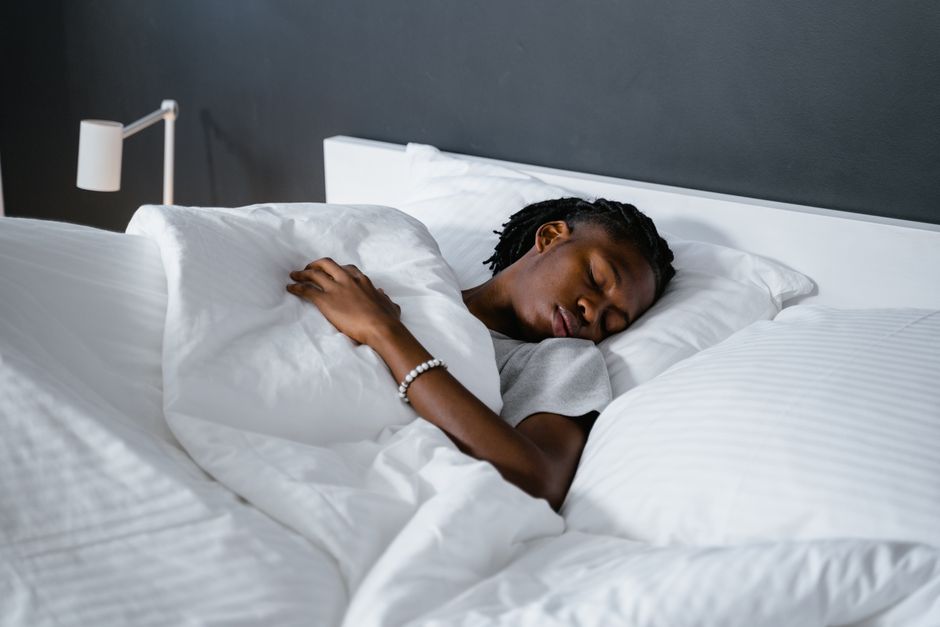
There is no technique that reliably puts a healthy adult to sleep in seconds on command. What does exist is a set of methods with real evidence behind them — paced breathing, progressive muscle relaxation, cognitive shuffling, and stimulus-control routines — that shorten how long it takes to fall asleep and improve sleep quality over time. “Immediately” is the wrong promise. “Faster” is a realistic one.
What Actually Happens In Your Body When You Fall Asleep?
Falling asleep is not a switch. It is a transition your brain has to be allowed to make.
The process depends on two systems working together. One is sleep pressure — a chemical called adenosine that builds in your brain the longer you stay awake. The other is your circadian rhythm, an internal clock that decides when your body is primed for sleep. When those two line up, sleep comes easily. When they don’t, no breathing exercise in the world will override it.
On top of that, falling asleep requires your nervous system to shift out of sympathetic (alert) mode and into parasympathetic (rest) mode. Heart rate drops. Core body temperature falls slightly. Breathing slows. Muscle tone decreases.
This is why the most effective techniques are the ones that nudge those physical changes rather than trying to force sleep with willpower. Trying harder to sleep activates the alert system you’re trying to quiet. That is a real physiological problem, not a character flaw.
How To Go To Sleep Immediately Proven Techniques That Hold Up
The techniques below have the strongest evidence behind them. None of them are instant. Most take a few minutes to work, and some only work consistently after you practice them for a couple of weeks.
Slow Paced Breathing
Slow breathing at roughly six breaths per minute increases what’s called heart rate variability — a marker of parasympathetic nervous system activity. Some studies show this kind of paced breathing reduces the time it takes to fall asleep and improves subjective sleep quality.
The practical version: breathe in through your nose for about four seconds, out through your mouth for about six. Keep it gentle, not forced. Do it for five to ten minutes.
You may have seen the 4-7-8 pattern promoted heavily online. It is a form of paced breathing and it is reasonable, but it is not uniquely better than slower, simpler breathing. The evidence does not single it out as superior.
Progressive Muscle Relaxation
This involves tensing a muscle group for about five seconds, then releasing it and noticing the difference. You work through the body — feet, calves, thighs, abdomen, hands, arms, shoulders, face.
The mechanism is straightforward. Muscle tension is a physical sign of arousal. Deliberately releasing it gives your nervous system a signal that there is no threat to stay alert for. Some research supports progressive muscle relaxation for reducing sleep onset latency, which is the technical term for how long it takes to fall asleep.
Cognitive Shuffling
This one is less well known. Instead of trying to empty your mind — which almost never works — you occupy it with random, neutral, unrelated words or images. Think “apple, bicycle, ocean, ladder” in loose succession, without connecting them into a story.
The idea is that racing thoughts and worry require logical, connected thinking. Random imagery interrupts that loop. Some sleep clinicians teach this as a way to reduce pre-sleep cognitive arousal. The evidence base is smaller than for breathing or muscle relaxation, but the approach is sound and low-risk.
Body Temperature Manipulation
Your core temperature needs to drop slightly for sleep to begin. A warm bath or shower one to two hours before bed can help — not because heat makes you sleepy, but because the subsequent cooling as your body sheds that heat mimics the natural temperature drop that precedes sleep.
A cool, dark, quiet bedroom supports the same process. A room that is too warm makes the temperature drop harder to achieve.
Why Do These Techniques Fail For So Many People?
Most people who try these methods and fail are not doing them wrong. They are using them in conditions that work against sleep.
If you get into bed at a wildly different time each night, your circadian rhythm has no anchor. If you spend two hours scrolling in bed before trying to sleep, your brain has learned that bed is for stimulation. If you drink coffee at 4 p.m., adenosine is still being blocked when you want it to accumulate.
There is also a common misunderstanding worth naming directly. Lying in bed awake for a long time does not build sleep pressure in a helpful way — it conditions your brain to associate the bed with frustration and alertness. Sleep clinicians call this conditioned arousal. It is one of the main drivers of chronic insomnia, and it gets worse the more nights you spend lying there trying.
Techniques work best when the conditions around them are already reasonable.



What Is Stimulus Control And Why Do Sleep Clinicians Recommend It First?
Stimulus control is the most evidence-supported behavioral treatment for insomnia. It is also the least exciting, which is probably why it gets less attention than breathing hacks.
The rules are simple:
- Go to bed only when you feel sleepy, not just tired.
- If you are not asleep after roughly 20 minutes, get up and do something quiet and boring in dim light.
- Return to bed only when sleepy again. Repeat as needed.
- Use the bed only for sleep and sex.
- Get up at the same time every day, regardless of how you slept.
The 20-minute figure is a clinical convention rather than a precise threshold. The goal is to avoid long stretches of frustrated wakefulness in bed.
This is uncomfortable at first. Many people find it makes the first few nights worse. Over one to two weeks it typically strengthens the association between bed and sleep. Cognitive behavioral therapy for insomnia, or CBT-I, combines stimulus control with sleep restriction, cognitive work, and relaxation training. It is considered first-line treatment for chronic insomnia in major clinical guidelines, ahead of sleeping medication for most adults.
Does Anything Work In Under A Minute?
No technique reliably puts a healthy adult to sleep in under a minute. Anyone claiming otherwise is selling something.
What can happen quickly is the shift into a relaxed, drowsy state. Paced breathing can lower heart rate within a minute or two. Releasing muscle tension can produce noticeable relaxation in a similar timeframe. That is a real effect. It is not the same as being asleep.
People who fall asleep in seconds are usually already severely sleep-deprived, or they have trained their sleep system so thoroughly through consistent habits that the transition is fast. That is the result of weeks or months of practice, not a trick.
What Should You Do When Nothing Works?
If you have tried these methods consistently for several weeks and still struggle to fall asleep most nights, that is worth taking seriously.
Chronic insomnia — difficulty falling asleep or staying asleep at least three nights a week for at least three months, with daytime consequences — is a diagnosable condition, not a bad habit. It responds well to structured treatment. A doctor or a clinician trained in CBT-I can assess whether something else is going on.
Several conditions can look like ordinary difficulty falling asleep. Sleep apnea, restless legs syndrome, thyroid problems, depression, and anxiety disorders all affect sleep and all require different treatment. No breathing pattern fixes any of them.
Medication is an option for some people in some situations, but it is not a first-line treatment for chronic insomnia in most guidelines, and it does not address the behavioral patterns that maintain the problem. That is a conversation to have with a clinician who knows your history.
One clarification worth making: sleep trackers are not reliable enough to diagnose anything. They estimate sleep from movement and heart rate, and they misclassify wakefulness as sleep fairly often. If your tracker says you slept badly but you feel fine, the tracker may be wrong.
Frequently Asked Questions
What is the fastest proven way to fall asleep?
Slow paced breathing at about six breaths per minute has the best evidence for shortening sleep onset, though it typically takes several minutes rather than seconds. Progressive muscle relaxation and stimulus control are also well supported.
Does the 4-7-8 breathing technique actually work?
It is a form of paced breathing and it can help, but research does not show it works better than other slow breathing patterns. The key factor appears to be the slow rate, not the specific count.
Why do I fall asleep instantly some nights and lie awake for hours on others?
Sleep pressure and circadian timing vary from day to day, so sleep onset naturally fluctuates. Large swings often point to inconsistent sleep schedules, late caffeine, or stress rather than a technique problem.
How long should it take to fall asleep normally?
For most healthy adults, falling asleep within about 10 to 20 minutes is considered normal. Consistently taking longer than 30 minutes on most nights may indicate insomnia worth discussing with a clinician.
