
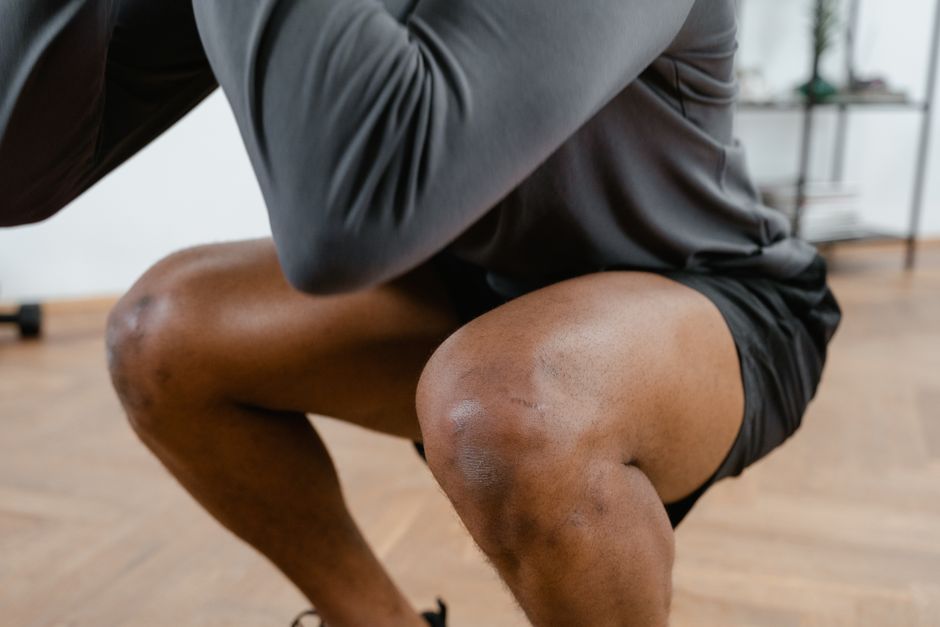
Strong knees are not about avoiding movement. They are about building the muscles that support the joint. The most effective way to get stronger knees is to perform specific strengthening exercises that target the quadriceps, hamstrings, and glutes, using your body weight or added resistance. These exercises improve the stability of the knee joint, which reduces pain and lowers the risk of future injury.
Why Do Knees Get Weak in the First Place?
The knee joint itself is fairly simple. It connects the thigh bone to the shin bone. It relies almost entirely on the muscles around it for stability. When those muscles are weak, the joint takes on more stress. That stress often shows up as pain, stiffness, or a feeling that the knee is going to give out.
Weakness usually comes from a lack of use. Sedentary jobs, long periods of sitting, and avoiding exercise because of existing pain all contribute. When you stop moving, the muscles around the knee shrink. This process is called muscle atrophy. It makes the knee less stable and more vulnerable to injury.
Another common cause is muscle imbalance. Your quadriceps run along the front of your thigh. Your hamstrings run along the back. If one group is significantly stronger than the other, the knee joint gets pulled unevenly. This uneven pull can irritate the joint and cause pain over time.
What Are the Best Exercises for Knee Strength?
The best exercises are the ones that work the muscles that cross the knee joint. These are your quadriceps, hamstrings, and calf muscles. You also need strong glutes. Your glutes control the rotation of your thigh bone. If they are weak, your knee tracks inward during movement, which is a common source of pain.
Start with these foundational exercises. They are safe for most people and require no special equipment.
- Straight Leg Raises: Lie on your back with one leg bent and the other leg straight. Tighten the thigh muscle of the straight leg and lift it about 12 inches off the floor. Hold for a few seconds, then lower slowly. This works the quadriceps without putting pressure on the knee joint itself.
- Wall Sits: Stand with your back against a wall and slide down until your thighs are parallel to the floor. Hold this position. It builds endurance in the quadriceps and glutes. Start with 15-second holds and build up.
- Step-Ups: Use a low, sturdy step or stair. Place one foot on the step and push through that heel to lift your body up. Step down slowly. This mimics everyday movements like climbing stairs and builds functional strength.
- Calf Raises: Stand with your feet hip-width apart. Rise up onto your toes, hold for a second, then lower back down. This strengthens the calf muscles, which support the back of the knee.
These exercises are the foundation. Once you can perform them with good form, you can progress to more challenging versions.
How To Get Your Knees Stronger Exercises That Work for Advanced Strength
Bodyweight exercises are a great starting point. But to keep making progress, you need to add resistance. This does not mean you need to be in a gym. Resistance bands are affordable, portable, and highly effective.
Here are the next-level exercises to build serious knee stability.
- Squats: Stand with your feet shoulder-width apart. Lower your hips back and down as if sitting into a chair. Keep your chest up and your knees tracking over your toes. Go as deep as you can without pain. You can hold a dumbbell at your chest for added resistance.
- Lunges: Step forward with one leg and lower your hips until both knees are bent at about a 90-degree angle. Push back to the starting position. Lunges work the quadriceps, hamstrings, and glutes all at once. They also challenge your balance, which improves joint awareness.
- Glute Bridges: Lie on your back with your knees bent and feet flat on the floor. Push through your heels to lift your hips toward the ceiling. Squeeze your glutes at the top. This strengthens the glutes and hamstrings, which are critical for knee alignment.
- Leg Press Machine: If you have access to a gym, the leg press is a controlled way to add significant resistance. It supports your back and isolates the leg muscles. Start with a light weight and focus on full range of motion.
When adding resistance, the rule is simple: you should feel the muscles working, but you should not feel sharp pain in the joint. If an exercise causes sharp knee pain, stop doing it. That is not weakness. That is a signal that the movement pattern is wrong for your body.





How Often Should You Do These Exercises?
Consistency matters more than intensity. You need to train these muscles at least two to three times per week. A single session does very little. The muscles need repeated stimulus over several weeks to grow stronger.
A good schedule is to do a knee-strengthening routine every other day. This gives your muscles time to recover. Recovery is when the muscle actually rebuilds and gets stronger. Training the same muscles every day does not speed up the process. It increases the risk of overuse injury.
Each session should take about 15 to 20 minutes. Perform two to three sets of each exercise. Aim for 10 to 15 repetitions per set. If you cannot complete 10 repetitions with good form, the exercise is too hard. If you can easily do 15, it is time to add more resistance.
What About Pain? Should You Exercise Through It?
This is the most common question people have. The answer depends on the type of pain. Muscle soreness during or after exercise is normal. That dull ache in the thigh or glute means you worked the muscle. Joint pain is different. Sharp pain inside the knee, swelling, or a catching sensation are warning signs.
If you have sharp joint pain, stop the exercise immediately. Do not push through it. You can try a different exercise that does not cause pain. For example, if squats hurt, try straight leg raises instead. The goal is to find movements that strengthen the supporting muscles without irritating the joint.
If you have been diagnosed with knee osteoarthritis, exercise is still recommended. Research consistently shows that strengthening exercises reduce pain and improve function in people with arthritis. The key is to work within a pain-free range of motion. Some discomfort is acceptable. Sharp, stabbing pain is not.
What Role Do Stretching and Mobility Play?
Strength is only half the equation. You also need adequate flexibility around the joint. Tight muscles pull on the knee and restrict its natural movement. This makes the joint work harder than it should.
Focus on stretching your quadriceps, hamstrings, and calves. Hold each stretch for about 30 seconds. Do not bounce. Bouncing can cause micro-tears in the muscle tissue. Stretch after your strengthening workout, when the muscles are warm.
Mobility work is different from stretching. It involves moving the joint through its full range of motion. Simple exercises like knee circles or walking backward can improve joint mobility. This helps the knee move smoothly during daily activities.
What Mistakes Are Keeping Your Knees Weak?
Several common mistakes prevent people from making progress. The first is doing only one type of exercise. If you only do quadriceps exercises, you ignore the hamstrings and glutes. This creates imbalances. You need a balanced routine that targets all the supporting muscles.
The second mistake is using too much weight too soon. This is common in the gym. People load up the leg press machine and do partial reps. This does not build functional strength. It puts excessive stress on the joint. Use a weight that allows you to complete the full range of motion with control.
The third mistake is ignoring your feet. Your foot position affects your knee alignment. If your feet point inward or outward, your knees will follow. Keep your feet pointing forward during squats and lunges. This keeps your knees in proper alignment.
The fourth mistake is skipping rest days. Your muscles need time to repair. If you train hard every day, you are breaking down muscle tissue faster than your body can rebuild it. This leads to weakness, not strength.
How Long Until You See Results?
Muscle strengthening is a gradual process. You will not notice a dramatic difference after one week. Most people begin to feel more stable and confident in their knees after about four to six weeks of consistent training. Visible changes in muscle size take longer, usually around eight to twelve weeks.
Pain relief often comes sooner. Many people report reduced knee pain within two to three weeks of starting a consistent strengthening program. This is because stronger muscles take pressure off the joint. The joint itself has time to recover and heal.
The most important factor is consistency. A moderate program done regularly beats an intense program done sporadically. Even on days when you do not feel motivated, a short 10-minute session is better than nothing.
When Should You See a Doctor?
Exercise is beneficial for most knee problems, but it is not a cure-all. You should see a doctor if you experience any of the following:
- Swelling that does not go down after a few days of rest
- Inability to bear weight on the affected leg
- A popping or grinding sensation accompanied by pain
- The knee locks or catches during movement
- Pain that persists despite several weeks of consistent exercise
These symptoms may indicate a structural injury like a meniscus tear or ligament damage. In those cases, strengthening exercises alone may not be enough. A doctor or physical therapist can assess your specific situation and recommend appropriate treatment.
Working with a physical therapist is often the best approach if you have chronic knee pain. They can identify your specific muscle imbalances and design a program tailored to your needs. This is more effective than guessing which exercises are right for you.
Frequently Asked Questions
Can walking make my knees stronger?
Walking is a good low-impact activity, but it is not enough to significantly strengthen the muscles around the knee. You need targeted resistance exercises like squats, lunges, and leg raises to build meaningful strength.
Are squats bad for your knees?
No. Squats are one of the best exercises for knee strength when performed with proper form. The problem is usually poor technique, not the exercise itself. Keep your knees tracking over your toes and avoid going deeper than your current flexibility allows.
How long does it take to strengthen weak knees?
Most people notice improved stability and reduced pain within four to six weeks of consistent training. Significant muscle growth takes about eight to twelve weeks. Consistency is the most important factor in how quickly you see results.
Should I ice my knees after exercise?
Icing is only necessary if you have swelling or significant joint pain after exercise. Mild muscle soreness does not require ice. If you regularly need ice after workouts, your exercise intensity may be too high for your current fitness level.
