
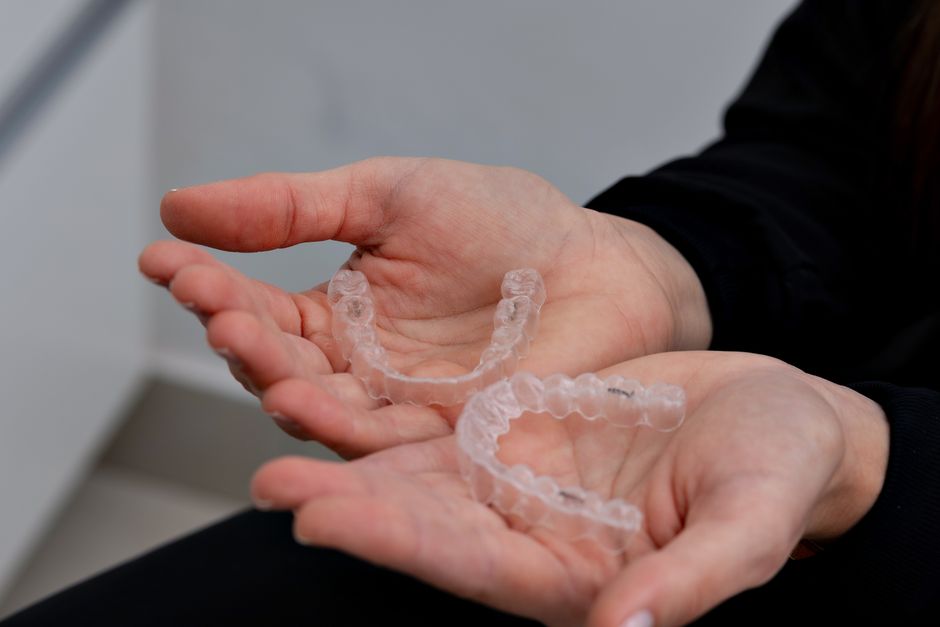
How Do Clear Aligners Work To Straighten Teeth?
Clear aligners work through a process called controlled force application. When you place an aligner over your teeth, it does not fit perfectly. It is slightly off—by fractions of a millimeter—in the direction the tooth needs to move. That misfit creates pressure on the tooth.
That pressure is transmitted to the periodontal ligament, the soft tissue that connects the tooth root to the jawbone. The ligament senses the pressure and triggers a biological response. On the side of the root being pushed, bone cells called osteoclasts break down bone tissue. On the opposite side, bone-building cells called osteoblasts create new bone. This process is called bone remodeling.
Over time—usually one to two weeks per aligner—the tooth shifts into the position of that tray. When it does, the pressure releases. You then move to the next aligner in the series, which applies a new, slightly different pressure. This repeats until the teeth reach the final position planned at the start of treatment.
The entire process is mapped out in advance using 3D imaging software. Your dentist or orthodontist takes digital scans of your teeth, and the software predicts how each tooth will move. That plan determines how many aligners you need and how long treatment will take.
What Problems Can Clear Aligners Fix?
Clear aligners are effective for a specific range of orthodontic issues. They work well for mild to moderate crowding, where teeth are too close together. They also correct gaps between teeth, a condition called diastema. And they can fix certain bite issues, including overbites, underbites, and crossbites—but only when those issues are not severe.
Aligners are not ideal for every case. Complex cases involving large tooth rotations, significant vertical bite problems, or teeth that need to move a long distance may require traditional braces. Some orthodontists also use aligners in combination with other appliances to handle more difficult movements.
The key limitation is control. Braces use brackets and wires that can move teeth in three dimensions with high precision. Aligners rely on the plastic tray gripping the tooth. For some movements—like rotating a canine tooth or moving a molar backward—aligners have historically been less predictable. Newer aligner designs with attachments and modifications have improved this, but the limitation still exists.
Your dentist or orthodontist will determine if you are a candidate. That decision is based on a full examination, X-rays, and a digital scan. It is not something you can determine from looking in a mirror.
What Are Attachments and Why Are They Used?
Attachments are small, tooth-colored bumps made of composite resin that are bonded to certain teeth. They look like tiny buttons. They are not brackets, and they are not visible from a distance.
Attachments give the aligner something to grip. Without them, the plastic tray can slip or fail to apply pressure in the right direction. Attachments help the aligner hold onto the tooth more firmly, which allows for more precise movements.
Not everyone needs attachments. Their use depends on the difficulty of the movement required. Simple cases may not need any. More complex cases may need several. They are placed at the start of treatment and removed when treatment is complete.
Another tool used in some cases is elastic bands, or elastics. These attach to small hooks on the aligners and apply additional force to correct bite issues. Elastics are typically worn as directed—often about 20 to 22 hours per day—and are changed regularly.





How Long Does Treatment Take?
Most clear aligner treatments take 12 to 18 months. Some cases finish in as little as six months. Severe cases can take two years or more. The exact timeline depends on the complexity of the movement and how consistently you wear the aligners.
Compliance is the single biggest factor in treatment duration. Aligners must be worn 20 to 22 hours per day. That means you can remove them to eat, drink, brush, and floss—but they need to be in your mouth the rest of the time.
If you do not wear them enough, the teeth will not move on schedule. The aligner will not fit properly when you try to put it back in, and treatment can stall. In some cases, you may need to restart with a new set of aligners, which extends the total treatment time.
After the active phase of treatment, you will need retainers. Retainers hold the teeth in their new position while the bone around them solidifies. This phase is not optional. Teeth naturally drift back toward their original positions, a process called relapse. Most orthodontists recommend wearing a retainer full-time for a few months, then nightly for the long term.
Is It Painful?
There is some discomfort, but it is usually mild and temporary. When you start a new aligner, you may feel pressure and soreness for a day or two. This is a sign that the aligner is working—the pressure is triggering bone remodeling.
Over-the-counter pain relievers can help. So can eating soft foods for the first day or two of each new tray. The discomfort typically fades as your teeth adjust to the new position.
This is different from braces, which can cause ongoing soreness and irritation from wires and brackets. Aligners are generally considered more comfortable because there are no sharp edges rubbing against your cheeks and gums.
Clear Aligners vs. Traditional Braces
The choice between aligners and braces depends on your specific case and your lifestyle.
| Factor | Clear Aligners | Traditional Braces |
|---|---|---|
| Appearance | Nearly invisible | Visible metal brackets and wires |
| Removability | Removable for eating and cleaning | Fixed in place for entire treatment |
| Diet restrictions | None—aligners are removed to eat | Avoid sticky, hard, or chewy foods |
| Oral hygiene | Easier—brush and floss normally | More difficult—requires special tools |
| Compliance required | High—must wear 20-22 hours daily | Low—cannot be removed |
| Best for | Mild to moderate cases | Mild to severe cases |
| Treatment time | Usually 12-18 months | Usually 12-24 months |
Braces remain the gold standard for complex cases. They offer the most control and do not depend on patient compliance. Aligners offer convenience and aesthetics but require discipline.
Do At-Home Aligners Work?
At-home aligner companies offer treatment without in-person visits. You take your own impressions or scan your teeth, and the company sends you a series of aligners by mail.
Some research suggests these programs can correct mild crowding or spacing. But there are significant risks. Without a clinical exam, X-rays, and professional oversight, underlying problems can go undetected. Gum disease, bone loss, root issues, and bite problems may not be visible from a scan alone.
The American Association of Orthodontists has warned against direct-to-consumer orthodontics. The concern is not that the aligners themselves are dangerous—it is that the lack of supervision can lead to poor outcomes. Teeth can move too fast, roots can be damaged, and bites can be made worse.
If you are considering at-home aligners, the honest position is this: the evidence for their safety and effectiveness is limited. Some people get acceptable results. Others end up needing corrective treatment with a professional, which costs more time and money in the long run. A consultation with a dentist or orthodontist is the safer path.
How to Care for Your Aligners
Clean aligners are important for both your oral health and the success of treatment. Aligners trap saliva and bacteria against your teeth. If they are not cleaned properly, you can develop plaque buildup, bad breath, and gum irritation.
Rinse your aligners every time you remove them. Brush them gently with a soft toothbrush and clear, unscented soap. Do not use toothpaste—it is abrasive and can scratch the plastic, making it look cloudy. Avoid hot water, which can warp the aligner and ruin its fit.
While your aligners are out, keep them in their case. Wrapping them in a napkin or leaving them on a table puts them at risk of being thrown away or damaged. Aligners are custom-made for your teeth. Losing one means waiting for a replacement, which delays treatment.
Frequently Asked Questions
How often do you change clear aligners?
Most people change aligners every one to two weeks, depending on their treatment plan. Your orthodontist will give you a specific schedule based on how your teeth are moving.
Can you eat while wearing clear aligners?
No. You should remove your aligners before eating or drinking anything other than water. Eating with aligners in can damage the trays and trap food against your teeth.
Do clear aligners hurt?
You may feel pressure and soreness for a day or two after switching to a new aligner. This is normal and usually fades quickly.
How long do clear aligners take to straighten teeth?
Most treatments take 12 to 18 months. Simpler cases can finish faster, and more complex cases can take longer.
