
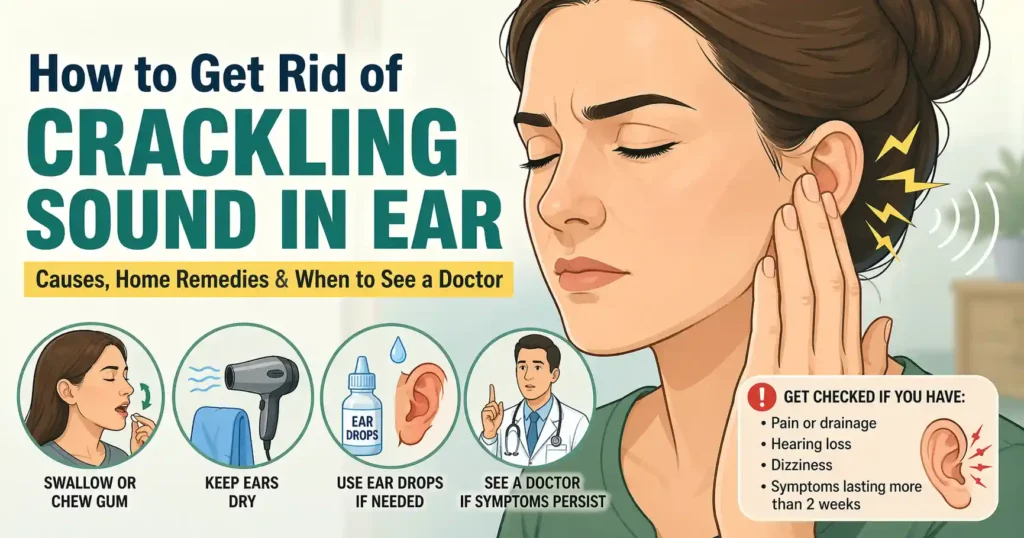
Crackling sound in ear is most often caused by Eustachian tube dysfunction — a condition where the small tube connecting your middle ear to the back of your throat fails to open or close properly. The sound you hear is the result of pressure trying to equalize, fluid shifting behind the eardrum, or earwax vibrating against it.
Most cases resolve with simple home treatment; a smaller number need medical care.
Crackling in the ear tends to feel stranger than it actually is. You swallow, and there’s a pop. You chew, and something crunches. You wake up after a cold, and your ear sounds like static.
The sensation is odd enough that most people assume something is seriously wrong — and most of the time, it isn’t. That said, the right fix depends entirely on what’s causing it, and the four or five most common causes each respond to different things.
Read More Hearing Health Content:
- What Causes Tinnitus in the Ear? What You Need to Know
- What Does Tinnitus from High Blood Pressure Sound Like?
- What Percentage of Hearing Loss is Legally Deaf? Here’s What to Know
What Causes Crackling in the Ear?
The crackling sound itself is almost always mechanical — something shifting, vibrating, or popping inside the ear canal or middle ear space. Here are the causes that matter clinically.
Eustachian tube dysfunction (ETD) is the most common by a wide margin. Your Eustachian tube connects your middle ear to the back of your throat and spends most of its time closed. It opens briefly when you swallow, yawn, or chew — and when it opens, it equalizes air pressure on both sides of the eardrum. When the tube is inflamed from a cold, allergies, or sinus congestion, it doesn’t open smoothly. The crackling you hear is that tube struggling to do its job.
Earwax impaction happens when wax builds up against the eardrum instead of migrating outward the way it’s supposed to. Jaw movement ordinarily helps push earwax toward the ear opening naturally. Cotton swabs, earbuds, and hearing aids all disrupt that process by pressing wax deeper. When compacted wax shifts or vibrates against the eardrum — particularly with chewing or head movement — it produces a crackling or crunching sound.
Middle ear infections (acute otitis media) cause crackling because fluid trapped behind the eardrum distorts sound transmission.
These infections almost always start with ETD: a blocked tube allows fluid to pool, and that fluid becomes infected. The crackling here is usually paired with ear pain, pressure, and muffled hearing.
TMJ disorders (TMD) affect the jaw joint located directly in front of each ear. The joint shares tissue and nerve pathways with the middle ear, which is why jaw problems so often produce ear sounds. If your crackling only happens when you chew, bite down, or open your mouth wide — with or without jaw pain — TMD is worth considering.
Middle ear myoclonus (MEM) is rare. It involves involuntary spasms of the stapedius and tensor tympani muscles inside the middle ear. The sound is usually rhythmic clicking or buzzing, unrelated to swallowing or jaw movement. This one needs a doctor, not a home remedy.
Cause-to-Fix Reference Table
| Cause | Typical Pattern | Best First Step | See a Doctor If |
|---|---|---|---|
| Eustachian tube dysfunction | Crackling when swallowing; worse after colds or flights | Nasal irrigation, decongestant, & steam | Doesn’t improve after 2 weeks |
| Earwax impaction | Crackling with jaw movement or head turns; muffled hearing | OTC ear drops to soften wax | Hearing loss persists after 5–7 days |
| Middle ear infection | Crackling with ear pain and pressure | Pain relief; early doctor visit | Fever, discharge, or severe pain |
| TMJ disorder | Crackling only when chewing or opening the mouth wide | TMJ exercises, ice, or heat on the joint | Jaw locking or worsening pain |
| Middle ear myoclonus | Rhythmic clicking unrelated to movement | See an ENT | Always warrants evaluation |
How to Get Rid of a Crackling Sound in the Ear at Home
Swallowing, yawning, and chewing are the starting point — and there’s an actual reason they work that most articles skip. Each of these actions activates the tensor veli palatini muscle, a small muscle at the back of the soft palate that physically pulls the Eustachian tube open.
That’s why chewing gum on a plane helps. The pop or crackle you hear when doing this is pressure equalizing — the tube doing its job.
The Valsalva maneuver takes this further when swallowing alone isn’t enough. Pinch your nostrils shut, close your mouth, and breathe out gently — as if trying to exhale through a blocked nose. The air pressure forces the Eustachian tube open. The operative word is gently. Forcing it too hard can push bacteria from the throat into the middle ear. If you have an active ear infection, skip this entirely.
Nasal saline irrigation (a neti pot or squeeze bottle rinse) works by clearing the mucus congestion that keeps the Eustachian tube blocked. You won’t feel an immediate difference, but regular rinsing over several days reduces tube inflammation as the congestion clears. A 2016 review in the Cochrane Database of Systematic Reviews found nasal saline irrigation consistently reduced congestion scores in adults with rhinitis — the same underlying problem that triggers most post-cold ETD.
OTC decongestants and antihistamines — pseudoephedrine or loratadine, for example — reduce mucosal swelling around the Eustachian tube. They’re useful for congestion-driven ETD. They do nothing for earwax-related crackling.
That’s a common mistake: treating an earwax problem with a decongestant makes no pharmacological sense.
Earwax softening drops (mineral oil, diluted hydrogen peroxide, or commercial products like Debrox) break up impacted wax over 3–5 days of use. One important caveat: do not use these drops if you suspect a perforated eardrum. Signs of perforation include sudden ear pain followed by a watery discharge and rapid relief of pressure. If you’re uncertain, see a doctor before putting anything in your ear.
Warm steam — leaning over a bowl of hot water with a towel draped over your head for 10–15 minutes — temporarily loosens congestion and may ease mild ETD symptoms. It won’t fix anything structural, but for post-cold crackling, it can provide short-term relief and speed recovery.
Quick Takeaway: Nasal irrigation and decongestants fix ETD; ear drops fix earwax. Using the wrong remedy for your cause won’t help.
Why Does My Ear Crackle When I Swallow?
Crackling specifically triggered by swallowing is nearly always Eustachian tube dysfunction. Each swallow contracts the tensor veli palatini muscle and briefly pulls the Eustachian tube open. If the tube lining is inflamed or coated with sticky mucus, the opening it makes produces a crackle or pop.
That sound is the tube trying to equalize pressure — not a sign that something is tearing or breaking.
Swallowing-triggered crackling is common during or after a cold, with seasonal allergies, or after air travel. It typically fades as congestion clears. If it’s persistent, one-sided, or paired with significant hearing loss, an ENT evaluation makes sense.





How to Get Rid of Crackling in the Ear After a Cold
Post-cold ear crackling is one of the most frequent complaints in primary care. A respiratory infection causes mucosal swelling throughout the upper tract, including the Eustachian tube lining. The tube swells shut, pressure in the middle ear becomes unequal, and fluid may begin to accumulate. The result: crackling, fullness, and sometimes muffled hearing.
ETD after a cold typically resolves within a few days to two weeks as the swelling subsides. Cleveland Clinic (2025) and NHS patient guidance both support watchful waiting as the standard first approach, with nasal saline rinsing and decongestants to manage symptoms in the meantime.
The two-week mark is the one to watch. If crackling hasn’t improved by then — or worsens with pain, fever, or discharge — the fluid in the middle ear may have become infected. At that point, antibiotics may be needed. Waiting it out beyond two weeks without improvement is where people get into trouble.
Quick Takeaway: Crackling after a cold is typically post-viral ETD. It clears on its own within two weeks in most adults.
Crackling in the ear after swimming or with Water
These are two different problems that feel similar.
Water trapped in the outer ear canal
This creates a muffled, bubbling, or crackling sensation. Tilt your head to the affected side, gently tug on the earlobe to straighten the canal, and let gravity work. A hair dryer on its lowest setting, held 12 inches from the ear, speeds evaporation.
OTC swimmer’s ear drops (diluted acetic acid or isopropyl alcohol) help dry the canal. Do not use these drops if you have ear tubes or any reason to suspect a perforated eardrum.
Pressure-related ETD from diving or deep swimming
This is a different animal. Rapid changes in water pressure cause middle ear pressure to shift faster than the Eustachian tube can equalize. The Valsalva maneuver, performed gently during descent rather than after, is the prevention.
If crackling, pressure, or muffled hearing persists after a dive, give the ear time to equalize naturally; if it doesn’t resolve within a day or two, an ENT visit is appropriate.
Crackling in Ear During Pregnancy
This is one of the most underaddressed scenarios in the existing content on this topic.
The mechanism is the same as post-cold ETD, but the cause is hormonal. Rising progesterone levels during pregnancy cause mucosal swelling throughout the body, including in the Eustachian tube lining. Increased fluid retention compounds this.
Some pregnant women also develop rhinitis of pregnancy — chronic nasal congestion without any infection — which blocks the Eustachian tube and produces crackling, fullness, and pressure.
Treatment options are more limited. Many OTC decongestants, including pseudoephedrine, are generally avoided during the first trimester.
Safe approaches include saline nasal irrigation, steam inhalation, gentle jaw movement, staying well-hydrated, and a gentle Valsalva (never forceful).
If symptoms are affecting sleep or hearing, discuss them with your OB or midwife before using any ear drops — some are fine during pregnancy, others are not, and it’s worth a five-minute conversation.
When Should You See a Doctor About Ear Crackling?
Most crackling is temporary. A few patterns indicate you should stop managing it at home.
- Crackling that hasn’t improved after two weeks
- Significant hearing reduction in one or both ears, alongside the crackling
- Ear pain, fever, or discharge
- Dizziness or vertigo accompanying the crackling — this suggests inner ear involvement
- Crackling in one ear only that persists and doesn’t respond to home treatment
- Symptoms that progressively worsen rather than plateau or improve
As of 2026, the American Academy of Otolaryngology supports watchful waiting for mild ETD in adults for a defined window.1Eustachian tube dysfunction in adults, PubMed Central. One-sided, persistent symptoms are the exception — those should always be evaluated to rule out less common causes.
Key Takeaways
- Crackling in the ear most commonly comes from Eustachian tube dysfunction, earwax impaction, middle ear fluid, or TMJ — each responding to different fixes.
- Swallowing and yawning open the Eustachian tube via the tensor veli palatini muscle; the crackle you hear is pressure equalizing, not damage.
- Post-cold ear crackling typically resolves within two weeks; if it doesn’t, seek medical evaluation.
- The Valsalva maneuver works for pressure-related ETD, but must be performed gently — forceful attempts can push bacteria into the middle ear.
- Decongestants treat ETD; earwax drops treat impaction. These are not interchangeable.
- Seek care for crackling that is one-sided, worsening, painful, or lasts beyond two weeks.
Frequently Asked Questions
How do I get rid of the crackling sound in my ear naturally?
The most effective natural methods are swallowing, yawning, or chewing to open the Eustachian tube, and saline nasal irrigation to reduce the congestion causing the blockage. Warm steam helps with mild congestion-related cases. For earwax-related crackling, mineral oil or diluted hydrogen peroxide drops soften the buildup so it clears on its own. Match the remedy to the cause for the best result.
Why does my ear crackle when I swallow?
Every swallow activates the muscle that pulls the Eustachian tube open. If the tube lining is inflamed or coated with mucus from a cold or allergy, that opening produces a popping or crackling sound. It’s a sign of mild Eustachian tube dysfunction — common after illness or flights — and typically fades as congestion clears over several days.
How long does crackling in the ear last after a cold?
Post-cold ear crackling from Eustachian tube dysfunction typically resolves within a few days to two weeks as mucosal swelling subsides. Nasal saline rinses and decongestants can help it resolve faster. If crackling or muffled hearing persists beyond two weeks, see a doctor — middle ear fluid may have become infected and may require antibiotics.
Can earwax cause crackling sounds in the ear?
Yes. Impacted earwax resting against the eardrum can shift and vibrate with jaw movement, producing a crackling or crunching sensation. It tends to be most noticeable when chewing or turning your head. OTC softening drops are the appropriate first step. Cotton swabs push wax deeper and make the problem worse — avoid them.
Is crackling in the ear serious?
Most crackling in the ear is not serious and resolves on its own or with home treatment. Knowing how to get rid of a crackling sound in the ear at home works in the majority of cases. It becomes a concern when paired with significant hearing loss, ear pain, discharge, fever, or dizziness — or when it persists in one ear beyond two weeks without improvement.
Scientific References
- 1Eustachian tube dysfunction in adults, PubMed Central. ↩︎
