
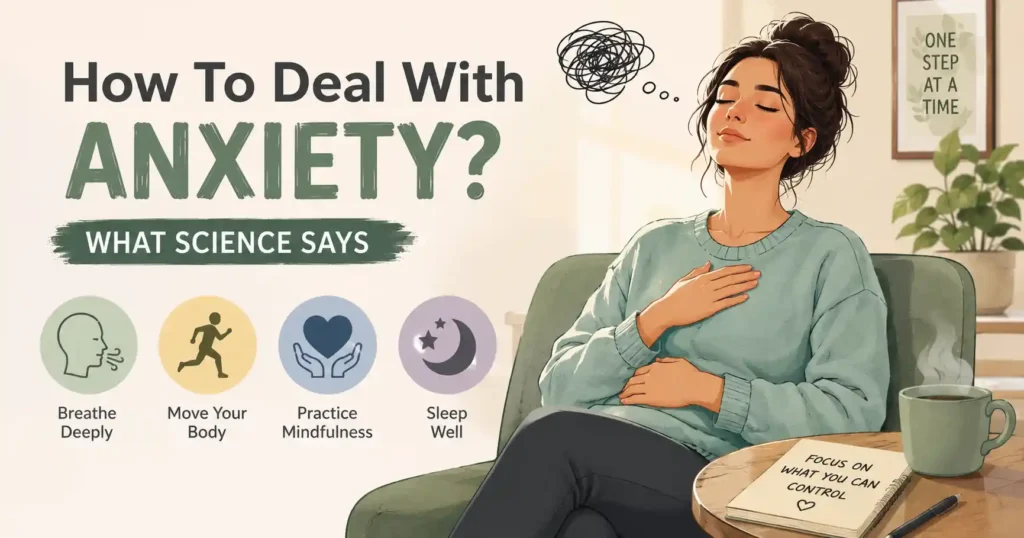
Anxiety is your body’s normal response to stress, but when it becomes overwhelming, certain strategies can help you regain control. Research shows that a combination of breathing exercises, physical activity, cognitive techniques, and sometimes professional support offers the most reliable relief. You do not need to fix anxiety in one day — small, consistent steps work better than searching for a single perfect solution.
Most people experience anxiety at some point. Your heart races before a presentation. You lie awake worrying about money or health. These moments are universal, but they do not have to define your days.
What separates temporary worry from clinical anxiety is intensity and duration. Clinical anxiety persists even when the stressor is gone. It interferes with work, relationships, and sleep. If that describes your experience, professional help makes sense. For everyone else, practical tools exist that have been tested and found effective in studies.
This article covers what actually works based on current research. No miracle cures. No empty reassurance. Just methods that help many people reduce anxiety in measurable ways.
What Causes Anxiety and Why Does It Feel So Physical?
Anxiety starts in your brain but shows up in your body. When you perceive a threat — real or imagined — your amygdala signals danger. Your hypothalamus activates the sympathetic nervous system. Adrenaline and cortisol flood your bloodstream within seconds.
This is the fight-or-flight response. It evolved to help you escape predators. The problem is your brain cannot always distinguish between a charging animal and an overdue bill. Both trigger the same cascade.
Your heart pounds because blood is redirected to large muscles. Your breathing becomes shallow because your body prioritizes oxygen delivery. Your stomach tightens because digestion is not a priority when running from danger. Sweating cools you down during physical exertion, but it never happens.
Chronic anxiety means this system activates too easily or stays on too long. Genetics plays a role. So do past experiences, current stress levels, and even gut bacteria. Researchers have identified differences in brain structure and neurotransmitter levels in people with anxiety disorders, though no single cause explains everyone’s experience.
Some people develop anxiety after trauma. Others have felt anxious for as long as they can remember. Still others notice it creeping in during specific life phases — new parenthood, career changes, health scares. The cause matters less than recognizing that anxiety is a physiological process, not a character flaw.
Understanding the physical basis helps. When your hands shake before a meeting, that is adrenaline. When your mind races at 3 AM, that is cortisol interfering with sleep architecture. These are mechanical processes you can influence.
Does Deep Breathing Actually Work for Anxiety?
Controlled breathing directly counteracts the physiological changes anxiety creates. Studies have found that slow, deep breathing activates the parasympathetic nervous system, which calms your fight-or-flight response.
The most researched technique is diaphragmatic breathing. Place one hand on your chest and one on your belly. Breathe in slowly through your nose for four counts, letting your belly rise while your chest stays still. Hold for two counts. Exhale through your mouth for six counts. The longer exhale is what triggers the calming effect.
A 2017 study in Frontiers in Psychology found that participants who practiced slow breathing for 15 minutes showed measurable decreases in cortisol and reported feeling less anxious compared to a control group. The effect was not huge, but it was real and immediate.
Box breathing is another evidence-backed method. Inhale for four counts, hold for four, exhale for four, hold for four. Repeat for several minutes. Navy SEALs use this technique before high-stress operations, which does not prove it works but suggests it has practical value beyond wellness blogs.
Breathing exercises work best when practiced regularly, not just during panic. Your nervous system learns patterns. If you only breathe deeply when terrified, your brain may start associating deep breathing with terror. Practice when calm so the technique is familiar when you need it.
Some people feel more anxious when focusing on their breath. If that is you, try counting backward from 100 by sevens instead, or use a different grounding technique. No single method works for everyone.
As of 2026, breathing techniques are considered a first-line self-management tool by most anxiety researchers. They cost nothing, have no side effects, and you can use them anywhere.
How Does Physical Activity Reduce Anxiety?
Exercise reduces anxiety through multiple biological pathways. It lowers cortisol levels, increases endorphins, promotes neurogenesis in the hippocampus, and improves sleep quality. These are not theories — they show up in blood tests and brain scans.
A 2018 meta-analysis in Depression and Anxiety reviewed 40 studies and found that people who exercised regularly had significantly lower anxiety levels than sedentary controls. The effect held across different types of exercise, though aerobic activity showed slightly stronger results than resistance training.
You do not need to run marathons. A brisk 20-minute walk reduces anxiety for several hours afterward. The key is elevating your heart rate enough to trigger the physiological changes, but not so much that you dread doing it.
Consistency matters more than intensity. Three 20-minute walks per week outperform one exhausting gym session. Your brain benefits from the routine as much as the movement.
Yoga combines movement with controlled breathing and has its own research base. Studies suggest it reduces anxiety comparably to other moderate exercise, with the added benefit of directly practicing nervous system regulation. You do not need flexibility or a special mat. Chair yoga works fine.
Outdoor exercise may offer additional benefits. Exposure to natural environments has been linked to lower stress hormones and improved mood in multiple studies, though separating the effects of nature from the effects of movement is difficult. Either way, a walk in a park beats a walk on a treadmill for most people.
The timing matters less than you might think. Some people feel energized by morning exercise. Others find evening movement helps them sleep. Pay attention to your own response rather than following generic advice.
| Exercise Type | Anxiety Reduction | Time Commitment | Accessibility |
|---|---|---|---|
| Brisk Walking | Moderate | 20-30 minutes | High – requires no equipment |
| Jogging/Running | High | 20-40 minutes | High – requires good knees |
| Yoga | Moderate to High | 30-60 minutes | Medium – videos available free |
| Swimming | High | 30-45 minutes | Low – requires pool access |
| Resistance Training | Moderate | 30-45 minutes | Medium – equipment helpful but not required |





What Cognitive Techniques Help Manage Anxious Thoughts?
Cognitive Behavioral Therapy for anxiety focuses on identifying and challenging distorted thinking patterns. You do not need a therapist to use basic CBT techniques, though professional guidance helps if anxiety is severe.
The first step is recognizing automatic thoughts. These are the instant interpretations your brain makes about situations. Someone does not text back, and you immediately think, “They hate me” or “I said something wrong.” That is an automatic thought. It feels true, but it is actually just one possible explanation.
Once you notice an automatic thought, examine the evidence. What facts support this interpretation? What facts contradict it? What are alternative explanations? This process is called cognitive restructuring. It sounds simple, but it interrupts anxiety’s feedback loop.
Thought records are a structured way to practice this. Write down the situation, your automatic thought, the emotion it created, evidence for and against the thought, and a more balanced alternative thought. Research shows people who keep thought records for several weeks report measurable decreases in anxiety.
Another technique is postponing worry. When an anxious thought appears, acknowledge it and schedule time to think about it later. Set aside 20 minutes in the evening as “worry time.” When anxiety pops up during the day, remind yourself you will address it then. This sounds absurd, but studies have found it reduces rumination. Your brain seems satisfied by the scheduled time and lets go more easily.
Acceptance and Commitment Therapy takes a different approach. Instead of challenging anxious thoughts, you practice noticing them without engagement. You might say to yourself, “I notice I’m having the thought that something bad will happen” rather than “Something bad will happen.” This creates distance between you and the thought.
Grounding techniques pull you out of anxious future thinking and into present sensory experience. The 5-4-3-2-1 method is popular: name five things you can see, four you can touch, three you can hear, two you can smell, one you can taste. It interrupts anxiety’s narrative by forcing your attention elsewhere.
No cognitive technique eliminates anxiety permanently. The goal is to reduce intensity and duration. If catastrophic thinking used to last an hour and now it lasts 15 minutes, that is real progress.
What Foods and Substances Affect Anxiety Levels?
Caffeine is the most common anxiety trigger people overlook. It blocks adenosine receptors in your brain, which promotes alertness but also mimics anxiety symptoms. If you drink coffee and feel jittery or worried an hour later, the caffeine may be responsible.
Some studies suggest that people with anxiety disorders have heightened sensitivity to caffeine. A dose that feels energizing to one person can trigger panic in another. Cutting back does not cure anxiety, but it often reduces baseline nervousness.
Alcohol temporarily dampens anxiety by enhancing GABA activity in your brain. The problem is that it disrupts sleep architecture and causes rebound anxiety as it metabolizes. Many people notice worse anxiety the day after drinking, even from small amounts. This is not a moral judgment — it is pharmacology.
Blood sugar crashes can trigger anxiety symptoms. When glucose drops too quickly, your body releases cortisol and adrenaline to mobilize energy stores. This feels identical to anxiety. Eating balanced meals with protein and fiber helps stabilize blood sugar throughout the day.
Magnesium deficiency has been linked to increased anxiety in several studies, though evidence for supplementation as treatment is mixed. Foods high in magnesium include leafy greens, nuts, seeds, and whole grains. If your diet lacks these, a supplement might help, but as of 2026, there is no strong evidence that megadosing magnesium reduces anxiety in people with adequate levels.
Omega-3 fatty acids found in fish have anti-inflammatory properties, and some research suggests they may reduce anxiety symptoms. The evidence is not overwhelming, but it is consistent enough that eating fatty fish twice a week makes sense for overall health, regardless of anxiety effects.
Probiotic foods like yogurt and fermented vegetables have gained attention because of the gut-brain axis. Some studies indicate that gut bacteria influence neurotransmitter production and immune signaling that affects mood. The research is early but promising. At a minimum, these foods support digestive health.
What does not work despite persistent claims: sugar-free diets, juice cleanses, and extreme carbohydrate restriction. Some people feel better on specific diets, but that is an individual response, not evidence that the diet treats anxiety.
- Reduce caffeine gradually to avoid withdrawal headaches
- Limit alcohol, especially if you notice next-day anxiety
- Eat protein with breakfast to stabilize morning blood sugar
- Stay hydrated — even mild dehydration affects mood
- Avoid skipping meals, which causes blood sugar crashes
When Should You Seek Professional Help for Anxiety?
Self-management works for mild to moderate anxiety. Professional help becomes necessary when anxiety interferes with daily functioning despite your best efforts.
Red flags include avoiding important activities because of anxiety, panic attacks that come from nowhere, physical symptoms that persist despite medical clearance, using alcohol or substances to cope, or thoughts of self-harm. If any of these apply, talk to a doctor or mental health professional.
Therapy for anxiety typically involves CBT or exposure therapy. Both have strong research support. CBT teaches you to identify and change thought patterns. Exposure therapy helps you gradually face feared situations in a controlled way so your brain learns they are not actually dangerous.
Medication is an option for moderate to severe anxiety. SSRIs like sertraline and escitalopram are first-line treatments and work for many people. They take several weeks to reach full effect and can have side effects during adjustment. Benzodiazepines like lorazepam work immediately but carry dependence risk and are meant for short-term use only.
Finding the right therapist matters. Not every provider is equally skilled with anxiety. Ask specifically about their experience treating anxiety disorders and what approaches they use. If someone offers only talk therapy without structured techniques, keep looking.
Online therapy platforms have expanded access. Studies suggest video-based therapy is comparably effective to in-person therapy for anxiety treatment. Cost and scheduling are often easier. The downside is less personal connection for some people.
Psychiatrists can prescribe medication. Psychologists and licensed counselors cannot help but often provide better therapy. Many people benefit from both — a psychiatrist managing medication and a therapist providing CBT or exposure work.
If cost is a barrier, look for community mental health centers, sliding-scale therapists, or university training clinics where supervised students provide care at reduced rates. Anxiety is highly treatable. Access is the main obstacle for most people.
Frequently Asked Questions About How to Deal with Anxiety
Can anxiety go away on its own without treatment?
Mild anxiety tied to specific stressors often improves once the situation resolves. Chronic or severe anxiety rarely disappears without intervention and tends to worsen over time if untreated.
How long does it take for anxiety management techniques to work?
Breathing exercises and grounding techniques can reduce anxiety within minutes. Cognitive techniques and lifestyle changes typically show noticeable effects after 2-4 weeks of consistent practice.
Is anxiety the same as an anxiety disorder?
Everyone experiences anxiety occasionally. An anxiety disorder is diagnosed when anxiety is persistent, excessive, and interferes with daily life despite the absence of real danger.
What is the fastest way to calm down during a panic attack?
Focus on slow controlled breathing and remind yourself the physical sensations are temporary and not dangerous. Grounding techniques like naming objects around you can also interrupt the panic cycle.
