
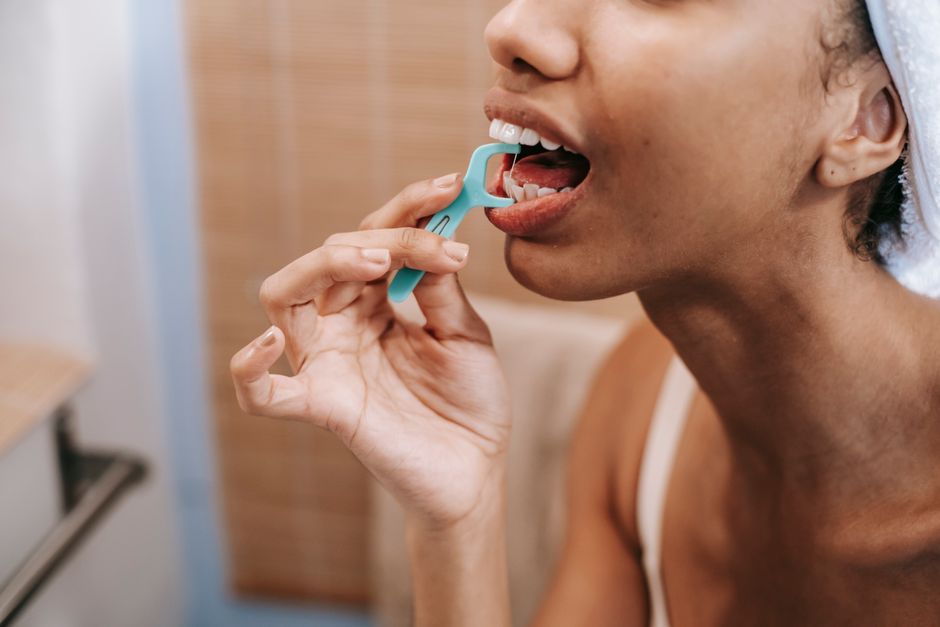
A permanent retainer is a thin wire bonded to the back of your front teeth, usually the lower front six. It holds those teeth in place after orthodontic treatment. Flossing around it is not optional and it is not impossible. You thread the floss under the wire, clean both sides of each tooth, and move to the next one.
The wire sits across the back of your teeth, which means a standard up-and-down floss motion will not work. You need to get the floss underneath the wire and against the side of each tooth. That takes a few extra seconds per tooth. Once you build the habit, it becomes automatic.
How To Floss Between Teeth With A Permanent Retainer
The core technique is called threading. You pass the floss under the wire so it can reach the gumline on both sides of each tooth.
Here is the step-by-step method:
- Break off about 18 inches of floss. Waxed floss or dental tape tends to slide under the wire more easily than unwaxed floss.
- Wrap the ends around your middle fingers, leaving a two-inch gap between your hands.
- Thread the floss under the wire between two teeth. A floss threader — a small plastic loop you can buy at any pharmacy — makes this faster. You push the floss through the loop, pass the loop under the wire, then pull the floss through.
- Once the floss is under the wire, wrap it into a C-shape around one tooth.
- Slide the floss gently up and down against that tooth, going just below the gumline. Do not snap it down.
- Wrap the floss around the other tooth in that gap and repeat.
- Pull the floss out, re-thread it under the wire at the next gap, and continue.
Work through every gap along the wire. That usually means five gaps for a six-tooth retainer. Then floss the rest of your teeth normally.
Some people find that a water flosser helps around a fixed retainer. A water flosser can rinse away loose debris, but it does not replace the physical scraping motion of string floss against the tooth surface. The American Dental Association recommends cleaning between teeth once a day with floss or another interdental cleaner. For fixed retainers, string floss remains the most reliable way to reach the tooth surface directly.
Why Is Flossing Around a Permanent Retainer So Important?
Plaque builds up wherever a surface is hard to reach, and a fixed retainer creates exactly that kind of surface. The wire itself, the bonding material that holds it to each tooth, and the tiny ledge where the bond meets the tooth all trap food and bacteria.
That trapped plaque raises your risk of two specific problems. The first is tooth decay at the gumline, especially right where the wire is bonded. The second is gum inflammation, which can progress to gum disease if plaque stays put. Both can develop quietly because the wire hides the early signs from view.
There is another reason that gets less attention. If you lose gum tissue or bone around a tooth that a retainer is holding, the tooth can still shift. The retainer keeps the crown of the tooth in line, but it cannot protect the foundation underneath. Clean gums and bone are part of what keeps the retainer doing its job.
Research in orthodontics has found that patients with fixed retainers tend to have more plaque and more gum inflammation than patients without them, particularly when home care is inconsistent. That is not a reason to avoid a retainer. It is a reason to clean around it carefully every day.
What Tools Actually Help With a Fixed Retainer?
You do not need a cabinet full of products. A few tools make the job faster and more thorough.
- Floss threaders. Small plastic loops that let you push floss under the wire in one motion. Inexpensive and widely available.
- Super floss. Floss with a stiffened end that works like a built-in threader, plus a spongy section for wider gaps.
- Interdental brushes. Tiny brushes that fit between teeth. Helpful for the spaces next to the retainer, though they may not fit every gap.
- Water flossers. Useful as a supplement. They rinse debris but do not scrape plaque off the tooth surface the way floss does.
- A small interdental or proxy brush. Some clinicians recommend these for cleaning along the wire itself.
If threading floss feels clumsy at first, that is normal. Most people get faster within a week or two of daily practice.





How Often Should You Floss With a Permanent Retainer?
Once a day is the standard recommendation for cleaning between teeth, and that applies to fixed retainers. Many dental professionals suggest flossing at night so plaque does not sit against your teeth and gums overnight.
Brushing twice a day with fluoride toothpaste covers the broader surfaces. Flossing once a day handles the spaces the bristles cannot reach. Together they cover the areas where a retainer traps debris.
If your gums bleed when you floss, do not stop. Bleeding is often a sign of inflammation that improves with consistent cleaning. If bleeding continues for more than a week or two despite daily flossing, that is worth a call to your dentist. Persistent bleeding can also signal gum disease, which needs professional evaluation.
What Happens If You Do Not Floss Around the Retainer?
Plaque hardens into tartar within about 24 to 72 hours if it is not removed. Once tartar forms, brushing and flossing cannot remove it. Only a dental professional can.
Over time, tartar along the retainer wire irritates the gums. Early gum inflammation, called gingivitis, is reversible with good home care and a professional cleaning. If it progresses to periodontitis, the damage to the bone and tissues that support teeth can become permanent.
Decay is the other concern. Cavities that form right at the wire can be hard to see in a mirror. By the time they cause pain or a visible spot, they may already be advanced. Regular dental visits let your dentist check the teeth under and around the retainer with tools and X-rays.
Can You Damage the Retainer While Flossing?
Floss itself will not break a properly bonded retainer. The wire is fixed in place and normal flossing pressure will not loosen it.
What can cause problems is the bonding material. If a bond comes loose, the wire can lift away from a tooth and start to shift. You may notice a loose wire with your tongue before you see it. If that happens, contact your orthodontist rather than trying to fix it yourself.
Do not use toothpicks, metal picks, or anything rigid to pry around the wire. Those can chip the bonding material or scratch the tooth surface. Stick with floss, interdental brushes, and a soft-bristled toothbrush.
What If Flossing With a Retainer Hurts or Feels Awkward?
Mild tenderness in the first days after a retainer is placed is common. The gums and teeth are adjusting. Gentle flossing usually eases that within a few days.
Sharp pain, a feeling that the wire is poking you, or a wire that has come loose on one end are different. Those are reasons to call your orthodontist. A poking wire can be covered temporarily with orthodontic wax, which you can buy at a pharmacy, until you are seen.
If the floss keeps shredding or catching on the wire, the wire may have a rough spot or a loose bond. Have it checked. A smooth wire should let floss glide under it without snagging.
Frequently Asked Questions
Can I use a water flosser instead of string floss with a permanent retainer?
A water flosser can rinse away loose food and debris, but it does not scrape plaque off the tooth surface the way string floss does. Most dental professionals recommend string floss as the primary method and a water flosser as a supplement.
How do I floss under a permanent retainer without a threader?
You can tie a small loop in one end of the floss and pass the loop under the wire, then pull the rest through. A floss threader or super floss makes the job faster, but threading by hand works if you do not have one.
Is it normal for my gums to bleed when I floss around my retainer?
Some bleeding can happen when you first start flossing a neglected area, and it often improves with daily cleaning. If bleeding continues for more than a week or two, see your dentist to rule out gum disease.
Can flossing loosen or break my permanent retainer?
Normal flossing will not break a properly bonded retainer. If the wire feels loose or shifts, contact your orthodontist, since a loose bond needs professional repair.
