
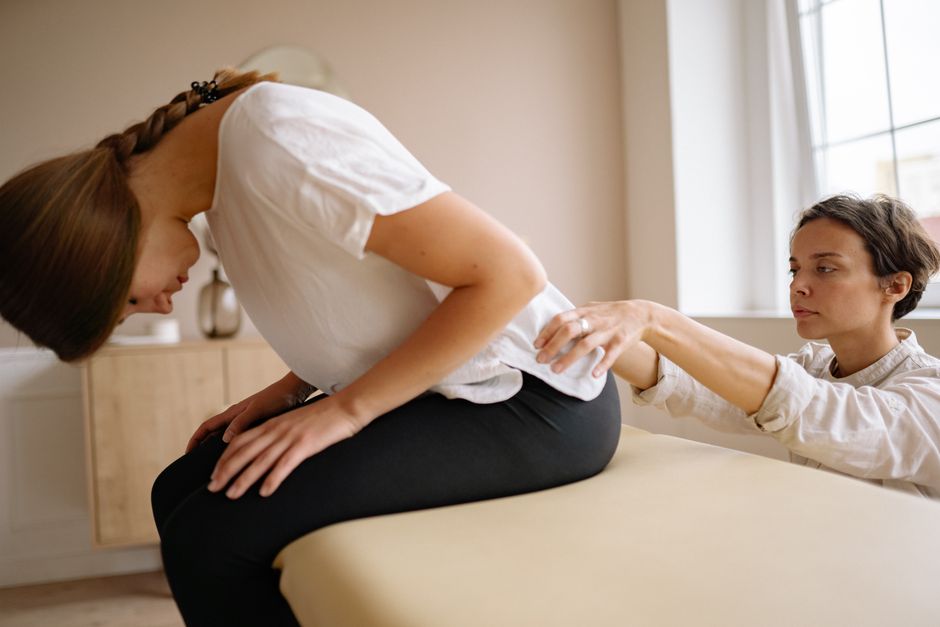
Lower back pain when bending over is almost always caused by the same thing: your spine rounding forward under load. The fix isn’t a single stretch or a pill. It’s learning to bend from your hips instead of your waist, strengthening the muscles that hold your spine stable, and stopping the movements that keep irritating the area. That combination works best for most people.
Why Does Bending Over Hurt Your Lower Back?
Your lower back (lumbar spine) is designed to be stable, not highly mobile. When you bend over to pick something up, your body has two choices. You can bend at the hips — which uses your glutes and hamstrings — or you can round your lower back forward.
Rounding the lower back puts the spine in a flexed position. The discs between your vertebrae get compressed at the front and stretched at the back. Ligaments are pulled. Small joints in the back of the spine get jammed. If you already have a disc bulge, arthritis, or muscle stiffness, that rounded position compresses the exact structures that are irritated.
Almost every case of bending-related back pain involves some combination of: weak glutes, tight hamstrings, poor movement patterning, or an existing spinal condition that gets aggravated by flexion. None of these are mysteries. Each has a practical fix.
How to Fix Lower Back Pain When Bending Over — What Really Works
The single most effective change is learning the hip hinge. This is not a stretch or a fancy exercise. It is a movement pattern. Stand with your feet hip-width apart. Keep your spine straight — imagine a line from your head to your tailbone. Push your hips backward as if closing a car door with your rear end. Keep your chest up. Your knees should bend slightly but not much. You will feel tension in your hamstrings and glutes.
If you cannot feel your hamstrings working when you bend, you are almost certainly bending from your lower back instead. Practice this without any weight at first. Do it ten times every few hours. The goal is to retrain your brain to bend at the hips, not the spine.
For most people, adopting the hip hinge alone reduces bending pain significantly within a week or two — provided no serious disc injury or structural problem is present. If it hurts to do the hip hinge even without weight, you may need more specific treatment first.
What Causes Lower Back Pain When Bending Over?
The most common causes are muscle strain, ligament sprain, disc problems, and joint dysfunction. Muscle strains happen when the erector spinae or multifidus muscles are overloaded in a stretched, rounded position. Ligament sprains occur from repeated or sudden bending.
Disc problems include bulges and herniations. When you bend forward, the nucleus of the disc pushes backward against the outer ring. If that ring is weak or torn, the disc can bulge or rupture, pressing on nerves. Pain down the leg or numbness in the foot suggests nerve involvement.
Facet joint pain comes from the small joints in the back of the spine. Bending forward opens these joints and can irritate arthritic surfaces. You may feel sharp pain on one side of the lower back when bending.
Less common but serious causes include spinal stenosis, vertebral fracture, infection, or cancer. Any pain accompanied by fever, unexplained weight loss, loss of bladder or bowel control, or recent trauma needs immediate medical evaluation.





Stretches and Exercises That Actually Help
No single exercise works for everyone. But the evidence supports a few approaches over others. The key is to strengthen the muscles that protect the spine, especially the glutes, hamstrings, and deep core. Stretching alone rarely fixes bending pain.
Glute bridges. Lie on your back with knees bent. Push your hips up toward the ceiling. Squeeze glutes at the top. Lower slowly. Do three sets of 10 to 15. This activates the glutes, which should be doing the work when you bend.
Dead bugs. Lie on your back with arms and legs in the air. Slowly extend one arm and the opposite leg toward the floor without letting your lower back arch. Return to center. Repeat on other side. This builds core stability without moving the spine.
Cat-cow stretch. On hands and knees, slowly alternate between arching your back up (cat) and letting it sag (cow). Move only as far as comfortable. This mobilizes the spine gently and can reduce stiffness for some people.
Knee-to-chest stretch. Lie on your back. Pull one knee toward your chest gently. Hold 20 seconds. Switch sides. This can relieve tension in the lower back muscles after bending activities.
If any exercise makes the pain worse, stop. Not all movement is good movement when there is active inflammation or nerve compression. Some research suggests that avoiding painful movements entirely during the acute phase may be better than pushing through pain.
When Bending Pain Requires Medical Attention
Most lower back pain improves within four to six weeks with conservative care. But some situations need a doctor visit sooner. See a healthcare provider if you have:
- Pain that radiates below the knee or causes numbness or weakness in the leg or foot
- Loss of bladder or bowel control
- Pain after a fall or injury
- Unexplained fever or weight loss
- Pain that does not improve after two to four weeks of self-care
Physical therapy is the most evidence-supported treatment for recurrent bending pain. A physical therapist can assess your specific movement patterns and give you targeted exercises. Chiropractic care and osteopathic manipulation also have some evidence for acute low back pain, though the quality of studies varies. No study has confirmed that any single manual therapy approach is clearly superior to others.
How to Prevent Lower Back Pain When Bending
Prevention relies on the same principles as treatment. Maintain a neutral spine during all bending. Keep your core engaged. Strengthen your glutes and hamstrings. Avoid sitting for long periods — prolonged sitting tightens the hip flexors and weakens the glutes, making you more likely to bend from your back.
Lifting technique matters. Keep objects close to your body. Do not twist while bending. Use your legs when lifting heavy items. These are well-established recommendations from occupational health guidelines.
Body weight also plays a role. Carrying extra weight around the midsection increases the load on your lower spine during bending. Weight loss is not a quick fix, but it reduces the mechanical stress on your back over time.
Common Mistakes That Keep Back Pain Going
Many people try to stretch a tight lower back by bending forward repeatedly. If the pain is caused by a disc problem, forward bending may actually worsen the bulge. Avoid prolonged forward bending — this includes bending over a sink, gardening on your knees, or slouching in a chair.
Another mistake is relying on pain relievers alone. NSAIDs like ibuprofen can reduce inflammation for a few days, but they do not correct the movement problem. Evidence suggests that early active approaches — like maintaining normal activity as tolerated — lead to better long-term outcomes than bed rest or heavy medication use.
Using a back brace or support belt may provide short-term relief but can weaken the core muscles over time. No strong evidence supports routine use of braces for prevention or treatment of bending-related back pain. Use them sparingly and only under professional guidance.
Sleep posture matters too. Side sleeping with a pillow between your knees keeps the spine in a neutral position. Stomach sleeping forces the lower back into extension and can contribute to morning stiffness and bending pain during the day.
Frequently Asked Questions
Is it safe to stretch a sore lower back?
Gentle stretching is safe for most muscle strains, but avoid any stretch that reproduces your bending pain exactly. If forward bending hurts, do not force it. Try gentle backward bending or side-to-side movements instead.
What is the best sleeping position for lower back pain?
Side sleeping with a pillow between your knees supports a neutral spine. Back sleeping with a pillow under your knees also works. Stomach sleeping is usually the worst option for bending pain.
Can sitting too long cause bending pain?
Yes. Prolonged sitting tightens the hip flexors and weakens the glutes, which leads to poor bending mechanics. Stand up and walk for a few minutes every hour to counteract this effect.
