
Plastic does not rot the way a fallen leaf does. Most of it lingers for decades because the chemical bonds holding its long molecular chains together are strong and hard for living things to break. Yet nature is not entirely helpless. Certain bacteria, fungi, and enzymes can attack plastic, and scientists are studying how to speed that process up. This article explains what actually happens when plastic decomposes, why it takes so long, and where the real science stands.
Why Is Plastic So Hard To Break Down?
Plastic resists decay because of its molecular structure. Most plastics are polymers, meaning they are built from thousands of small units called monomers linked into long chains. Those chains are held together by strong carbon-carbon bonds. Microorganisms evolved to break down natural materials like wood and leaves, which have bonds their enzymes recognize. Synthetic plastics often have bonds those enzymes do not fit.
There is a second problem. Many plastics are also water-repellent and chemically inert, so they do not dissolve or react easily with the environment. Add in additives like colorants and stabilizers, and you get a material that can sit in a landfill or ocean for a very long time.
The word “decompose” also gets used loosely. There is a difference between a plastic physically fragmenting into tiny pieces and it being truly broken down into water, carbon dioxide, and biomass. Fragmentation creates microplastics. That is not the same as decomposition, and it is a common source of confusion.
How Do Bacteria Break Down Plastic?
Some bacteria can use plastic as a food source. They attach to the surface and release enzymes that cut the polymer chains into smaller molecules. Those smaller pieces can then be pulled inside the cell and used for energy.
This process is slow. In laboratory studies, certain bacteria have been shown to degrade plastics like PET and polyurethane, but often only under specific conditions and over long periods. The rate depends on the plastic type, temperature, oxygen, and the bacterial species involved.
One well-studied example is Ideonella sakaiensis, a bacterium discovered in Japan that can break down PET. It produces an enzyme that digests the plastic into its building blocks. This finding was important because it showed that a natural system could target a common plastic. But laboratory results do not automatically translate into fast cleanup in the real environment.
Gut bacteria in some insects, such as certain beetle larvae and waxworms, have also been linked to plastic breakdown. Research suggests the microbes, not the insects alone, do much of the work. The evidence is promising but still largely experimental.
What Role Do Fungi Play In Plastic Decomposition?
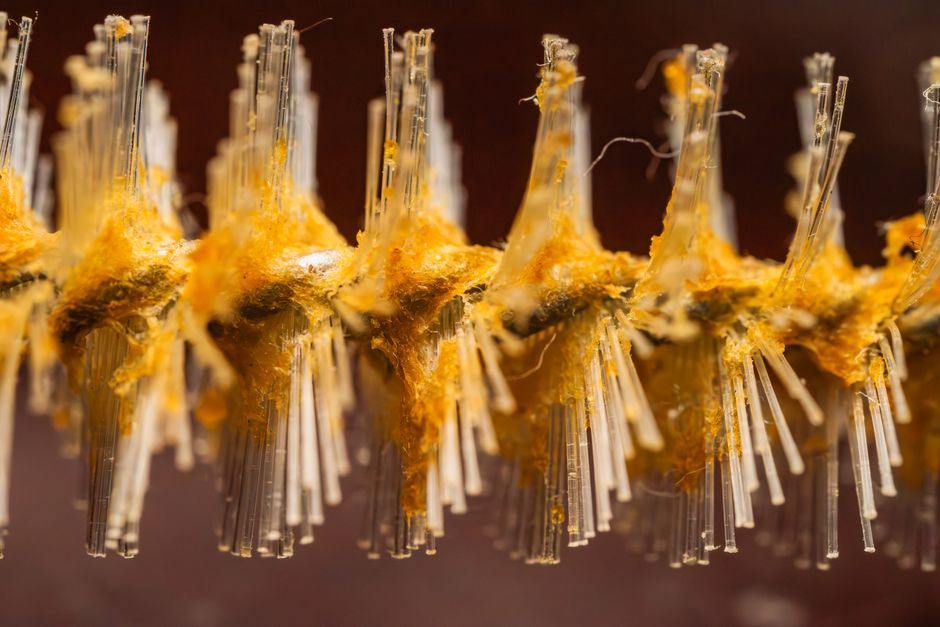
Fungi are the other major group of organisms studied for plastic breakdown. Unlike bacteria, fungi grow as branching threads called hyphae. These threads can spread across a surface and penetrate cracks, giving fungi more physical access to the material.
Some fungi produce enzymes that can attack the bonds in certain plastics. Research has identified fungi capable of degrading polyethylene and polyurethane to varying degrees. As with bacteria, the process is usually slow and depends on conditions.
Fungi also work in partnership with bacteria in soil and compost. In a natural environment, no single organism does the whole job. A community of microbes gradually chips away at the material, and different species may handle different steps.
It is worth being clear about the limits here. The evidence that fungi can meaningfully break down common plastics like polyethylene in a real-world setting is limited. Most findings come from controlled lab experiments. No large field studies have shown that fungi can clean up plastic waste at scale.




What Chemistry Is Involved In Breaking Plastic Down?
At the chemical level, breaking down plastic means cutting the long polymer chains into shorter ones and eventually into simple molecules. This can happen in a few main ways.
- Hydrolysis: Water breaks certain bonds. This works well for plastics like PET that contain chemical links water can attack.
- Oxidation: Oxygen or reactive molecules damage the chains. Sunlight and heat can trigger this, which is why plastic left outside becomes brittle over time.
- Enzymatic cleavage: Microbial enzymes act like molecular scissors, snipping specific bonds.
- Thermal and mechanical breakdown: Heat, friction, and physical force fragment the material without fully decomposing it.
The key distinction is between breaking a chain and fully mineralizing it. Cutting a long chain into shorter pieces is easier. Turning those pieces all the way into carbon dioxide, water, and cell material is the hard part. Many “degradable” plastics only reach the first stage.
This is also why recycling and decomposition are different goals. Recycling reshapes plastic into new products. Decomposition aims to break it down chemically. They use different methods and solve different problems.
Can We Speed Up Plastic Decomposition?
Scientists are actively trying to make plastic breakdown faster. Several approaches are under study:
- Engineering enzymes to work faster or at higher temperatures
- Combining multiple enzymes so they can attack plastic in stages
- Using bacteria and fungi together in controlled bioreactors
- Designing new plastics that are easier for microbes to break down from the start
Some engineered enzymes have shown improved activity in laboratory settings. That is a real step forward for research. But a lab result is not the same as a working waste-treatment system. Scaling up, keeping the process stable, and making it affordable are unsolved challenges.
There is also a practical limit. Even the best-known plastic-degrading microbes work slowly compared with the amount of plastic waste produced worldwide. Current research is best understood as a promising direction, not a proven solution to plastic pollution.
What About “Biodegradable” And “Compostable” Plastics?
Labels on packaging can be misleading. A plastic marked “biodegradable” does not mean it will break down quickly in any environment. Many such plastics need specific conditions, such as the high heat of an industrial composting facility, to decompose at all.
In a home compost pile or in the ocean, a “compostable” plastic may behave much like ordinary plastic. Some studies have found that certain compostable items did not break down in marine conditions within the timeframes tested. The evidence here is mixed and depends heavily on the specific material and setting.
The honest position is this: the terms are not tightly standardized in everyday use, and what happens in a controlled facility may not happen in nature. If you are choosing products, the conditions where the item ends up matter as much as the label.
Does Plastic Ever Fully Disappear?
Over very long timescales, plastic does break down, but slowly and incompletely. Sunlight, heat, oxygen, and mechanical wear fragment it into smaller and smaller pieces. Microbes may consume some of these fragments. But a large share becomes microplastics and nanoplastics that persist in soil, water, and air.
Complete mineralization of common plastics in the environment is not something that happens on a human timescale in most cases. Some plastics may take centuries to fully break down, and the exact timelines are not well established. Estimates vary widely by plastic type and conditions.
This is why reducing plastic use and improving waste systems matter more than relying on natural decomposition. Nature can help, but it cannot keep up with current production and disposal rates.
Frequently Asked Questions
Can bacteria actually eat plastic?
Some bacteria can break down certain plastics and use them as an energy source. This has been shown mainly in laboratory studies and is usually slow.
How long does it take for plastic to decompose?
Timelines vary widely by plastic type and conditions, and reliable estimates are limited. Many common plastics persist for decades to centuries in the environment.
Are biodegradable plastics better for the environment?
Not always. Many need specific conditions like industrial composting to break down, and they may behave like ordinary plastic in oceans or home compost.
Do fungi break down plastic in nature?
Some fungi can degrade certain plastics in lab settings, but large-scale breakdown in the real environment is not well demonstrated.
