
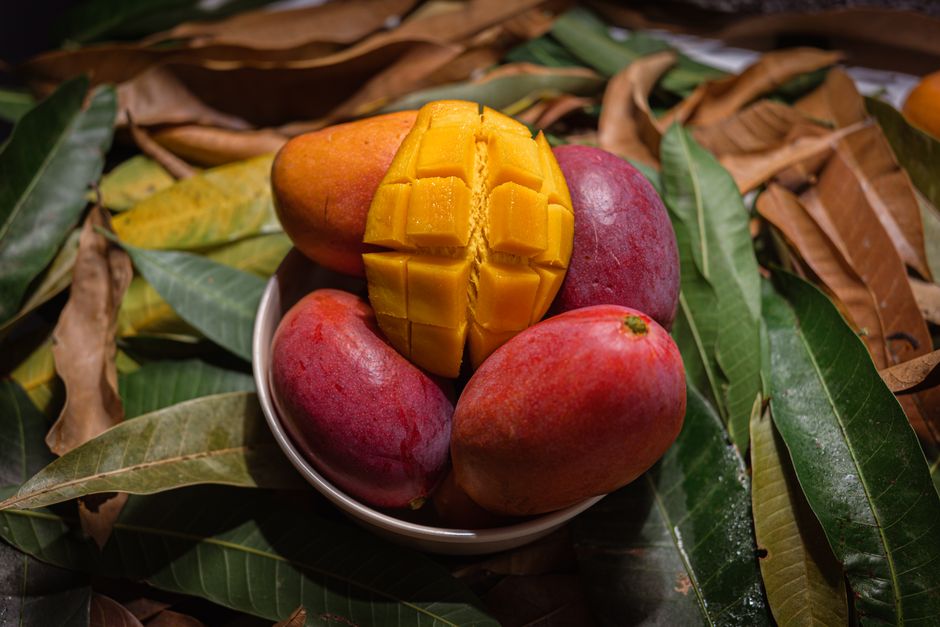
Cutting a mango with its large, flat seed in the middle can feel tricky, but the goal is simple: get the most fruit off the pit with the least mess. The best method is to stand the mango upright on a cutting board, find the narrow side, and slice downward on each side of the seed to get two large “cheeks.” You then score the flesh of each cheek in a grid without cutting through the skin, push the skin inward to pop the cubes out, and slice them off. This technique works every time and wastes very little fruit.
What Is the Best Way to Cut Around the Mango Seed?
The mango seed is flat, not round. This is the key fact most people miss. The seed runs vertically through the center of the fruit, and it is wide from side to side but thin from front to back.
To find the seed, hold the mango on your cutting board with the stem end pointing up. The mango has two narrow sides and two wide sides. You want to slice down along the wide sides. Place the mango with one narrow side facing you. Imagine the seed running from the stem down. Make a cut about a quarter-inch from the center line on one wide side. Slide your knife down, following the curve of the seed. You will feel the blade hit the pit. Repeat on the other wide side.
This gives you two large cheeks. The remaining center piece has the seed with some flesh still attached. Many people throw this piece away, but it still has usable fruit.
How Do You Cut a Mango Without Making a Mess?
The traditional hedgehog method is the cleanest way to cut mango cheeks. After you have the two cheeks, take one cheek in your hand with the skin side down. Use a small knife to score the flesh in a grid pattern. Cut down to the skin but do not cut through the skin. Make lines about half an inch apart in both directions.
Push the skin side inward with your thumbs. The scored cubes will pop outward. You can then slice them off the skin with your knife or a spoon. This method keeps your fingers clean and gives you neat cubes.
For the center piece with the seed, you have two options. You can peel the skin off with a vegetable peeler and slice the remaining flesh off the seed. Or you can just bite the fruit off the seed over the sink. Both work. The first is more presentable for a fruit salad.
What Tools Make Cutting a Mango Easier?
You do not need special tools, but a few items help. A sharp chef’s knife is the most important tool. Dull knives slip more easily and crush the soft mango flesh. A 7- to 8-inch chef’s knife works well for the initial cuts around the seed.
A vegetable peeler is useful for the center piece. It removes the thin skin cleanly without wasting flesh. A small paring knife helps for the scoring step and for trimming flesh off the seed.
Mango splitters exist. These are plastic or metal tools with a blade shaped to cut around the seed. Some people find them helpful. Others find they waste more fruit than a knife does. Research from consumer testing groups suggests that a sharp knife gives you more usable fruit per mango than a splitter does. The splitter follows a fixed shape, but mango seeds vary slightly in size and curve.
| Tool | Best For | Drawback |
|---|---|---|
| Chef’s knife (7-8 inch) | Cutting cheeks off the seed | Requires sharpening |
| Paring knife | Scoring flesh and trimming | Small blade takes more passes |
| Vegetable peeler | Peeling center piece skin | Not useful for cheeks |
| Mango splitter | One-step cheek removal | Wastes more fruit on odd-shaped mangoes |





How To Cut A Mango With Seed? Tips for Different Mango Varieties
Not all mangoes are the same shape. The method above works for most common varieties, but adjustments help. Ataulfo mangoes, also called honey or champagne mangoes, are smaller and have a very thin seed. Their flesh is softer. You can often cut them by slicing off the cheeks and then simply scooping the flesh with a spoon.
Tommy Atkins mangoes are larger with more fibrous flesh. Their seed is thicker. The standard cutting method works well here, but you need a sharper knife to cut through the fibers cleanly. Fibrous mangoes can be harder to score neatly. Some people prefer to peel them first with a peeler, then slice the flesh off the seed in strips.
Kent and Haden mangoes fall in between. They have less fiber than Tommy Atkins but more than Ataulfo. The hedgehog method works consistently on these varieties. The main tip is to feel for the seed with your knife before cutting. Do not assume the seed is exactly in the center. Mangoes grow with slight asymmetry. Let your knife find the pit naturally.
What Common Mistakes Ruin a Mango Cut?
The biggest mistake is cutting too close to the center on the first slice. If you cut directly down the middle, you hit the seed and waste the first cheek. You then have to cut around both sides of the seed, which leaves you with thin, uneven pieces. Always start a quarter-inch off center.
Another mistake is using a dull knife. A dull blade crushes the mango cells, making the cut edge mushy and causing juice to leak everywhere. A sharp knife makes a clean cut that keeps the juice inside the fruit. The CDC has noted that dull knives also increase the risk of hand injuries because they require more force.
People also often skip the scoring step for the cheeks. They try to peel the cheek with a peeler or cut the flesh off in one slab. This wastes a lot of fruit. Scoring and popping gives you nearly 100 percent of the edible flesh from the cheek. The grid pattern exposes the maximum surface area for easy removal.
Some people also try to cut the mango while holding it in their palm. This is dangerous. Always use a cutting board. A mango is slippery when ripe. One slip with a knife can send you to urgent care. The American Academy of Orthopaedic Surgeons reports that knife cuts from fruit preparation are a common household injury. Use a stable cutting board and a towel underneath to keep it from sliding.
Can You Cut a Mango Without Peeling It First?
Yes, and this is the preferred method for most people. Cutting a mango with the skin on is actually easier than peeling it first. The skin provides structure. It holds the soft flesh together while you cut around the seed and score the cheeks. If you peel a mango first, the flesh is slippery and collapses under the knife.
The skin of a mango is edible, though many people find it tough and bitter. If you plan to eat the mango cubes in a fruit salad or yogurt, the skin is usually removed after cutting. If you want to eat the mango like an apple, choose a variety with thin skin like Ataulfo and wash it thoroughly. The FDA recommends washing all produce under running water before cutting to remove surface bacteria.
For recipes where the mango will be blended, such as smoothies or sauces, you do not need to remove the skin at all. The blender will break it down completely. This saves time and reduces food waste. The skin contains fiber and some nutrients including vitamin C and vitamin A, though the flesh is much more nutrient-dense.
What Is the Fastest Method for Cutting Many Mangoes?
If you are preparing multiple mangoes, efficiency matters. The fastest method is the slice-peel-slice method. Start by cutting off both cheeks as usual. Then use a large spoon to scoop the flesh out of each cheek in one piece. The curve of the spoon follows the curve of the skin. This takes practice but is faster than scoring and popping for large quantities.
For the center piece, use a vegetable peeler to strip the skin, then slice the remaining flesh off the seed in two or three vertical cuts. Discard the seed. This whole process takes about 45 seconds per mango once you have the motion down.
Restaurant kitchens often use this method because it produces clean slices for plating. The hedgehog method is better for home use when you want cubes for snacking. Choose the method that matches your final dish. Cubes for salsa or salad work best with the hedgehog. Slices for garnish or drying work best with the spoon method.
Frequently Asked Questions
How do you cut a mango so you don’t hit the seed?
Stand the mango upright on its narrow side and slice down about a quarter-inch from the center on each wide side. This avoids the flat seed that runs vertically through the fruit.
What is the easiest way to remove mango skin after cutting?
After scoring the cheek in a grid pattern, push the skin inward to pop the cubes outward and slice them off. For the center piece, use a vegetable peeler to remove the skin.
Can you eat the mango seed or the skin?
The skin is edible but tough and slightly bitter; wash it thoroughly if you eat it. The seed itself is not edible and should be discarded.
Do you need a special mango cutter tool?
No, a sharp chef’s knife and a cutting board are all you need. Mango splitters exist but often waste more fruit than a knife does.
