
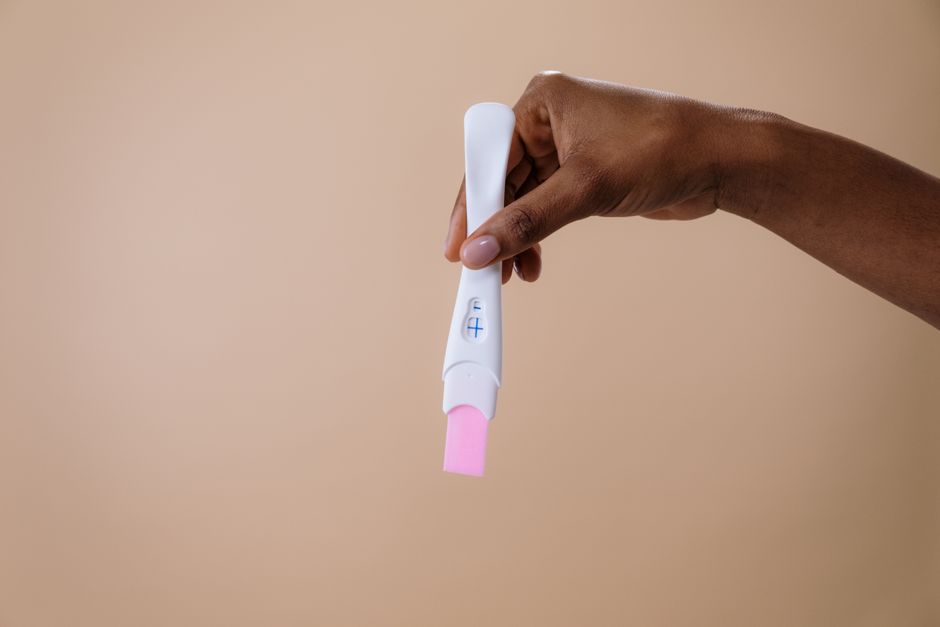
A pregnancy test works by detecting a hormone called hCG in your urine. Your body only makes this hormone after a fertilized egg implants in your uterus. Implantation usually happens 6 to 10 days after ovulation. This means a pregnancy test can show a positive result as early as 10 days past ovulation, but it is most reliable if you wait until the first day of your missed period. Testing too early often gives a negative result even if you are pregnant, simply because your hCG levels are still too low to detect.
What Exactly Is hCG and How Does the Test Detect It?
Human chorionic gonadotropin, or hCG, is a hormone produced by cells that form the placenta. Your body starts producing it right after implantation. Before implantation, there is no hCG in your system. That means no test can give a positive result before implantation happens.
Once implantation occurs, hCG levels double roughly every 48 to 72 hours in early pregnancy. Home pregnancy tests are designed to catch this hormone in your urine. Each test has a specific sensitivity threshold — the lowest amount of hCG it can detect. Most home tests detect hCG at levels of 20 to 25 mIU/mL. Some highly sensitive tests claim to detect levels as low as 10 mIU/mL.
Your urine concentration matters too. hCG is more concentrated in your urine when you first wake up, because you have not been drinking fluids overnight. Testing with first-morning urine gives you the best chance of getting an accurate result when you test early.
How Many Days Past Ovulation Can a Test Turn Positive?
Here is the short answer: the earliest a positive result can appear is about 10 days past ovulation. But this is not typical for everyone. Most women will not get a clear positive until 12 to 14 days past ovulation.
The timeline depends on two things: when implantation happens and how sensitive your test is. Implantation can occur anywhere from 6 to 12 days after ovulation. If you implant on day 6, your hCG has a head start. If you implant on day 12, your hCG levels will be lower at day 14.
Research shows that most implantations happen between days 8 and 10 after ovulation. This is why testing before day 10 is almost always too early. Even with a highly sensitive test, a negative result on day 9 does not rule out pregnancy.
Day by Day: What to Expect From a Pregnancy Test
Here is a realistic day-by-day breakdown based on typical implantation timing. Remember, these are general patterns, not guarantees.
- Days 1 to 5 past ovulation: No hCG exists yet. Any test you take will be negative. Do not test this early.
- Days 6 to 8 past ovulation: Implantation may happen in this window. If it does, hCG production begins. Levels are still far too low for any home test to detect.
- Days 9 to 10 past ovulation: The earliest possible positive with a highly sensitive test. Only a small percentage of women will see a positive result this early.
- Days 11 to 12 past ovulation: About half of pregnant women will get a positive result by this point. A negative result still does not rule out pregnancy.
- Days 13 to 14 past ovulation: Most women who are pregnant will test positive by now. This corresponds to roughly the first day of a missed period.
- Day 15 past ovulation and beyond: If you are pregnant, hCG levels are now high enough that almost any home test will detect it. A negative result at this point is highly reliable.
The key takeaway: a negative test before day 10 means nothing. A negative test on the day of your missed period is fairly reliable but not absolute. A negative test one week after your missed period is about 99% accurate.





Why Testing Too Early Gives False Negatives
False negatives are far more common than false positives. This happens because you are asking the test to detect something that is not there yet. Your body has not produced enough hCG for the test to see.
Even if implantation happened on day 6, your hCG level on day 8 might only be a few mIU/mL. A test that requires 25 mIU/mL will show negative. You are not broken. Your test is not faulty. It is simply too early.
This is why the packaging on most pregnancy tests says to wait until the day of your missed period. The manufacturer knows that testing earlier leads to confusion and disappointment. Waiting a few extra days gives your body time to build up measurable hCG levels.
Could a Negative Test on the Day of Your Missed Period Be Wrong?
Yes, it can be wrong, but it is uncommon. If you have irregular cycles, you might not actually be at the day of your missed period. You could be ovulating later than you think, which means you are testing earlier in your cycle than you realize.
If you tested on the day you expected your period and got a negative result, wait three to five days and test again. By that point, hCG levels will have risen significantly if you are pregnant. This second test is much more reliable.
Also consider that some women have very dilute urine, especially if they drink a lot of fluids. Testing in the afternoon after drinking water all day can lower the hCG concentration in your urine. Always try to test with first-morning urine for the most accurate result.
How Quickly Can A Pregnancy Test Work Day By Day: Blood Tests vs. Urine Tests
Blood tests can detect pregnancy earlier than urine tests. A blood test at your doctor’s office can pick up hCG levels as low as 5 mIU/mL. This means a blood test can be positive as early as 8 to 10 days past ovulation.
There are two types of blood tests. A qualitative blood test simply tells you yes or no. A quantitative blood test, often called a beta hCG test, measures the exact amount of hCG in your blood. Doctors use the quantitative test to monitor early pregnancy and check that hCG levels are rising appropriately.
Blood tests are not necessary for most women. Home urine tests are highly accurate when used at the right time. Your doctor might order a blood test if you have a medical condition, a history of pregnancy complications, or if you need confirmation for medical reasons.
What If You Get a Faint Positive Line?
A faint positive line is still a positive result. The test detects hCG, and even a faint line means hCG is present. This is not a false positive in most cases.
A faint line usually means your hCG level is just barely above the test’s detection threshold. This is common when you test a few days before your missed period. As your hCG levels rise, the line will become darker on subsequent tests.
If you get a faint positive, wait two days and test again. The line should be noticeably darker if your pregnancy is progressing normally. If the line stays faint or disappears, contact your doctor. This can sometimes indicate a very early miscarriage, though it can also just be a variation in test sensitivity.
Can Anything Cause a False Positive?
True false positives are rare. They happen when the test detects hCG but you are not pregnant. This can occur if you are taking certain fertility medications that contain hCG, such as some ovulation induction shots.
Other rare causes include certain medical conditions that produce hCG, like some ovarian tumors. An evaporation line — a faint colorless line that appears after the test dries — can be mistaken for a positive result. This is why you should always read the test within the time window specified in the instructions.
If you get a positive result and are not taking fertility medication, you are almost certainly pregnant. Confirm with your doctor for official confirmation and to discuss next steps.
Tips for Testing Accurately
Follow these practical tips to get the most reliable result from a home pregnancy test.
- Wait until at least the first day of your missed period. This eliminates most false negatives.
- Test with first-morning urine. It has the highest concentration of hCG.
- Read the instructions carefully. Each test has a specific waiting time for results.
- Do not drink excessive fluids before testing. This dilutes your urine.
- If the result is negative but your period does not start, wait three to five days and test again.
- If the result is positive, call your doctor to schedule a confirmation appointment.
Testing early is tempting, especially when you are trying to conceive. But testing at the right time saves you from unnecessary stress and confusion. Your body follows its own timeline, and the test can only tell you what is already happening.
Frequently Asked Questions
How many days past ovulation can a pregnancy test be positive?
A pregnancy test can be positive as early as 10 days past ovulation with a highly sensitive test. Most women will not see a positive until 12 to 14 days past ovulation.
Can a pregnancy test be negative at 10 DPO and positive later?
Yes, absolutely. A negative test at 10 days past ovulation is common even in pregnancy because hCG levels may still be too low to detect.
Is a faint positive line on a pregnancy test reliable?
Yes, a faint positive line is a positive result. It means hCG is present in your urine, and the level is just barely above the test’s detection threshold.
When is the best time of day to take a pregnancy test?
First-morning urine is the best time to test because it has the highest concentration of hCG. Testing later in the day after drinking fluids can dilute your urine and cause a false negative.
