
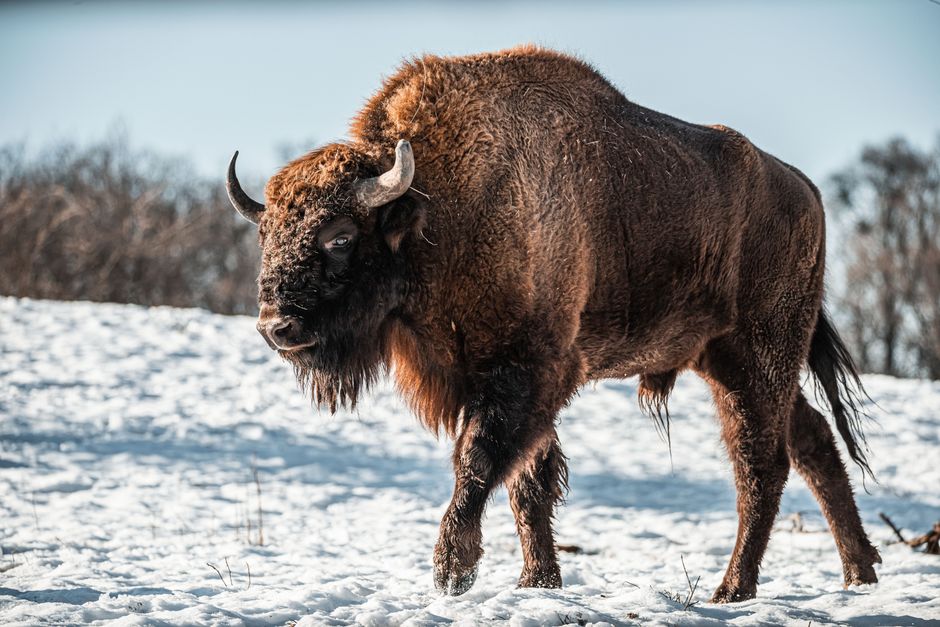
A mature male bison, called a bull, typically weighs between 1,000 and 2,200 pounds. Adult females, called cows, usually weigh between 800 and 1,200 pounds. The heaviest wild bison on record reportedly approached 2,800 pounds, though weights at that extreme are rare and not typical of the species.
Those numbers can surprise people. A bison is not a slightly bigger cow. It is one of the largest land mammals in North America, and its weight shapes everything about how it moves, eats, and survives.
How Much Do Bison Weigh Compared to Cattle and Other Large Mammals?
A bison bull at 1,500 pounds outweighs most domestic beef cattle. A mature beef cow commonly falls in the 1,000 to 1,400 pound range, and a beef bull can reach 2,000 pounds or more. So the two animals overlap, but bison carry their weight differently.
Bison have a massive hump over the shoulders, a thick neck, and a low-slung head. That build concentrates muscle and bone where it matters for pushing through snow and defending against predators. Cattle are built more for grazing in place.
Compared with other North American land mammals, bison sit near the top. A mature bull outweighs a typical moose in most cases, though large Alaska moose bulls can rival or exceed a bison bull. A grizzly bear in peak fall condition can also reach weights comparable to a bison cow. Bison are not the single heaviest land animal on the continent in every comparison, but they are in the top tier.
One detail worth clarifying: the “bison” you see in many parks and ranches is the American bison, sometimes called the American buffalo. The European bison, or wisent, is a separate species and tends to be slightly taller but lighter on average.
Why Do Male and Female Bison Weigh So Differently?
Sexual dimorphism is the term for when males and females of a species differ in size. In bison, that difference is substantial. A bull can weigh nearly twice what a cow weighs.
The gap comes down to reproductive biology. Bulls compete for mating access during the rut, the late-summer breeding season. Larger bulls tend to win those contests, so size has been favored over generations. Cows do not face the same pressure to grow large, and carrying less weight may offer advantages in pregnancy and calving.
Age matters as much as sex. A newborn bison calf weighs roughly 30 to 50 pounds. It grows fast on its mother’s milk. By its first fall, a calf may weigh several hundred pounds. Full size generally comes later, with bulls continuing to add mass for several years.
How Much Do Bison Weigh at Different Life Stages?
Weight in bison is not a single number. It changes with age, sex, season, and food supply.
- Newborn calf: roughly 30 to 50 pounds
- Six-month calf: often in the low hundreds of pounds
- Yearling: several hundred pounds, still growing
- Adult cow: commonly 800 to 1,200 pounds
- Adult bull: commonly 1,000 to 2,200 pounds
These ranges are broad on purpose. A bison on rich grassland in a mild year will weigh more than one scraping through a hard winter. Wild bison can lose a meaningful share of body weight over winter and regain it when spring grass returns. That seasonal swing is normal, not a sign of poor health.
Captive and ranch bison often run heavier than wild ones because feed is consistent and plentiful. That does not mean they are healthier. It means the environment is different.





What Does a Bison’s Weight Mean for Its Body and Behavior?
A bison’s mass is not just a statistic. It explains a lot about how the animal lives.
The heavy head and neck act like a snowplow. Bison can swing their heads side to side to push snow aside and reach grass underneath, which lets them stay on the open plains through winter instead of migrating far. Few large grazers can do this as effectively.
That same build makes bison fast. Despite weighing over a ton, a bison can run at speeds reported around 35 miles per hour for short bursts. It can also turn quickly. People sometimes assume a heavy animal is slow. With bison, that assumption is wrong and has led to serious injuries when visitors get too close.
Weight also affects how bison handle cold. Their thick coat and large body mass help them retain heat. A big animal loses heat more slowly relative to its size than a small one. This is part of why bison thrive in places with brutal winters where smaller animals struggle.
How Much Do Bison Weigh on a Farm or Ranch?
Bison ranching has grown in the United States, and weight is a core concern for producers. Ranch bison are often managed to reach market weight faster than wild bison would.
There is no single standard weight for ranch bison because management, feed, and genetics vary widely. Some operations target bulls in the range of 1,000 to 1,200 pounds at harvest, while others let animals grow larger. Because bison are not fully domesticated the way cattle are, handling them is harder and growth rates are less predictable.
Bison meat, often sold as ground bison or bison steak, tends to be leaner than beef from grain-fed cattle. That leanness is a selling point, but it also means the meat cooks faster and dries out more easily. The weight of the animal and the leanness of its meat are related but separate facts. A heavier bison does not automatically produce fattier meat.
Can You Estimate a Bison’s Weight by Looking at It?
Not accurately. Estimating the weight of a live bison by eye is unreliable, even for people who work with them.
The thick coat hides body condition. A bison can look enormous in winter and much leaner by late spring without changing its actual frame much. The hump and heavy front end also make the animal look front-heavy, which throws off visual estimates.
When weight matters, such as in veterinary care or livestock management, it is measured rather than guessed. Producers use livestock scales or weight tapes, and even those have limits with a species this large and this unwilling to stand still.
For the average person, the practical takeaway is simple: treat any bison as far heavier and far faster than it looks. Park regulations that require staying a certain distance from bison exist because the animals are large, quick, and unpredictable. Those rules are not arbitrary.
Why Does Bison Weight Matter to Know?
Knowing how much a bison weighs is more than trivia. It corrects a common mental image. Many people picture bison as shaggy, slow, cow-like animals. The reality is a one-ton mammal with the speed of a racehorse over short distances.
That gap between perception and reality is exactly why bison encounters in parks sometimes end in injury. People underestimate the animal. Understanding the weight helps explain the danger, the animal’s winter survival, and why it dominates the grasslands it lives on.
Bison also carry cultural and ecological weight that goes beyond pounds. They shaped the Great Plains for thousands of years, and their near-removal in the 1800s reshaped that landscape. Their size is part of why they mattered so much.
Frequently Asked Questions
How much does a full-grown bison weigh?
A full-grown male bison usually weighs between 1,000 and 2,200 pounds, while a full-grown female usually weighs between 800 and 1,200 pounds. Exact weight depends on age, sex, diet, and season.
What is the heaviest bison ever recorded?
The heaviest wild bison on record reportedly approached 2,800 pounds, though weights near that figure are rare. Typical adult bulls fall well below that number.
Is a bison heavier than a cow?
A bison bull is generally heavier than a typical domestic beef cow, which commonly weighs 1,000 to 1,400 pounds. However, large beef bulls can reach weights comparable to bison bulls, so the two overlap.
How fast can a bison run despite its weight?
Bison can run at speeds reported around 35 miles per hour for short bursts. Their heavy build does not make them slow, which is why park safety distances matter.
