
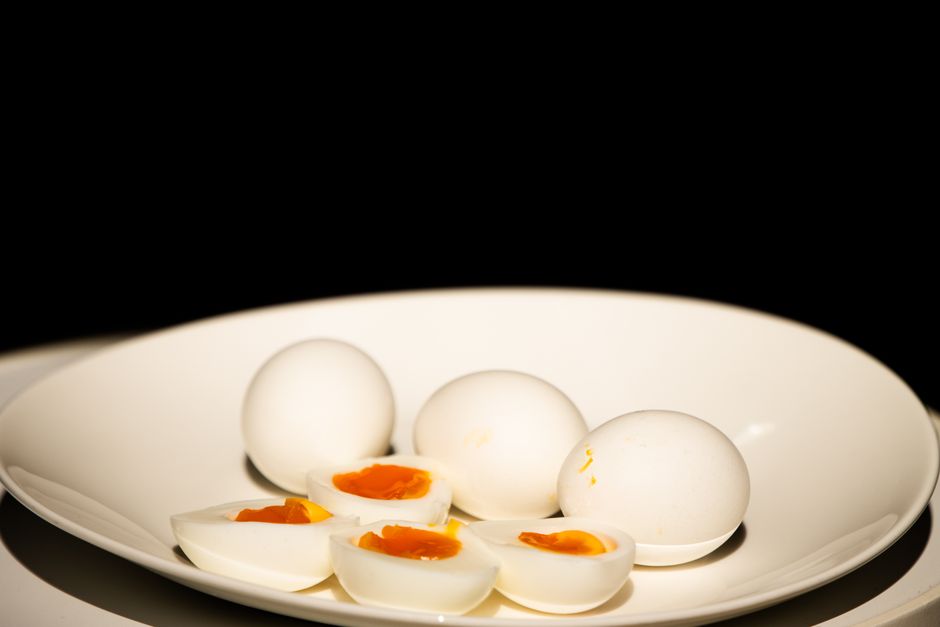
Hard-boiled eggs take about 10 to 12 minutes in gently boiling water for a fully set yolk. The exact time depends on how firm you want the center, the size of the egg, and whether the eggs start cold or go into already-boiling water. Most home cooks land on 10 minutes for a slightly soft, bright yolk and 12 minutes for a fully firm, pale yolk all the way through.
How Long Do You Boil Eggs Hard-Boiled?
For a standard large egg placed into water that is already boiling, 10 to 12 minutes produces a hard-boiled egg. At 10 minutes the yolk is set but still has a soft, slightly fudgy center. At 12 minutes the yolk is fully firm and uniform from edge to center.
Going past 12 minutes is where eggs start to go wrong. The white turns rubbery and the yolk develops a gray-green ring around it. That ring is a real chemical change, not just a cosmetic flaw, and I’ll explain it below.
Two variables shift the timeline:
- Egg size. Large is the default most recipes assume. Jumbo eggs need a minute or two longer. Small eggs need less.
- Starting temperature. Eggs lowered into boiling water cook differently than eggs that start in cold water and heat up with it.
If you start eggs in cold water, begin counting once the water reaches a full rolling boil. From that point, 10 to 12 minutes still applies for a large egg.
Does the Starting Method Change the Time?
Yes, and this is one of the most common sources of confusion. The two main methods are hot-start and cold-start, and they are not interchangeable.
Hot start. You bring water to a boil first, then lower the eggs in. Timing begins immediately. This method gives you more control because the eggs hit a known temperature right away. The tradeoff is that a cold egg dropped into boiling water can crack, since the shell expands fast. Lowering eggs in gently with a spoon or slotted ladle reduces that risk.
Cold start. You put eggs in a pot, cover with cold water, and bring everything to a boil together. Timing begins when the water reaches a rolling boil, not when you turn on the stove. This method is gentler on the shells and is a common approach for people who tend to crack eggs. The catch is that the total cooking time is longer and slightly less predictable, because the ramp-up time varies with your stove and pot.
Both methods can produce a good hard-boiled egg. The 10-to-12-minute figure applies to the boiling phase in either case. What matters is that you start counting at the right moment and keep the boil steady rather than violent.
Why Do Hard-Boiled Eggs Get a Green Ring?
The gray-green ring around the yolk is iron sulfide, and it forms when eggs are cooked too long or cooled too slowly. It is harmless. It does not make the egg unsafe to eat, and it does not mean the egg has spoiled.
Here is what happens. Egg whites contain sulfur, and yolks contain iron. When heat is applied for a long time, the sulfur in the white reacts with the iron in the yolk and produces iron sulfide at the boundary where the two meet. The longer and hotter the cook, the more of it forms.
This is why the timeline matters. Pulling eggs at 10 to 12 minutes and then cooling them quickly limits how much iron sulfide can develop. A fast cool-down with cold water or an ice bath stops the cooking process and slows the reaction.
The ring is a useful signal. If you see a thick green layer, your eggs went too long. If you see only a faint trace or none at all, your timing was close to right.





How Do You Cool and Peel Hard-Boiled Eggs?
Move the eggs straight from the hot water into cold water or an ice bath as soon as the timer goes off. This does two things: it stops the cooking so the yolk does not overcook, and it makes peeling easier.
Let them sit in the cold water for a few minutes until they are cool enough to handle. Then peel under running water or in a bowl of water. The water helps loosen the shell and rinse away small fragments.
Peeling difficulty is mostly about egg freshness, not technique. Very fresh eggs are harder to peel because the white clings tightly to the inner shell membrane. As eggs age, the white’s pH rises and the membrane separates more easily. Eggs that are about a week to ten days old tend to peel more cleanly than eggs laid the same day. This is one of those small facts that surprises people who assume fresher is always better for boiling.
If you want an easier peel and don’t mind a slight change in texture, you can also steam eggs instead of boiling them. Some cooks find steamed eggs peel more reliably, though the evidence on this is mostly practical experience rather than controlled study.
Can You Boil Eggs Ahead of Time?
Yes. Hard-boiled eggs keep in the refrigerator for about a week, whether peeled or unpeeled. Store them in a covered container. Unpeeled eggs generally hold up a bit better because the shell protects the white.
If you peel them ahead of time, keep them in a sealed container with a slightly damp paper towel to reduce drying. Peeled eggs are best eaten within a few days, though the food-safety window is the same as unpeeled.
Do not leave hard-boiled eggs at room temperature for more than two hours. This is standard food-safety guidance for perishable foods. If they sat out longer than that, throw them out.
One more note: hard-boiled eggs are different from soft-boiled eggs, and the timelines do not overlap. A soft-boiled egg with a runny yolk comes out at roughly 6 minutes. If you want a jammy, custardy yolk, aim for about 7 minutes. The 10-to-12-minute range is specifically for a fully set hard-boiled yolk.
What About Altitude and Egg Temperature?
Water boils at a lower temperature as altitude increases. At sea level water boils at 212°F (100°C). At higher elevations the boiling point drops, which means food cooks more slowly in boiling water. If you live at a high altitude, you may need to add time to the standard 10-to-12-minute range.
The exact adjustment depends on your elevation, and there is no single number that covers everyone. A reasonable approach is to test one egg at your usual time, then adjust. People at significant elevation often find they need a few extra minutes.
Cold eggs straight from the fridge also take slightly longer than eggs that have sat at room temperature, though the difference is small. If you are timing carefully, let eggs sit out for a few minutes first, or simply add a minute as a buffer.
None of these variables change the basic answer. For most people at ordinary elevations using large eggs, 10 to 12 minutes in gently boiling water is the working range.
Why Does the Yolk Sometimes Look Different?
Yolk color varies naturally with the hen’s diet and has nothing to do with how long you boiled the egg. A deeper orange yolk usually reflects what the hen ate, such as more carotenoid-rich feed. A pale yellow yolk reflects a different diet. Both are normal.
What does relate to cooking is yolk texture. An undercooked hard-boiled yolk is soft or liquid in the center. A properly cooked one is firm but still slightly moist. An overcooked one is dry, crumbly, and chalky, sometimes with the green ring described earlier. If your yolks are consistently chalky, you are cooking too long.
The white tells a similar story. A well-timed hard-boiled white is firm and sliceable. An overcooked white is rubbery and tough. If your egg whites squeak when you cut them, they went past the mark.
Frequently Asked Questions
How long do you boil eggs for hard-boiled?
Boil large eggs for 10 to 12 minutes in gently boiling water for a fully set hard-boiled yolk. Ten minutes gives a slightly softer center and 12 minutes gives a fully firm yolk.
Is 10 minutes enough to hard boil an egg?
Yes, 10 minutes is enough for a large egg with a set but slightly soft yolk. If you want a completely firm, dry yolk, go closer to 12 minutes.
Should you put eggs in cold or boiling water?
Both methods work, but the timing starts differently. With boiling water you start the timer immediately; with cold water you start the timer once the water reaches a rolling boil.
Why do my hard-boiled eggs have a green ring?
A gray-green ring around the yolk is iron sulfide, which forms when eggs are overcooked or cooled too slowly. It is harmless and does not mean the egg is spoiled.
