
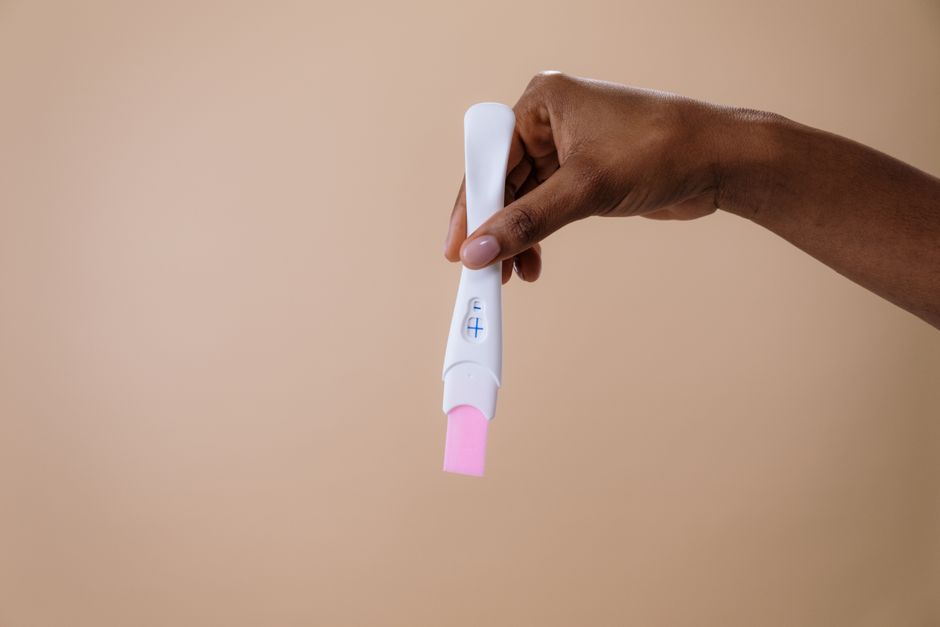
The earliest a pregnancy test can show positive is about 10 days after ovulation — and that is the exception, not the rule. Most home urine tests turn positive around the time of a missed period, which is roughly 14 days after ovulation in a regular cycle. The biology behind that timing is well understood, and it explains why testing too early is the most common reason people get a false negative.
How Long Before a Pregnancy Test Shows Positive?
Implantation is the gatekeeper. After an egg is fertilized, it travels down the fallopian tube and buries into the uterine lining. That process usually takes 6 to 12 days after ovulation, with most implantations occurring around day 8 or 9.
The hormone hCG (human chorionic gonadotropin) starts entering the bloodstream only after implantation. Home urine tests detect hCG, so a test cannot turn positive before implantation happens. From there, hCG roughly doubles every 48 to 72 hours in early pregnancy. It takes a few of those doublings before urine levels are high enough for a standard test to register.
Put those two pieces together and you get the practical window most clinicians describe: about 14 days after ovulation for a reliable result, or the first day of a missed period. A small share of people will test positive earlier. Some will not test positive until several days later, even in a healthy pregnancy.
Why Does Testing Too Early Give a False Negative?
A false negative happens when you are pregnant but hCG has not yet reached the test’s detection limit. This is not a flaw in the test so much as a timing problem.
Standard home urine tests typically detect hCG at concentrations around 20 to 25 mIU/mL. Some brands claim sensitivity of 10 mIU/mL. A lower detection threshold sounds better, but it only helps if your hCG has crossed that line — and in the first days after implantation, levels can sit below any test’s limit.
There is a second factor people rarely consider. Urine concentration matters. hCG measured in first-morning urine is generally higher than in urine diluted by drinking a lot of fluid. A test taken after several glasses of water can read negative when the same person would test positive the next morning.
This is why a negative result taken very early tells you almost nothing definitive. It means hCG was not detected at that moment. It does not mean you are not pregnant.
How Do Urine and Blood Pregnancy Tests Compare?
Blood tests can detect pregnancy earlier than urine tests. A quantitative blood test measures the exact hCG level and can pick up pregnancy around 8 to 11 days after ovulation in many cases. A qualitative blood test simply confirms whether hCG is present.
That said, blood testing is not a routine first step for most people. Clinicians typically order it when there is a reason — monitoring an early pregnancy, tracking hCG progression, or investigating symptoms. For everyday use, a home urine test taken at the right time is accurate for the large majority of people.
The table below summarizes the general timing differences. These are typical windows, not guarantees for any individual.
| Test Type | What It Detects | Typical Earliest Detection |
|---|---|---|
| Standard urine test | hCG in urine | Around the missed period (about 14 days after ovulation) |
| High-sensitivity urine test | hCG in urine at lower levels | Sometimes a few days before the missed period |
| Qualitative blood test | Presence of hCG in blood | Roughly 8 to 11 days after ovulation |
| Quantitative blood test | Exact hCG level in blood | Roughly 8 to 11 days after ovulation |



When Should You Take a Pregnancy Test?
The most reliable time is the first day of a missed period. If your cycles are regular, that lands about two weeks after ovulation — right when hCG has had time to build up.
If you do not track ovulation and your cycles are irregular, timing gets harder. You may not know when you ovulated, so the missed-period rule is less precise. In that case, testing and then retesting a few days later if the result is negative and your period still has not come is a reasonable approach.
A few practical points help accuracy:
- Test first thing in the morning when possible, especially if you are testing early.
- Follow the package instructions exactly, including how long to wait for results.
- Do not read a test after the time window stated on the package — results outside that window are unreliable.
- If the result is negative but you still suspect pregnancy, wait a few days and test again.
Some clinicians advise waiting a couple of days past a missed period for the clearest result. Others say testing on the day of the missed period is fine. Both positions are common in practice, and neither is wrong — it comes down to how much certainty you want versus how soon you want an answer.
What Affects How Soon a Test Turns Positive?
Several factors shift the timing, and most of them are outside your control.
Implantation timing is the biggest one. Implantation on day 6 means hCG starts rising several days earlier than implantation on day 12. That difference alone can separate an early positive from a late one.
Ovulation timing matters just as much. Many people assume ovulation happens on day 14 of their cycle, but that is an average, not a rule. Ovulation can happen earlier or later, and it can vary from cycle to cycle. If you ovulated later than you thought, your hCG will rise later than you expected.
Test sensitivity plays a role, though a smaller one than timing. A test that detects 10 mIU/mL will turn positive slightly sooner than one that detects 25 mIU/mL, all else being equal.
Twin or multiple pregnancies sometimes produce hCG that rises faster, which can lead to an earlier positive. This is not reliable enough to use as a sign of twins.
One clarification worth making: the strength of the line on a home test is not a dependable measure of how far along a pregnancy is or whether it is progressing normally. Line darkness varies with urine concentration, test brand, and timing. It is not a clinical measurement.
What If You Test Positive Before Your Missed Period?
An early positive is possible and does happen. If you get one, the result is generally trustworthy — false positives on home tests are uncommon. hCG is not produced in meaningful amounts outside pregnancy, with rare exceptions that clinicians are aware of.
A positive result before a missed period usually means implantation happened on the earlier side and hCG has risen enough to be detected. The next step is confirming with a clinician, who may repeat testing or schedule an early appointment depending on your situation.
If you test positive and then later test negative, or your period arrives, contact a healthcare provider. This pattern can happen for several reasons, and a clinician can help sort out what is going on. It is not something to diagnose on your own from home tests.
What Causes a Missed Period If You Are Not Pregnant?
A late period does not automatically mean pregnancy, and a negative test plus a missed period is common. Stress, significant weight change, intense exercise, thyroid problems, and hormonal conditions such as polycystic ovary syndrome can all disrupt ovulation and shift cycle timing.
If your period is late and tests stay negative, that is worth discussing with a clinician — not because something is necessarily wrong, but because cycle changes can have treatable causes. The timing of a pregnancy test and the timing of a missed period are related, but a missed period on its own is not a diagnosis.
Frequently Asked Questions
Can a pregnancy test show positive 5 days after ovulation?
It is very unlikely. Implantation usually takes 6 to 12 days after ovulation, and hCG only starts rising after that, so 5 days is generally too early for any test to detect pregnancy.
How accurate is a pregnancy test on the day of a missed period?
Home urine tests are highly accurate when used on or after the first day of a missed period, assuming you follow the instructions. Accuracy drops when tests are taken earlier than that.
Can you be pregnant and still test negative?
Yes. A negative test can happen if you tested too early, if your urine was diluted, or if implantation occurred later than usual. Waiting a few days and retesting usually resolves it.
Does a faint line on a pregnancy test count as positive?
A visible line in the test window generally counts as positive, even if faint, as long as it appears within the time stated on the package. Lines that show up after that window should not be trusted.
