
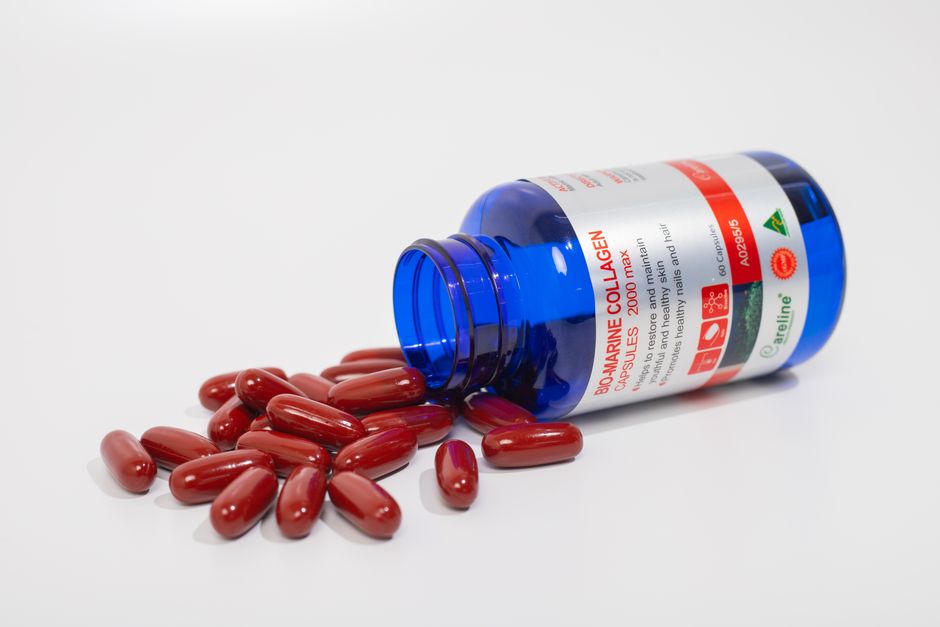
Most collagen in a drugstore jar starts as fish skin that would otherwise be thrown away. Marine collagen is made by extracting collagen protein from the skin, scales, and sometimes bones of fish and other seafood, then breaking that protein down into smaller pieces the body can absorb. The finished powder is a peptide — a short chain of amino acids — not whole collagen. That distinction matters for how it behaves in the body, and for what the evidence actually shows about it.
What Is Marine Collagen Made From?
Marine collagen comes from the connective tissue of fish. The most common sources are the skin and scales of cold-water species like cod, salmon, and pollock. Fish swim bladders and bones are used less often. In most cases these are byproducts of commercial fishing and filleting — material that would otherwise be discarded.
Collagen is the most abundant protein in vertebrate animals. It gives skin, tendon, bone, and cartilage their structure. Fish collagen differs from the collagen in cow or pig hides in one important way: its amino acid sequence and its melting temperature. Fish collagen has a lower denaturation temperature than mammalian collagen, which is why it is generally easier to extract and process. That same property is why marine collagen is often promoted as more absorbable, though the claim needs some nuance.
The raw material is sorted, cleaned, and frozen or dried shortly after harvest. Species matters. Cold-water fish tend to yield collagen with a slightly different amino acid profile than warm-water fish, and manufacturers often specify the species on the label. What the label rarely tells you is the exact tissue used or the extraction method, which can vary widely between brands.
How Is Marine Collagen Made The Manufacturing Process?
The manufacturing process moves through four main stages: pretreatment, extraction, hydrolysis, and purification. Each stage affects the final product, and the differences between cheap and expensive powders usually come down to how carefully these steps are controlled.
Pretreatment
Raw fish skin arrives with fat, pigment, and non-collagen proteins attached. These are removed first. The material is typically washed and treated with dilute acid or alkali to break down fats and loosen the collagen fibers. Some producers use enzymes instead. This step is not optional — leftover fat and pigment would carry through to the final powder and affect taste, color, and shelf life.
Extraction
Once pretreated, the collagen is pulled out of the tissue using hot water, dilute acid, or enzymes. Hot-water extraction is the simplest and most common method. The temperature is controlled carefully because fish collagen denatures — loses its triple-helix structure — at a lower temperature than beef or pork collagen. What comes out is gelatin, a partially broken form of collagen.
Enzyme-assisted extraction is used by some manufacturers to improve yield and reduce processing time. It is generally considered more efficient, though it adds cost. The choice of method is rarely disclosed on a label, and there is no regulatory requirement to do so.
Hydrolysis
This is the step that turns gelatin into collagen peptides. Hydrolysis uses enzymes or heat to cut the long protein chains into shorter fragments. The result is a mixture of peptides with varying molecular weights, usually measured in daltons.
Molecular weight is the number most often used in marketing. Smaller peptides are generally absorbed more readily through the intestinal wall. Collagen peptides in the range commonly sold are far smaller than intact collagen, which is not absorbed intact to any meaningful degree. But “smaller is better” is not a settled rule. Absorption studies show that some peptides cross into the bloodstream, while others are broken down into individual amino acids. How much of a given peptide reaches skin or joint tissue is not well established.
Purification and Drying
After hydrolysis, the liquid is filtered to remove impurities, decolorized, and sometimes deodorized. It is then concentrated and dried into a powder, usually by spray drying. The powder is tested for heavy metals, microbial contamination, and protein content before packaging.
Heavy metal testing is not a marketing detail. Fish skin can accumulate arsenic, mercury, and other metals from the environment, though levels vary by species and fishing region. Reputable manufacturers test each batch. Third-party certification programs exist, but they are voluntary.
What Is the Difference Between Marine Collagen and Bovine Collagen?
Both are collagen peptides. The main differences are the source animal, the amino acid profile, and the practical handling.
- Source: Marine collagen comes from fish; bovine collagen comes from cow hide or bone.
- Amino acid profile: Both are rich in glycine, proline, and hydroxyproline. Marine collagen tends to be higher in type I collagen, which is the main type found in skin, tendon, and bone.
- Particle size: Marine collagen peptides are often smaller, which some research suggests may improve absorption.
- Taste and smell: Marine collagen can carry a fishy odor if poorly processed. Bovine collagen is usually more neutral.
- Dietary fit: Marine collagen suits pescatarians. Bovine collagen does not suit vegetarians or vegans, and neither does marine collagen.
One point that gets lost: neither type is a complete protein. Both lack tryptophan, an essential amino acid. They are supplements, not protein sources in the way eggs or beans are.




Does Hydrolysis Actually Make Collagen More Absorbable?
Yes, in a limited and specific sense. Intact collagen is a large, tightly coiled protein. The digestive tract cannot absorb it whole in any meaningful amount. Hydrolysis breaks it into peptides small enough to pass through the intestinal lining.
What happens after absorption is where the evidence gets thinner. Some peptides do appear in the bloodstream after oral intake. Whether they reach skin, cartilage, or joint tissue in amounts that change tissue biology is not clearly established. Much of the absorbed material is broken down further into free amino acids and used wherever the body needs them — which may have nothing to do with your skin or joints.
This is a key distinction. Absorption is not the same as a clinical effect at a target tissue. Marketing often treats the two as interchangeable. They are not.
What Does the Evidence Say About Marine Collagen Supplements?
The evidence is mixed and generally modest. Some small trials have reported improvements in skin elasticity and hydration with oral collagen peptide supplementation, including marine sources. Other trials have found no significant difference from placebo. Study sizes are often small, durations are short, and industry funding is common — all of which limit how much weight the results can carry.
For joint pain, the picture is similar. Some studies suggest minor symptom improvement in specific groups, such as athletes with activity-related joint discomfort. Results vary, and the effect sizes reported are generally small. No strong evidence supports collagen peptides as a treatment for osteoarthritis or any diagnosed joint disease.
No clinical evidence currently confirms that marine collagen reverses skin aging, rebuilds cartilage, or treats any medical condition. The claims you see most often are ahead of the data.
Is Marine Collagen Safe?
For most healthy adults, collagen peptides are well tolerated. Reported side effects are usually mild and digestive — bloating, fullness, or changes in stool. These are not common in the trials published to date.
Two groups need more caution. People with fish allergies should avoid marine collagen entirely, since it is derived from fish and can trigger reactions. And because supplements are not held to the same regulatory standards as drugs in the United States, purity and label accuracy vary. Independent testing has found that some collagen products contain less protein than claimed or contain contaminants.
Pregnant and breastfeeding women, children, and people with kidney or liver conditions should talk to a clinician before using any collagen supplement. No clinical guidelines currently exist for collagen peptide use in these groups.
How to Read a Marine Collagen Label
Labels are not standardized, which makes comparison hard. A few things are worth checking.
- Source species: Named species are a better sign than vague terms like “marine collagen.”
- Peptide amount: Look for the grams of collagen peptides per serving, not the total scoop weight.
- Molecular weight: Often listed in daltons. Lower numbers are commonly marketed as better, though the evidence for that claim is not settled.
- Third-party testing: Look for independent certification for heavy metals and purity.
- Added ingredients: Many powders include sweeteners, flavorings, or vitamins. These change what you are actually buying.
One non-obvious point: “hydrolyzed collagen” and “collagen peptides” mean the same thing. They are not different products. The terms are used interchangeably, and some brands use both on the same label to sound more sophisticated.
Frequently Asked Questions
How is marine collagen made?
Marine collagen is extracted from fish skin, scales, or bones using acid, heat, or enzymes, then broken into smaller peptides through hydrolysis. The resulting liquid is purified, dried, and sold as a powder.
Is marine collagen better than bovine collagen?
Marine collagen peptides are often smaller, which may improve absorption, but head-to-head trials comparing the two are limited. The evidence does not clearly establish one as more effective than the other.
Does marine collagen actually work for skin and joints?
Some small studies suggest modest improvements in skin hydration and joint comfort, but results are mixed and often industry-funded. No clinical evidence confirms it treats any medical condition.
Can you get collagen from food instead of supplements?
Yes. Collagen is found in animal foods like fish, meat, and bone broth, and the body also makes its own collagen from amino acids and vitamin C. Whether dietary collagen produces the same effects as supplements is not well studied.
