
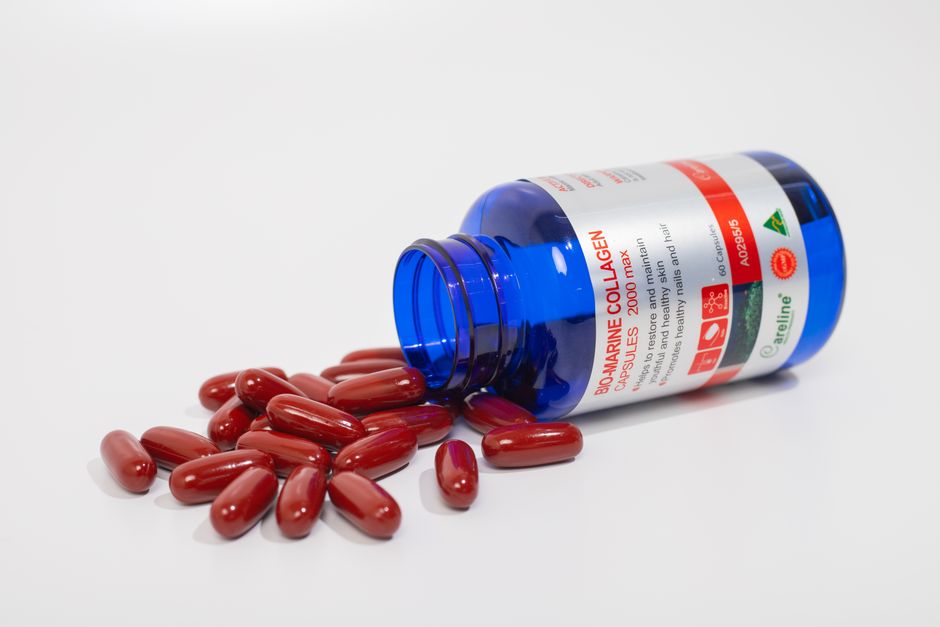
Collagen supplements have become one of the most popular products in the wellness aisle, and the dose on the label is often surprisingly small. If you have picked up a gummy or a beauty powder and seen “100 mg” printed on the front, you are right to pause and ask whether that number is doing anything at all. The short answer: 100 mg of collagen per day is far below the doses used in most clinical research on skin, joints, and bone. It is not a meaningless amount, but it is unlikely to produce the effects people typically buy collagen for.
Is 100 Mg Of Collagen Really Enough Per Day?
For most of the outcomes collagen is studied for, 100 mg is not considered a meaningful daily dose. The clinical trials that show measurable effects on skin elasticity, joint discomfort, or hydration have generally used doses in the range of 2.5 grams to 10 grams per day.
That is 2,500 mg to 10,000 mg — roughly 25 to 100 times the 100 mg figure. The gap is not a small rounding difference. It is the difference between a dose that has been tested and a dose that has mostly been chosen because it fits into a small capsule or gummy.
This does not mean 100 mg is dangerous or completely inert. Collagen is a protein, and 100 mg of protein is still 100 mg of protein. But the body’s collagen turnover involves grams of material per day, not milligrams. A dose that small is unlikely to move the needle on skin, joints, or bone in any way a person would notice.
Why Do Collagen Labels Use Such Different Doses?
Dose varies wildly across collagen products because there is no single regulated standard for how much collagen a supplement should contain. In the United States, collagen is sold as a dietary supplement, which means it is not held to the same pre-market review as a prescription drug.
That regulatory gap creates room for marketing decisions to drive dose. A product designed as a small capsule or a chewable gummy has limited space. A powder that you mix into a drink can hold several grams. Both can legally call themselves “collagen,” even though the amounts differ by a factor of dozens.
You will often see this split:
- Capsules and gummies: frequently 100 mg to 1,000 mg per serving
- Powders and liquids: commonly 2,500 mg to 10,000 mg per serving
- Collagen “boosters” or blends: sometimes list collagen as one of many ingredients, at amounts too small to study
The format often tells you more about the dose than the marketing copy does. If a product is built around fitting into a tiny delivery system, the collagen content is usually a casualty of that design.
What Does the Research Actually Use?
Most published human trials on oral collagen use doses between 2.5 g and 10 g daily, with many skin studies clustering around 2.5 g to 5 g and joint studies often using higher amounts. This is the range where researchers have looked for measurable changes.
It is worth being precise about what those studies show. The evidence is not uniform. Some trials report improvements in skin elasticity, hydration, or wrinkle depth. Others find no significant difference from placebo. Study sizes are often modest, and many are funded or supported by collagen manufacturers, which is a conflict worth knowing about when you read the results.
What the research does not show is a benefit from 100 mg per day. That dose has not been the subject of the trials that generated the positive headlines. When a company cites “clinical studies” on its label while selling a 100 mg product, the studies being referenced are almost certainly using a much higher dose than what is in the package.
This is one of the more useful things to understand about supplement marketing: the study and the product are not always the same thing. A trial on 5 g of a specific collagen peptide does not automatically transfer to a 100 mg capsule of a different collagen source.
Does Collagen Type or Source Change the Answer?
Type and source matter less than dose for this particular question. Whether the collagen is type I, type II, type III, marine, bovine, or eggshell-derived, the amount needed to match clinical research is still measured in grams, not milligrams.
Different types are studied for different purposes. Type I and type III are most commonly studied for skin and bone. Type II is more often studied for joint cartilage. But a 100 mg dose of any of them is still well below the studied range.
Hydrolyzed collagen, sometimes called collagen peptides, is the form most often used in research because the protein is broken into smaller pieces that are easier to absorb. That processing may improve absorption compared with intact collagen. It does not, however, change the fact that 100 mg is a small amount.
Can a Small Dose Still Do Something?
The honest position is that we do not have good evidence either way for 100 mg specifically. It has not been well studied as a standalone dose, so claims in either direction — that it works or that it is useless — go beyond what the data support.
There is a plausible argument that very small amounts of collagen peptides could act as signaling molecules rather than as raw building material. Some research on collagen peptides has explored whether they trigger certain skin or joint cell responses at low concentrations. This is an area of active interest, but it is not established, and it has not been confirmed in human trials at 100 mg.
Biological plausibility is not the same as demonstrated benefit. A mechanism that looks reasonable in a lab dish does not always translate into a real effect in people. Until there are human trials using 100 mg and showing outcomes, the most accurate statement is that the evidence is absent, not that the dose is proven ineffective.
How Does 100 Mg Compare to Food?
For context, the collagen you eat in food is measured in grams. A typical serving of bone broth, a chicken thigh with skin, or a piece of fish with connective tissue can contain several grams of collagen and related proteins. That is thousands of milligrams.
This comparison is not an argument that food is a better collagen supplement. It is simply a way to see the scale. A 100 mg capsule is a small fraction of what you would get from an ordinary mixed diet that includes animal proteins.
If your goal is general protein intake, 100 mg is negligible — it would not meaningfully contribute to a daily protein target, which for most adults is measured in tens of grams. If your goal is specifically the outcomes studied in collagen research, the dose is similarly small relative to what those studies used.
What Should You Take Away From the Number on the Label?
The number on the front of a collagen product is the most important thing to check, and it is often the least emphasized. A product can be beautifully packaged, taste good, and contain collagen — while still containing far less than the amounts used in research.
If you are considering collagen for a specific reason, the useful questions are:
- How many milligrams or grams of collagen are in a full daily serving, not just one capsule or gummy?
- Is that amount in the range used in human trials — generally grams, not milligrams?
- Does the company cite studies, and if so, what dose did those studies use?
None of this means you must take collagen, or that any dose is right for you. It means the dose on the label is worth reading carefully, because a 100 mg product and a 5 g product are not the same thing, even if both say “collagen” on the front.
Frequently Asked Questions
Is 100 mg of collagen enough to see results?
Based on the doses used in clinical research, 100 mg is well below the range that has shown measurable effects. Most human trials use 2.5 g to 10 g per day, which is 25 to 100 times higher.
How much collagen do studies usually use per day?
Most human trials use between 2.5 grams and 10 grams daily, depending on whether the focus is skin or joints. That is 2,500 mg to 10,000 mg, far above a 100 mg dose.
Can a small amount of collagen still help my skin?
There is no reliable human evidence that 100 mg per day improves skin, though it has not been well studied at that dose. The skin benefits reported in research come from doses measured in grams.
Why do some collagen products only contain 100 mg?
Small doses often reflect the limits of the delivery format, such as a capsule or gummy, rather than an evidence-based choice. Collagen is not held to a standard dose by regulators, so the amount varies widely by product.
