
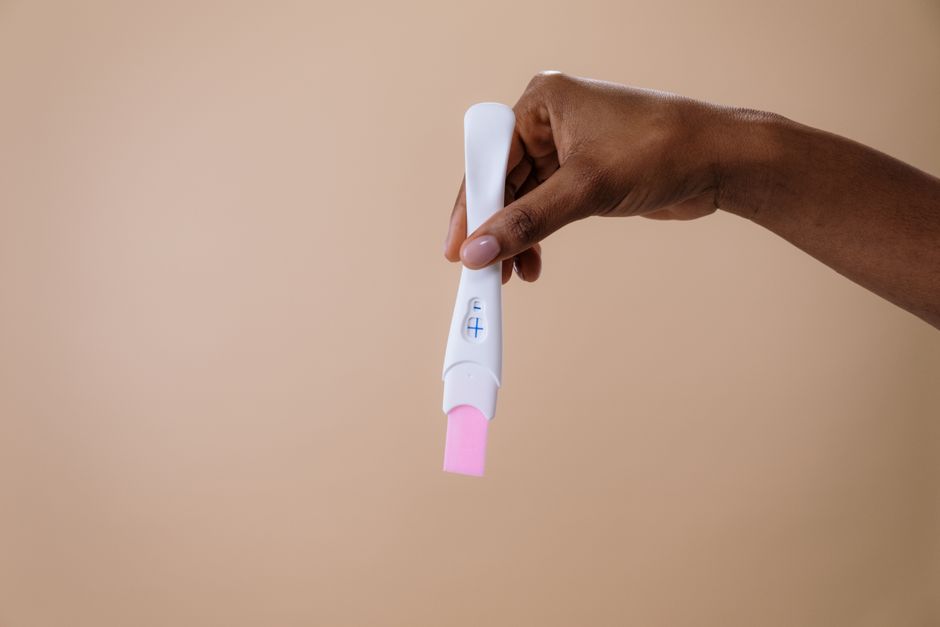
Most home pregnancy tests can give you a reliable positive result on the first day of your missed period. Some sensitive tests may work a few days earlier, but accuracy drops significantly the sooner you test. For the most dependable result, wait until the day after your expected period start date.
How Do Home Pregnancy Tests Detect Pregnancy?
Home pregnancy tests measure a hormone called human chorionic gonadotropin, or hCG. Your body starts making hCG after a fertilized egg attaches to the lining of your uterus. This implantation usually happens 6 to 12 days after ovulation.
Once implantation occurs, hCG levels double roughly every 48 to 72 hours. The test works by using antibodies that bind to hCG in your urine. When enough hormone is present, a line or a symbol appears to show a positive result.
Most tests sold in the US claim to detect hCG at levels around 20 to 25 milli-international units per milliliter (mIU/mL). Some “early response” tests claim sensitivity at 10 mIU/mL. The American Pregnancy Association notes that even sensitive tests may miss a pregnancy if you test before implantation finishes.
How Early Will A Pregnancy Test Show a Positive Result?
The earliest reliable positive result comes about 12 to 14 days after ovulation. That timeline lines up with the first day of a missed period for most people with regular 28-day cycles. Testing earlier than that increases your chance of a false negative.
A study published in the journal Human Reproduction looked at how early tests could detect pregnancy. Researchers found that only 10% of pregnant women had a positive test 5 days before their missed period. By the day of the missed period, 90% of pregnant women tested positive. By the day after the missed period, 97% tested positive.
The study used a test sensitive to 25 mIU/mL hCG. That is the standard sensitivity for most drugstore tests. So “how early will a pregnancy test” work depends on when you ovulated and when implantation happened.
What Factors Affect How Early You Can Get a Positive Result?
Several things determine when a test will turn positive. The biggest factor is the timing of implantation. If the fertilized egg implants early, around day 6 after ovulation, hCG rises sooner. If implantation happens later, around day 12, hCG takes longer to build up.
Your cycle length matters too. People with cycles longer than 28 days ovulate later in their cycle. Testing on day 28 might be too early if you ovulated on day 18 instead of day 14. Knowing your ovulation date is more useful than counting days since your last period.
Test sensitivity also plays a role. Tests that detect 10 mIU/mL hCG can show a positive result a day or two earlier than tests that need 25 mIU/mL. But even the most sensitive test cannot detect pregnancy before implantation happens. No test on the market can do that.


How Accurate Are Early Pregnancy Tests Before Your Missed Period?
Accuracy drops sharply the earlier you test. According to the manufacturer information for First Response Early Result, the test can detect pregnancy in 76% of pregnant women up to 6 days before the missed period. That means 24% of pregnant women would get a false negative at that point.
By 5 days before the missed period, detection rates rise to about 96% for that same brand. But those numbers come from the manufacturer’s own studies. Independent research has not confirmed those exact figures for every brand.
The FDA regulates home pregnancy tests as medical devices. Manufacturers must submit data showing their tests work. But the FDA does not independently verify the accuracy claims for every single brand. Some brands may overstate their early detection ability.
| Days Before Missed Period | Approximate Detection Rate | False Negative Risk |
|---|---|---|
| 6 days before | 10-25% | Very high |
| 5 days before | 25-50% | High |
| 4 days before | 50-75% | Moderate |
| 3 days before | 75-90% | Low |
| 2 days before | 90-95% | Low |
| 1 day before | 95-97% | Very low |
| Day of missed period | 97%+ | Minimal |
These numbers come from multiple studies including the Human Reproduction research and manufacturer data. They are estimates. Your individual timing may vary.
What Should You Do If You Get a Negative Test but Still Think You Are Pregnant?
Wait two days and test again. hCG levels double every 48 hours in early pregnancy. A test that was negative on Monday could be clearly positive on Wednesday. Testing too frequently only wastes money and causes unnecessary stress.
Use first morning urine for the most concentrated sample. Your urine is most concentrated after sleeping all night. Drinking lots of fluids before testing can dilute your hCG levels enough to cause a false negative. If you cannot test in the morning, try to hold your urine for at least four hours before testing.
Some people report getting a negative test but later finding out they were pregnant. This is almost always because they tested too early. Less commonly, a very diluted urine sample or a defective test can cause a false negative. If your period is a week late and tests are still negative, see your doctor.
What Common Myths About Early Pregnancy Tests Should You Ignore?
A common myth is that any line, no matter how faint, means you are pregnant. That part is actually true. A faint line usually means low hCG levels, not a false positive. But the myth that a faint line means a chemical pregnancy or a miscarriage risk is not supported by evidence. A faint line just means early pregnancy.
Another myth is that blue dye tests are less reliable than pink dye tests. Some people report that blue dye tests show evaporation lines that look like faint positives. Pink dye tests may be easier to read. But both types work the same way chemically. The reliability depends on the brand and your hCG level, not the dye color.
Some people believe that drinking lots of water before testing will help the test work better. The opposite is true. Diluted urine makes it harder for the test to detect hCG. The CDC advises using concentrated urine for the most accurate result.
A dangerous myth is that a negative test means you cannot be pregnant if you have pregnancy symptoms. Many early pregnancy symptoms like fatigue, nausea, and breast tenderness are also caused by normal hormonal changes before your period. Symptoms alone cannot confirm pregnancy. Only a positive test or a blood test from your doctor can do that.
What Is the Most Reliable Way to Test for Early Pregnancy?
Blood tests done at a doctor’s office are the most reliable early detection method. A quantitative blood test, also called a beta hCG test, can detect hCG as early as 6 to 8 days after ovulation. That is about a week before your missed period. Blood tests are more sensitive than urine tests and give an exact number for your hCG level.
But blood tests are not practical for most people. They cost more, require a visit to the doctor, and take longer to get results. For home testing, the most reliable approach is to wait until the day of your missed period and use a pink dye test from a reputable brand.
Digital pregnancy tests work the same way as line tests. They use the same chemical reaction. The digital display just removes the guesswork of reading a faint line. Digital tests are not more sensitive. They are just easier to read. Some digital tests even tell you how many weeks pregnant you are based on hCG levels, but those estimates are rough and not medically accurate.
If you get a positive result at home, call your doctor to confirm with a blood test. Home tests are very accurate when used correctly, but false positives can happen. A false positive can occur from certain medical conditions, medications containing hCG, or a very rare phenomenon called a “hook effect” where very high hCG levels overwhelm the test and cause a negative result.
Frequently Asked Questions
Can a pregnancy test be positive 5 days before my missed period?
Yes, some sensitive tests can show a positive result 5 days before your missed period, but only about 25% to 50% of pregnant women will get a positive result that early.
How many days after ovulation can I take a pregnancy test?
You can get a reliable positive result about 12 to 14 days after ovulation, which is usually the day of your missed period for a standard 28-day cycle.
What time of day is best to take a pregnancy test?
First morning urine gives the most accurate result because it is the most concentrated and contains the highest level of hCG if you are pregnant.
Can a pregnancy test be wrong?
Home pregnancy tests are about 99% accurate when used on the day of your missed period, but false negatives are common if you test too early or use diluted urine.
