
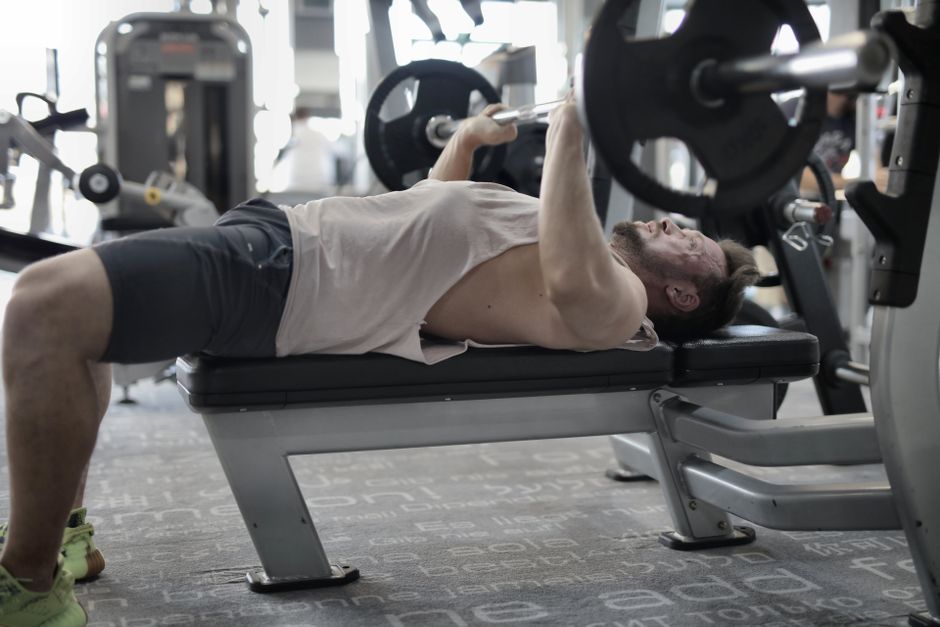
To do a bench press, you lie on a flat bench, grip a barbell at shoulder width, lower it to your mid-chest, and press it back up until your arms are straight. This is a compound exercise that works your chest, shoulders, and triceps. The key is controlled movement, proper breathing, and keeping your body stable throughout the lift. Done correctly, it is one of the most effective upper body strength exercises you can do.
What Is the Correct Setup for a Bench Press?
Your setup determines how safe and effective your bench press will be. Lie flat on the bench with your eyes directly under the barbell. Plant your feet firmly on the floor — flat-footed, not on your toes. Your shoulder blades should be pulled back and down, pinched together as if holding a pencil between them.
Grip the bar with your palms facing away from you. Your thumbs should wrap around the bar, not rest on top. This is called a closed grip and it prevents the bar from slipping. Your hands should be just outside shoulder width. If your forearms are vertical at the bottom of the lift, your grip width is correct.
Unrack the bar by straightening your arms. Bring the bar over your shoulders, not your face or neck. Take a deep breath and hold it. This creates intra-abdominal pressure that protects your spine. Lower the bar to your mid-chest with control, keeping your elbows at about a 45-degree angle to your body.
How Do You Do A Bench Press With Proper Form?
Proper form is not about how much weight you move. It is about how safely and efficiently you move it. The bar should touch your chest at or just below your nipple line. Do not bounce the bar off your chest. That turns the exercise into a momentum drill and increases injury risk.
Press the bar up in a slight arc back toward the rack position. Your elbows should not flare out to the sides. Flaring puts your shoulder joints in a vulnerable position. Keep your elbows tucked at roughly 45 degrees from your torso. This distributes the load across your chest, shoulders, and triceps evenly.
Exhale as you press the bar up. Do not hold your breath through the entire rep. Breathing out during the hardest part of the lift — the press — is standard. Inhale at the top or during the descent. Keep your hips on the bench. If your hips come up, you are arching too much or the weight is too heavy.
What Are Common Bench Press Mistakes?
Most mistakes come from ego or lack of awareness. Lifting too much weight too soon is the most common error. It leads to poor form, bouncing the bar, and lifting your hips. If your form breaks down before you finish your set, the weight is too heavy.
Another mistake is grip width. A grip that is too wide reduces range of motion and shifts strain to your shoulders. A grip that is too narrow works your triceps more than your chest. Find the width that lets your forearms stay vertical at the bottom of the movement.
Not using leg drive is also common. Your legs are not just for balance. Pushing your feet into the floor creates tension through your entire body. This tension helps you press more weight safely. Without leg drive, your upper body does all the work and your form suffers.
- Bouncing the bar off your chest turns the lift into a rebound exercise. It reduces muscle work and can crack your ribs.
- Lifting your head to watch the bar strains your neck. Keep your head on the bench.
- Uneven grip or bar path leads to one side working harder. Check your grip before each set.





How Does the Bench Press Compare to Other Chest Exercises?
The bench press is not the only way to build chest strength, but it is one of the most efficient. It allows you to load more weight than dumbbell presses or push-ups. That makes it ideal for building raw strength. However, it is not superior for everyone in every situation.
Dumbbell presses allow a greater range of motion and reduce the risk of muscle imbalances. Push-ups are safer for people with shoulder issues and require no equipment. Cable flyes isolate the chest with constant tension. Each exercise has a place.
Current research suggests that varying your chest exercises produces better long-term results than doing only bench press. Your muscles adapt to repeated stress. Changing the angle, load, or equipment keeps them responding. A balanced program includes flat bench, incline press, and some form of fly or push-up variation.
| Exercise | Primary Muscles | Equipment Needed | Best For |
|---|---|---|---|
| Barbell Bench Press | Chest, shoulders, triceps | Barbell, bench, rack | Maximal strength |
| Dumbbell Bench Press | Chest, shoulders, triceps | Dumbbells, bench | Range of motion |
| Push-Up | Chest, shoulders, core | None | Bodyweight strength |
| Cable Fly | Chest | Cable machine | Isolation |
What Does the Research Say About Bench Press Safety?
Studies have found that the bench press has a higher injury rate than many other upper body exercises. The most common injuries involve the shoulder, specifically the rotator cuff and labrum. Most of these injuries are caused by poor form, excessive weight, or lack of warm-up.
Research shows that using a spotter or safety bars significantly reduces the risk of injury. A spotter can help you lift the bar if you fail mid-rep. Safety bars in a power rack catch the bar if you drop it. Never bench press alone with collars on the bar — if you fail, you cannot tilt the bar to dump the weights.
Some studies suggest that the decline bench press places less stress on the shoulder joint compared to flat or incline. However, decline presses also activate less of the upper chest. As of 2026, most exercise scientists recommend flat bench press as the primary choice for most lifters, provided form is correct and load is managed.
How Should You Progress With the Bench Press?
Progression means adding weight, reps, or sets over time. Do not add weight every session. Your body needs time to adapt. A common approach is to add 2.5 to 5 pounds per week if you can complete all your reps with good form. If you cannot, stay at the same weight until you can.
Track your sets and reps. Write them down. Without a record, you are guessing. Most programs use 3 to 5 sets of 5 to 10 reps for strength and muscle growth. If you are training for pure strength, lower reps with heavier weight works better. If you want muscle size, moderate weight with more reps is effective.
Deload weeks are important. Every 4 to 6 weeks, reduce your weight by 40 to 60 percent for a week. This allows your joints and nervous system to recover. Lifters who skip deloads often stall or get injured. Progress is not linear. Some weeks you will feel strong. Some weeks you will not. That is normal.
Common Misconceptions About the Bench Press
A common myth is that the bench press is a dangerous exercise that should be avoided. The truth is that any exercise is dangerous with poor form. The bench press is safe for most people when done correctly. If you have a pre-existing shoulder injury, consult a physical therapist before benching.
Another misconception is that you need to touch your chest with every rep. This is true for a full range of motion. But if you have shoulder pain at the bottom, stopping an inch above your chest is acceptable. Partial reps are better than no reps. Do not force a range of motion that hurts.
Some people believe that arching your back is cheating. A slight arch is normal and safe. It protects your shoulders and allows you to press more weight. The key is keeping your hips on the bench. If your butt lifts off, your arch is excessive and you are risking lower back injury.
Frequently Asked Questions
How often should I bench press per week?
Most people do well benching 1 to 3 times per week. Frequency depends on your recovery and goals.
Should I touch the bar to my chest on every rep?
Yes, if you can do so without pain. Touching your chest ensures a full range of motion.
Can bench press cause shoulder pain?
Yes, if form is poor or the weight is too heavy. Keeping elbows tucked and warming up properly reduces this risk.
What is the best grip width for bench press?
Shoulder width plus a hand width on each side is a good starting point. Adjust until your forearms are vertical at the bottom.
