
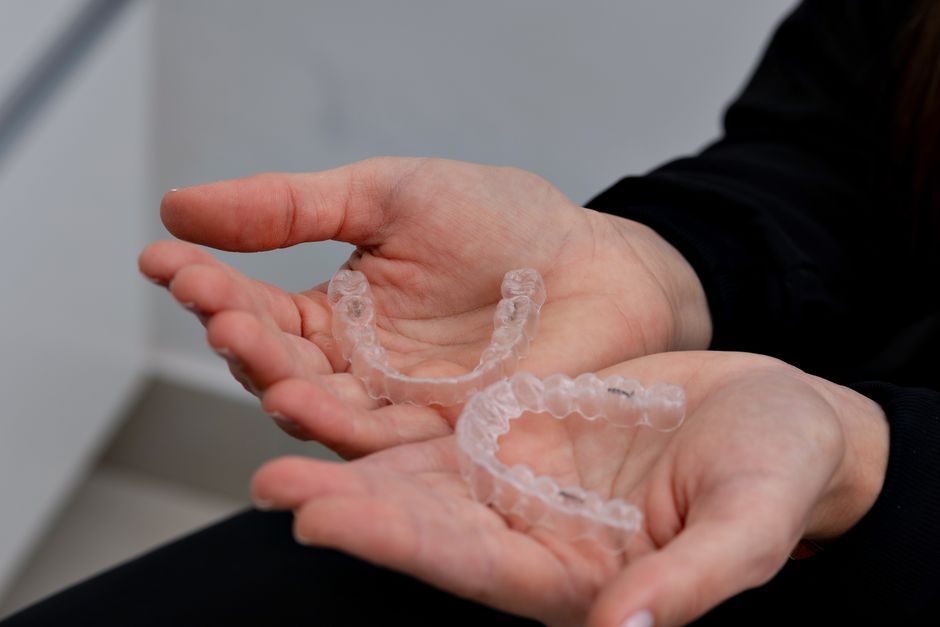
Invisible aligners straighten teeth by applying a series of precisely controlled, gentle forces that gradually move teeth into new positions over time. Unlike traditional metal braces, which use brackets and wires, clear aligners are custom-made plastic trays that fit snugly over your teeth. Each tray in the series is slightly different, and wearing them in sequence shifts your teeth step by step toward the final planned alignment.
How Do Invisible Aligners Straighten Teeth?
The process relies on consistent, low-level pressure. When you wear an aligner, it fits tightly over your teeth and pushes against them in specific directions. That pressure stimulates the bone around each tooth root. Your body responds by remodeling that bone — breaking it down on one side and building it up on the other. This is the same biological process that moves teeth with braces.
Each aligner is worn for about one to two weeks before you switch to the next one. The exact schedule depends on your treatment plan. Every new tray moves the teeth a small amount, typically less than a quarter of a millimeter. Over months, those small movements add up to significant repositioning.
What Makes Aligners Different from Braces?
The main difference is how the force is applied. Braces use a fixed wire that runs through brackets attached to each tooth. The orthodontist adjusts the wire periodically to change the direction and amount of force. Aligners use a series of removable trays, each designed to move teeth a specific way. No wire adjustments are needed because each new tray does the work.
Aligners are also removable. You take them out to eat, drink, brush, and floss. This makes oral hygiene easier during treatment. With braces, food gets trapped around brackets and wires, which raises the risk of cavities and gum inflammation. With aligners, you can clean your teeth normally — as long as you are disciplined about wearing the trays the recommended hours per day.
However, removability is also the biggest risk. Aligners only work if you wear them consistently. Most treatment plans require 20 to 22 hours of wear per day. Taking them out too often or for too long slows progress and can even cause teeth to shift backward.
What Happens During Treatment?
Treatment begins with a full dental evaluation. Your dentist or orthodontist takes impressions, X-rays, and photographs of your teeth. These images are used to create a 3D digital model of your mouth. From that model, a computer generates your custom treatment plan — showing the starting position, the final position, and every step in between.
Once the plan is approved, all of your aligners are manufactured at once. You receive them in sealed packets, each labeled with the order in which they should be worn. You wear each tray for the prescribed duration, then move to the next one. You visit your provider every six to eight weeks so they can check your progress and confirm your teeth are tracking as planned.
Mild discomfort is common in the first few days of a new tray. You may feel pressure, soreness, or tenderness when chewing. This is a sign that the aligner is working — the teeth are moving. The discomfort usually fades within a few days as your mouth adjusts.





What Can Invisible Aligners Fix?
Aligners can treat many of the same issues as traditional braces. These include:
- Crowded teeth
- Gaps between teeth
- Overbites
- Underbites
- Crossbites
- Open bites
That said, aligners are not right for every case. Severe rotations, large vertical movements, or complex bite issues may require braces or other appliances instead. Your provider should be honest about whether aligners can achieve the result you want. If a case is too complex, a referral to an orthodontist is the appropriate step.
It is also worth noting that aligners move the crowns of the teeth well, but controlling the roots is harder. Root position matters for long-term stability. This is one reason why a qualified provider — not a mail-order kit — should plan your treatment.
Do At-Home Aligners Work?
Direct-to-consumer aligner companies let you take your own impressions at home and receive aligners by mail without an in-person exam. The marketing is appealing: lower cost, no office visits, and convenience. But the evidence does not support the same safety and effectiveness profile as provider-led treatment.
No clinical guidelines currently exist for remote-only orthodontic treatment. The American Association of Orthodontists has publicly warned against it. The concern is not the aligners themselves — it is the lack of supervision. Teeth move through bone, and moving them incorrectly can damage the roots, the gums, or the bite. X-rays are needed to check for issues that cannot be seen from the surface, such as impacted teeth, root resorption, or bone loss.
Some research suggests that mild cases can be treated successfully with remote monitoring. But the studies are limited, and the risk of complications is real. If you are considering at-home aligners, understand that you are accepting a different level of oversight. For any significant crowding, bite problem, or history of dental issues, in-person care is the safer choice.
How Long Does Treatment Take?
Most aligner treatments take 6 to 18 months. Mild cases may finish in as little as 4 to 6 months. More complex cases can take 2 years or longer. The total time depends on the severity of the misalignment, how consistently you wear the trays, and how well your teeth respond to movement.
After the active phase, you will need a retainer. Retainers hold the teeth in their new positions while the surrounding bone and gum tissue stabilize. Without a retainer, teeth naturally drift back toward their original positions. This relapse can happen quickly — within months in some cases. Plan on wearing a retainer long-term, often at night, to preserve your results.
What Are the Risks and Side Effects?
Aligners are generally safe when treatment is planned and supervised by a qualified professional. But they are not risk-free. Common side effects include temporary discomfort, minor speech changes, and increased saliva production during the first few days of each new tray.
More serious risks include:
- Tooth decay from poor hygiene while wearing trays
- Gum inflammation from plaque buildup
- Root resorption — shortening of the tooth roots
- Bite problems if teeth are not moved in the right sequence
- Teeth not tracking as planned, requiring refinements or a switch to braces
These complications are more likely when treatment is not properly supervised. They are also more likely when patients do not wear their aligners as directed. If your teeth are not tracking, your provider can adjust the plan. Ignoring the problem only makes it worse.
Do Aligners Hurt?
Some pressure and soreness is normal, especially in the first few days of a new tray. This is the same sensation people feel with braces after an adjustment. Over-the-counter pain relievers can help if needed. The discomfort usually subsides within 3 to 5 days as your teeth and gums adapt.
Severe or persistent pain is not normal. If you experience sharp pain, pain that lasts more than a week, or pain that does not improve with the next tray, contact your provider. It may indicate that the aligner is not fitting properly or that something else is wrong.
How Much Do Invisible Aligners Cost?
The cost of invisible aligners varies widely. In-office treatment with a dentist or orthodontist typically ranges from $3,000 to $8,000. At-home aligner companies may charge $1,500 to $3,000. The lower price reflects the reduced overhead — not necessarily a lower-quality product.
Dental insurance rarely covers orthodontic treatment for adults. Some plans offer partial coverage, but most do not. Flexible spending accounts and health savings accounts can often be used to pay for aligners. Some providers offer payment plans. Ask for a full breakdown of costs before starting treatment, including the cost of refinements, retainers, and any follow-up visits.
Frequently Asked Questions
How long do you wear each set of aligners?
Most providers recommend wearing each set for 1 to 2 weeks before switching to the next one. Your exact schedule depends on your treatment plan.
Can you eat with invisible aligners in?
No, you should remove your aligners before eating or drinking anything other than water. Food can get trapped inside the trays and cause cavities.
Do invisible aligners work as well as braces?
Aligners work well for mild to moderate cases of crowding, gaps, and some bite issues. Severe cases may still require traditional braces for the best result.
Will my teeth stay straight after aligner treatment?
Teeth naturally shift over time, so you will need to wear a retainer after treatment. Most people wear their retainer at night to keep their teeth in place.
