

Vaping can stain teeth, though usually less severely and more slowly than cigarette smoking. The stains come from two sources: nicotine and the flavoring chemicals in e-liquids, which can leave a yellowish film on tooth enamel over time. If you vape daily, you are exposing your teeth to staining compounds with every session.
Does Vaping Stain Teeth?
Yes, vaping can stain teeth. The evidence is not as extensive as the research on cigarette staining, but the mechanism is well understood and consistent with what dentists report in practice.
Nicotine itself is colorless when pure. But when it oxidizes — which happens naturally when exposed to air and light — it turns yellow-brown. That oxidized nicotine is what you are inhaling and depositing on your teeth with every puff. Even e-liquids labeled “clear” contain nicotine that will darken over time.
Flavoring agents add to the problem. Many e-liquid flavors contain the same types of pigments and chemical compounds found in coffee, tea, and wine — all known to stain enamel. Vanilla, caramel, chocolate, and berry flavors tend to be the worst offenders because of the organic compounds they contain.
The staining process is gradual. Most vapers will not notice significant discoloration within weeks. Over months and years, though, the accumulation becomes visible, particularly along the gum line and in the crevices between teeth where the film is harder to brush away.
How Does Vaping Cause Tooth Discoloration?
Tooth enamel is not perfectly smooth. At a microscopic level, it has tiny pores and ridges. Staining agents in e-liquid vapor settle into these irregularities and bond to the enamel surface.
Unlike cigarette tar, which is thick and dark and coats teeth quickly, e-liquid residue is thinner. It builds up more slowly. But it still accumulates.
There is a second mechanism at work that many people do not consider. Vaping reduces saliva production in the mouth. Saliva is your mouth’s natural cleaning system — it washes away food particles, neutralizes acids, and dilutes staining compounds before they can settle. When saliva flow drops, those protective effects weaken.
Propylene glycol and vegetable glycerin, the two main ingredients in e-liquid, are both hygroscopic. That means they absorb moisture. When they coat the mouth and throat, they pull moisture away from oral tissues, contributing to dry mouth. Less saliva means more staining and more bacterial activity.
This is the non-obvious part: the staining is not just about what is in the vapor. It is also about what the vapor displaces. A dry mouth stains faster than a well-hydrated one.
Is Vaping Worse Than Smoking for Your Teeth?
No. Cigarette smoking causes more severe and faster tooth discoloration than vaping. The tar and combustion byproducts in cigarette smoke are far more concentrated staining agents than anything in e-liquid vapor.
But “not as bad as cigarettes” is not the same as “safe for teeth.” The comparison matters because many people switch to vaping specifically to reduce harm. That switch likely does reduce staining compared to continued smoking. It does not eliminate it.
Smoking also damages gums and bone structure through reduced blood flow, impaired healing, and direct toxic effects on periodontal tissue. Vaping’s effects on gum health are less well studied, and the evidence that exists is mixed. Some studies suggest vaping may increase inflammation markers in gum tissue. Others have not found a clear connection. The research is still developing.
What is clear: neither smoking nor vaping is neutral for oral health. If you are choosing between the two, vaping appears to cause less staining. If you are choosing between vaping and neither, neither is better for your teeth.
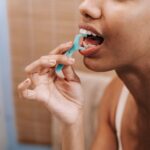




What Other Oral Health Problems Does Vaping Cause?
Staining is the most visible issue, but it is not the only one.
- Dry mouth: Reduced saliva flow is common among regular vapers. Chronic dry mouth raises the risk of cavities because saliva normally buffers acids and remineralizes enamel.
- Gum irritation: Some vapers report bleeding gums or gum sensitivity. The evidence linking vaping directly to gum disease is not yet strong enough to state a confirmed cause-and-effect relationship, but dentists do report these symptoms in vaping patients.
- Increased cavity risk: The combination of dry mouth and the sugary flavorings in some e-liquids creates conditions that favor cavity-causing bacteria. Research on this is ongoing.
- Bad breath: The residue left by e-liquid vapor can contribute to halitosis, especially when combined with dry mouth.
- Mouth irritation: Some users develop irritation on the roof of the mouth or throat from the heat and chemicals in vapor. This is usually temporary but can become chronic with heavy use.
The mouth is often the first place health effects show up because it is directly exposed to whatever you inhale. Dentists are frequently the first to notice changes in patients who vape.
Can You Remove Vape Stains From Your Teeth?
Yes, in most cases. Vape stains are surface stains, which means they respond well to cleaning.
Regular brushing with a fluoride toothpaste removes some of the film before it sets. But once stains have bonded to enamel, brushing alone will not fully remove them. This is true for coffee and tea stains as well.
Professional dental cleaning is the most reliable way to remove surface stains. A dental hygienist uses specialized tools and polishing agents that reach into the microscopic pits where stains collect. Most people see a noticeable difference after a single cleaning.
Whitening treatments — either in-office or at-home — can also lighten stained enamel. However, whitening does not work on stains below the surface, and it does not prevent new stains from forming. If you continue vaping, the stains will return.
There is no evidence that any toothpaste, mouthwash, or home remedy specifically removes vape stains better than it removes other surface stains. Marketing claims about “vape stain removal” products are not backed by clinical trials.
How Can You Reduce Staining If You Vape?
The most effective way to prevent vape staining is to stop vaping. That is the straightforward answer, and it is worth stating plainly before listing anything else.
If you are not ready to stop, some practical steps may reduce the rate of staining:
- Stay hydrated. Drinking water throughout the day helps maintain saliva flow and rinses away residue before it settles.
- Brush twice daily and floss. This is standard advice for everyone, but it matters more when you are regularly exposing your teeth to staining compounds.
- Rinse with water after vaping. A quick swish and spit can remove some of the film before it bonds to enamel.
- Choose lighter-colored e-liquids. Darker liquids tend to contain more pigments and flavoring compounds that stain. This is a reasonable inference from how staining works, though no controlled study has directly compared stain severity across e-liquid colors.
- Get regular dental cleanings. Professional cleaning every six months removes surface stains before they become more difficult to address.
None of these steps eliminate staining. They reduce the rate at which it happens. The only way to stop it completely is to stop the exposure.
Do Dentists Notice Vaping Stains?
Many do. Dentists and dental hygienists are trained to look for patterns of discoloration and tissue changes that suggest tobacco or nicotine use. The staining pattern from vaping tends to be more diffuse and lighter than the heavy brown staining seen with cigarettes, but it is still noticeable to a trained eye.
Some dental professionals also report seeing a distinct film or coating on the teeth of regular vapers — particularly along the gum line and on the back of the front teeth. This film is not always visible to the patient but becomes apparent during a cleaning.
If you vape and your dentist has not mentioned anything, that does not mean there is no staining. Early staining can be subtle. It is worth asking directly at your next appointment.
Does Nicotine-Free Vaping Stain Teeth?
Nicotine-free e-liquids can still stain teeth, though likely less than nicotine-containing ones. The flavoring compounds and pigments in e-liquid are independent of nicotine, and those are significant contributors to staining.
That said, the evidence here is limited. No large clinical study has directly compared staining from nicotine-free versus nicotine-containing e-liquids over time. The biological reasoning is sound — if the pigments and organic compounds are present, they can deposit on enamel — but biological plausibility is not the same as demonstrated clinical effect.
What can be said with confidence: nicotine-free vaping removes one staining agent from the equation. It does not remove all of them.
Frequently Asked Questions
Does vaping stain your teeth permanently?
No, vape stains are surface stains and can usually be removed with professional dental cleaning or whitening. They will return if you continue vaping.
How long does it take for vaping to stain teeth?
There is no established timeline. Most people will not notice visible staining within weeks, but discoloration tends to become apparent over months to years of regular use, depending on oral hygiene and other habits.
Is vaping worse than coffee for staining teeth?
No, coffee is generally a stronger and faster staining agent than e-liquid vapor. That does not mean vaping is stain-free, only that the comparison favors coffee as the more aggressive stainer.
Can vaping cause yellow teeth even if you brush regularly?
Yes. Brushing removes some surface film but cannot fully prevent stains from bonding to enamel over time, especially when vaping reduces saliva flow.
