
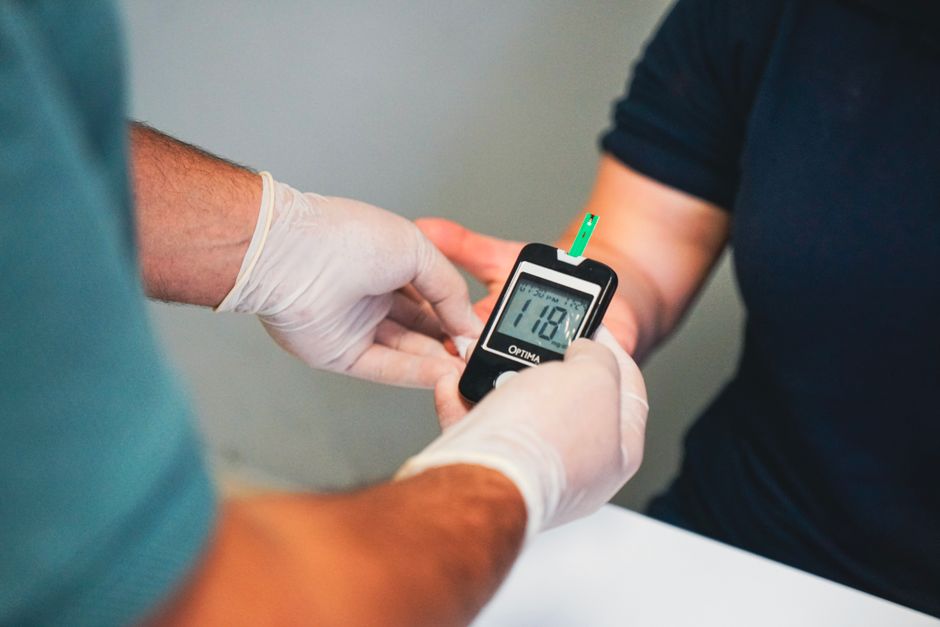
Expired blood glucose test strips tend to read falsely high, not low. The chemistry that turns glucose into a measurable signal keeps running after the strip’s expiration date, and that drift usually pushes results upward. A high reading from an expired strip can be dangerous because it may prompt someone to take insulin they do not need. The safest approach is to check the expiration date before every test and replace any strip that is past it.
Why Do Expired Test Strips Usually Read High?
Most test strips use an enzyme called glucose oxidase or glucose dehydrogenase to convert glucose in a blood sample into an electrical signal. The strip’s reagents are calibrated to produce a predictable response. Over time, those reagents degrade.
As the enzyme and other chemicals break down, the strip’s response becomes less reliable. In many designs, the degradation shifts the reading upward rather than downward. That is the general pattern, but it is not a universal rule. Different strip chemistries and storage conditions can produce different failure modes, and some expired strips read low or simply fail to give a result at all.
The key point is that an expired strip is unreliable in a direction you cannot predict with confidence. You cannot correct for the error because you do not know how far off it is. A strip that reads 40 points high and a strip that reads 40 points low look identical on the meter display. The number appears with the same authority either way.
Do Expired Blood Glucose Test Strips Read High Or Low?
High is the more common direction, but “unreliable” is the more accurate answer. The reagent degradation that happens past the expiration date generally skews results upward, yet the size of the error varies. Some strips drift only slightly. Others fail badly. A few produce error codes and no reading at all.
This matters because the direction of the error changes what a person might do. A falsely high reading could lead someone to take extra insulin, which risks hypoglycemia. A falsely low reading could lead someone to eat more sugar than needed or skip a dose. Neither is safe when the true glucose level is unknown.
Manufacturers set expiration dates based on stability testing. The date reflects the period during which the strip is expected to stay within its labeled accuracy range under proper storage. Past that date, no accuracy guarantee holds. That is not a marketing buffer. It is the point at which the manufacturer can no longer vouch for the reading.
What Happens to Test Strips Over Time?
Test strips are sensitive chemical and biological products. Several things degrade them, and expiration is only one factor.
- Enzyme breakdown. The glucose-converting enzyme loses activity over time, especially once the vial is opened and exposed to air.
- Moisture. Humidity is one of the fastest ways to ruin strips. Even brief exposure to damp air can damage the reagents.
- Heat. Storing strips in a hot car, a bathroom, or near a stove accelerates degradation.
- Light. Some strip chemistries are light-sensitive.
- Contamination. Touching the test area or leaving the vial open lets in moisture and dirt.
The expiration date assumes the strip was stored correctly the whole time. A strip that expired last month but sat in a hot glove compartment is likely in worse shape than its date suggests. A strip stored cool and dry may hold up better, but that does not make it safe to use past its date. You still have no way to know how far the reading has drifted.



How Accurate Are Blood Glucose Meters in General?
Even fresh, correctly stored strips are not perfectly accurate. This is important context for anyone worried about expired strips.
Regulatory standards allow a margin of error for home glucose meters. Current international guidance, which the US Food and Drug Administration has aligned with, calls for meter results to be within 15 percent of a laboratory value for readings at or above 100 mg/dL, and within 15 mg/dL for readings below 100 mg/dL. That is the accuracy target for strips used within their date and stored properly.
So a meter reading of 150 mg/dL could reflect a true value anywhere in a range around it and still meet the standard. Expired strips add an unknown error on top of that existing margin. The combined uncertainty can be large enough to change a treatment decision.
This is the non-obvious part many people miss: home meters are screening and monitoring tools, not laboratory instruments. They are accurate enough to guide daily decisions when used correctly. They are not precise enough to tolerate an added source of error like an expired strip.
How Should You Store Test Strips So They Last?
Proper storage keeps strips within their accuracy range until the expiration date. The habits below are well established in manufacturer instructions and diabetes education.
- Keep strips in the original vial with the cap closed tightly.
- Store at room temperature, away from heat, direct sunlight, and moisture.
- Do not store strips in the bathroom, where humidity is high.
- Do not refrigerate or freeze strips unless the manufacturer’s instructions specifically allow it.
- Write the date you open a new vial on the label. Many vials have a shorter use-by window after opening than the printed expiration date.
- Take a strip out and close the cap right away. Do not leave the vial open.
- Do not use strips that look discolored or damaged.
The after-opening window is easy to overlook. A vial may carry an expiration date a year out, but the manufacturer may specify that strips must be used within a shorter period once the vial is opened. Check the vial label or package insert for that number. It varies by product, so there is no single figure that applies to all strips.
Can You Still Use Expired Strips in an Emergency?
No clinical guidelines endorse using expired strips, even when fresh ones are unavailable. The evidence does not support it, and the direction and size of the error are unknown.
If you find yourself without valid strips, the safer path is to get fresh ones. If that is not possible and you must rely on an expired strip, treat the result as a rough signal only, not a number you act on with insulin or other dose adjustments. Confirm with a fresh strip or a meter with valid strips as soon as you can.
For anyone who takes insulin or a medication that can cause low blood sugar, acting on an unreliable reading carries real risk. Symptoms of low blood sugar — shakiness, sweating, confusion, rapid heartbeat — should be treated according to your care plan regardless of what an expired strip shows. When in doubt about a reading, contact a clinician or pharmacist rather than adjusting medication based on a number you cannot trust.
What Should You Do With Expired Strips?
Replace them. Expired strips should not be used for decisions about insulin, food, or activity. Check the expiration date on the vial before each test, and check the after-opening date if the manufacturer provides one.
Dispose of expired strips according to local rules for medical waste or household trash, following the package instructions. Do not keep them “just in case.” A strip you cannot trust is worse than no strip, because it gives you a number that looks authoritative when it is not.
If you are unsure whether a strip is still good, the expiration date and the after-opening window are your guides. When either has passed, the strip is out of its accuracy guarantee. That is the honest position, and it is the one that protects your health.
Frequently Asked Questions
Do expired blood glucose test strips read high or low?
They most often read falsely high because the strip’s reagents degrade in a way that shifts results upward. However, the direction and size of the error vary, so an expired strip is simply unreliable.
Can I use test strips a few months past the expiration date?
No, because the manufacturer’s accuracy guarantee ends at the expiration date and the error is unknown. Replace expired strips rather than guessing how far off the reading is.
Why do my test strips expire even if the vial is unopened?
The reagents degrade slowly over time regardless of whether the vial has been opened. The expiration date reflects the period the manufacturer can confirm the strip stays within its accuracy range.
How accurate are home blood glucose meters?
Current standards call for results within 15 percent of a lab value at or above 100 mg/dL and within 15 mg/dL below 100 mg/dL. That margin applies to fresh, properly stored strips, not expired ones.
