
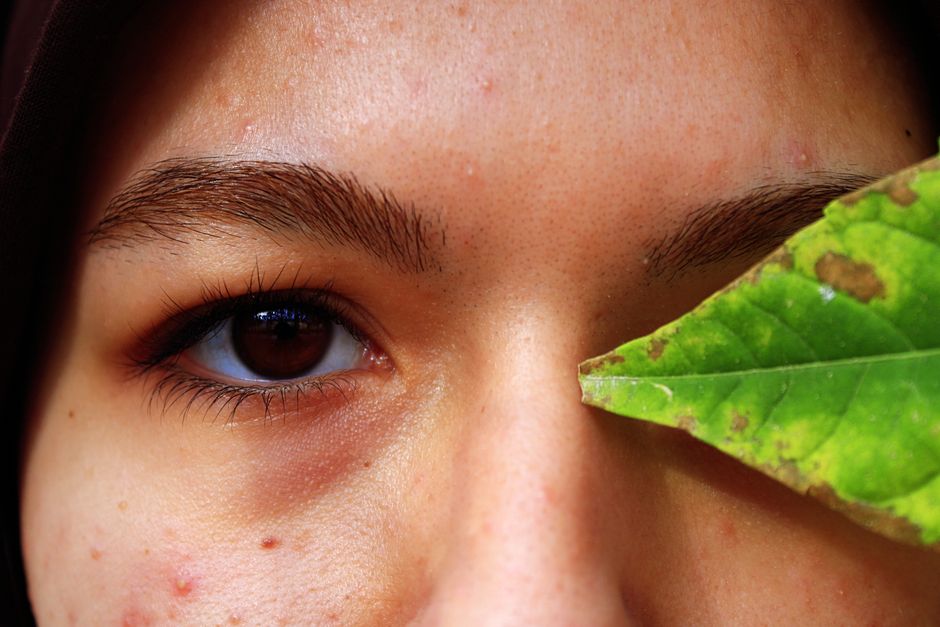
Yes — two brown-eyed parents can have a blue-eyed child. It is uncommon, but it happens, and the reason comes down to how eye color is actually inherited. The old story that brown eyes always dominate blue eyes is a simplification. Eye color is controlled by several genes working together, not one switch.
Most people are taught in school that brown is dominant and blue is recessive. That model is not wrong so much as incomplete. It explains many families, but it fails to explain plenty of others. Understanding why takes a closer look at the genetics and the biology behind the color itself.
What Determines Eye Color?
Eye color comes from melanin, the same pigment that colors your skin and hair. The iris has two layers of tissue, and the amount and distribution of melanin in those layers produces the color you see.
People with blue eyes have very little melanin in the front layer of the iris. Their eyes are not actually blue from pigment. The blue comes from the way light scatters off the tissue, a phenomenon called Rayleigh scattering — the same effect that makes the sky look blue. Brown eyes contain more melanin. Green and hazel eyes fall somewhere in between, with different combinations of pigment amount and light scattering.
One detail that surprises many people: everyone’s eyes contain the same basic pigment cells. What differs is how much melanin those cells produce. Eye color is a matter of quantity and placement, not a different kind of pigment.
Is Eye Color Really Just One Gene?
No. For decades, the standard explanation was that a single gene with two versions — brown and blue — controlled eye color. That model is now known to be too simple.
The main gene involved is called OCA2, and variations near it account for a large share of the variation in eye color. But researchers have identified many other genes that also influence eye color, including HERC2, which helps regulate OCA2, and others with smaller effects. This is why eye color runs in families in patterns that do not always follow simple rules.
When multiple genes each contribute a small effect, the outcome depends on the combination a child inherits. Two parents can each carry gene variants for lighter eyes without showing them, and a child can inherit a combination that produces blue eyes. This is the core reason two brown-eyed parents can have a blue-eyed child.
Can Two Brown Eyes Make a Blue-Eyed Baby?
Yes, it is possible. The chance is generally low, but it is real.
Consider a simplified example. Suppose each parent has one brown-eye version and one blue-eye version of the main gene, and the brown version is dominant. Each parent would have brown eyes. But each could pass the blue version to a child. If both do, the child could have blue eyes. Under that simplified model, the chance would be about one in four for each child.
Real inheritance is messier than that example. Because several genes are involved, actual probabilities vary from family to family and cannot be calculated from eye color alone. Some couples with two brown-eyed parents will have a higher chance than others, depending on the gene variants they carry.
What can be said with confidence is this: brown-eyed parents having a blue-eyed child is well documented and does not indicate anything unusual about the family. It is a normal outcome of how multiple genes combine.





Why Did the Old “Brown Always Wins” Rule Stick Around?
The single-gene model was taught for so long because it fit many families and was easy to explain. It gave clean predictions, and clean predictions are memorable.
The problem is that it treated a complex trait as if it were a simple one. When a brown-eyed couple had a blue-eyed child, the old model labeled it an exception. In reality, the model was the thing that was incomplete. Modern genetics research has shown that eye color involves many genes, each contributing a piece.
This is a common pattern in genetics. Traits that seemed straightforward — eye color, height, even some aspects of personality — usually turn out to involve many genes and environmental factors. The simple version gets taught first because it is easier to grasp, and the full picture arrives later.
What About Green and Hazel Eyes?
Green and hazel eyes come from intermediate amounts of melanin combined with light scattering. They do not fit neatly into a brown-versus-blue framework at all.
Two brown-eyed parents can also have a green-eyed or hazel-eyed child. So can two blue-eyed parents, though that combination is less common. These outcomes are harder to predict than blue from brown because the underlying pigment combinations are more varied.
If you are trying to guess a child’s eye color from the parents’ eye colors, the honest answer is that you can only speak in general tendencies. Exact prediction is not possible with current knowledge.
Can Two Blue-Eyed Parents Have a Brown-Eyed Child?
It is possible, though less commonly discussed. The same logic applies in reverse: because multiple genes are involved, two blue-eyed parents can occasionally have a child with darker eyes.
This surprises people who learned the simple dominant-recessive model, where blue plus blue should always produce blue. The fuller genetic picture allows for exceptions in both directions. They are uncommon, but they are documented.
If you have heard someone insist that a certain eye-color outcome is “impossible,” that claim is stronger than the science supports. Eye color inheritance is probabilistic, not deterministic.
Do Eye Color Calculators and Predictions Work?
Online eye color calculators and prediction tools give rough estimates based on simplified genetic models. They can be entertaining, but they should not be treated as reliable forecasts.
These tools typically rely on the single-gene model or a slightly expanded version of it. They do not account for the full set of genes now known to influence eye color, and they cannot know which variants a specific couple carries. A prediction of “0% chance of blue eyes” from such a tool would be misleading.
Genetic testing can reveal some information about eye color variants, but even that does not provide a precise probability for a future child. The trait is too polygenic — influenced by too many genes — for that level of certainty.
Does Eye Color Change Over Time?
Yes, especially in infancy. Many babies are born with blue or grayish eyes, and the color can shift over the first months of life as melanin production increases. This is normal and expected.
Most of this change happens in the first year, though some subtle shifts can occur later. By adulthood, eye color is generally stable. Changes in eye color in adults can sometimes signal a medical issue and are worth mentioning to a doctor, but gradual minor variation is common and usually harmless.
The Bottom Line
Two brown-eyed parents can absolutely have a blue-eyed child. Eye color is shaped by multiple genes and by how much melanin develops in the iris, not by a single dominant-versus-recessive switch. The old classroom model captured part of the truth, but the real biology is richer and less predictable.
If you are a brown-eyed couple with a blue-eyed child, nothing about that outcome is a red flag. It is simply genetics doing what genetics does: combining in ways that do not always follow the simplest rule.
Frequently Asked Questions
Can two brown-eyed parents have a blue-eyed baby?
Yes, it is possible, though generally uncommon. Eye color is influenced by several genes, so two brown-eyed parents can each pass on variants that produce blue eyes in a child.
What is the chance of two brown-eyed parents having a blue-eyed child?
The chance varies by family and cannot be calculated from eye color alone. Under a simplified model it might be around one in four, but real probabilities depend on the specific gene variants each parent carries.
Is eye color controlled by one gene or many?
Many genes influence eye color, with OCA2 and HERC2 playing major roles. The single-gene model taught in schools is an oversimplification.
Can two blue-eyed parents have a brown-eyed child?
It is possible, though less common. Because multiple genes are involved, exceptions can occur in either direction.
