
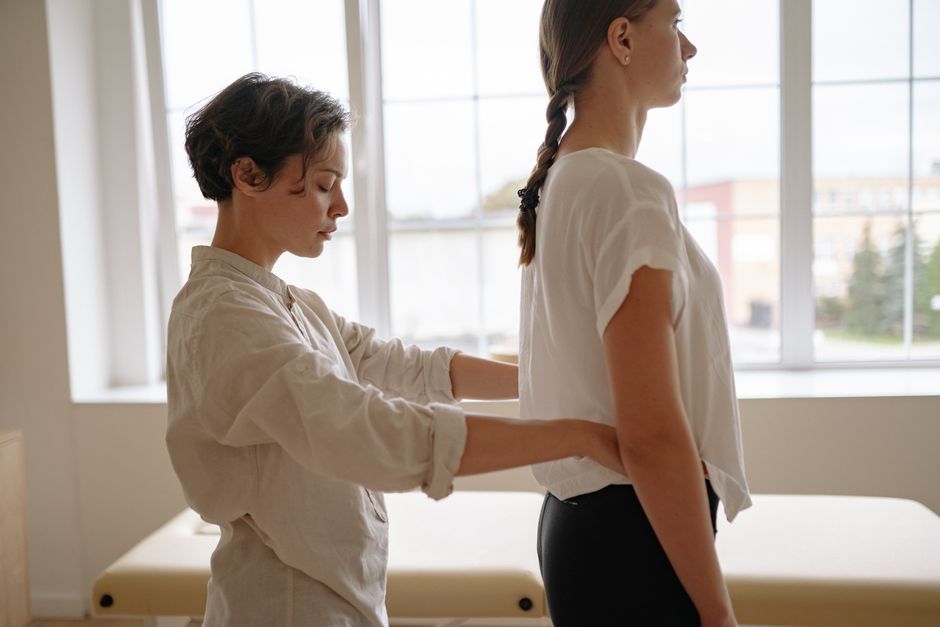
Kyphosis is a forward curve of the upper spine. Many people worry that this curve is permanent and unchangeable. The truth is that treatment depends entirely on the cause, your age, and how severe the curve is. Some forms of kyphosis can be fully corrected. Others can be managed but not completely reversed. Most people with kyphosis do not need surgery, and many improve significantly with physical therapy and posture training.
What Exactly Is Kyphosis and When Is It a Problem?
Your spine naturally curves inward at the neck and lower back, and outward at the upper back. That outward curve in the upper back is called kyphosis. A normal thoracic curve falls between 20 and 45 degrees. When the curve exceeds 50 degrees, doctors consider it hyperkyphosis, which is what most people mean when they say kyphosis.
Mild curves are common and often cause no symptoms at all. Problems arise when the curve is severe enough to cause back pain, stiffness, breathing difficulty, or visible postural changes that affect daily life. The term “dowager’s hump” refers to the visible bump at the base of the neck that appears with some types of kyphosis, particularly in older adults with osteoporosis.
Not every rounded upper back is true kyphosis. Poor posture can create a similar appearance, but postural kyphosis is a soft curve that straightens when you lie down or consciously correct your posture. Structural kyphosis, by contrast, involves changes in the vertebrae themselves and does not fully straighten with position changes.
Can Kyphosis Be Cured Treatment Options Explained by Type
Whether kyphosis can be cured depends almost entirely on which of the main types you have. The four most common types are postural kyphosis, Scheuermann’s disease, congenital kyphosis, and osteoporotic kyphosis. Each behaves differently and responds to different treatments.
Postural kyphosis is the most common and the most treatable. It develops from prolonged poor posture and weak back muscles. This type is fully reversible. A consistent exercise program that strengthens the upper back and stretches the chest can flatten the curve back toward normal. The key is consistency — muscles respond to regular training over weeks and months.
Scheuermann’s disease causes a rigid, structural curve that develops during adolescence. Vertebrae grow unevenly, creating a wedge shape that produces a sharper angle than postural kyphosis. This type cannot be “cured” in the sense that the bone shape will not revert to normal. However, bracing during adolescence can stop progression and sometimes reduce the curve by several degrees. In adults, physical therapy manages pain and improves function, but the structural curve remains.
Congenital kyphosis results from vertebrae that form abnormally before birth. This is the rarest type and the most likely to require surgery. Surgery fuses the abnormal vertebrae to halt progression, but it does not create normal vertebrae — it creates a stable, straighter alignment.
Osteoporotic kyphosis occurs when weakened vertebrae collapse under normal pressure, creating a forward curve. Treatment focuses on preventing further collapse through bone-strengthening medication and fall prevention. Physical therapy helps maintain mobility, but collapsed vertebrae cannot be rebuilt through exercise alone.
What Treatment Options Exist for Kyphosis?
Treatment falls into three broad categories: physical therapy and exercise, bracing, and surgery. Your doctor will recommend one or a combination based on your specific curve and symptoms.
Physical Therapy and Exercise
Physical therapy is the first-line treatment for most adults with kyphosis. The goal is not to force the spine straight but to strengthen the muscles that hold it in better alignment. Exercises typically target the rhomboids, mid-traps, and other muscles between the shoulder blades. Stretching the chest muscles and hip flexors also helps because tightness there pulls the shoulders forward.
Research consistently shows that targeted exercise programs reduce kyphotic angle in adults with postural kyphosis. Studies have also found that exercise improves pain and quality of life in older adults with hyperkyphosis, even when the curve is related to osteoporosis. The improvements are modest — often a few degrees of curve reduction — but they translate into meaningful symptom relief.
No single exercise program has been proven superior to others. The common thread is consistent, progressive strengthening of the upper back and stretching of the front of the chest. A physical therapist can design a program suited to your specific curve and fitness level.
Bracing
Bracing is primarily used for adolescents with Scheuermann’s disease whose bones are still growing. The brace applies pressure to guide growth toward a straighter alignment. Bracing is not effective for adults because their bones have stopped growing and the brace cannot reshape mature bone.
For adults, bracing is sometimes used temporarily for pain relief but does not produce lasting structural change. No evidence supports the idea that a brace worn by an adult permanently reduces kyphotic curvature.
Surgery
Surgery is reserved for severe curves, typically those exceeding 70 to 75 degrees, or curves that cause nerve compression, breathing problems, or pain that does not respond to conservative treatment. The procedure, called spinal fusion, involves realigning the vertebrae and fusing them together with bone grafts and metal hardware.
Surgery is major and recovery takes months. It is not a decision made lightly. Most people with kyphosis never need surgery, and outcomes for conservative management are generally good.





How Does Posture Correction Fit Into Treatment?
Posture is central to kyphosis treatment but is often misunderstood. Correcting posture is not about standing up straighter when you remember to do so. It is about retraining muscle patterns so that a straighter position becomes your default rather than your temporary effort.
The modern lifestyle works against this goal. Desk work, smartphone use, and driving all encourage a forward head and rounded shoulders. Over time, the muscles in the front of the chest shorten and the muscles in the upper back weaken. This imbalance locks the body into a kyphotic posture even when you try to stand tall.
Effective posture training involves both strengthening and awareness. Strengthening exercises build the endurance of upper back muscles so they can hold the spine in better alignment for longer periods. Awareness techniques — such as periodic posture checks during the day — help you notice and correct slumping before it becomes habitual.
Posture correctors worn as clothing or straps are popular, but the evidence for them is limited. They may provide temporary sensory feedback, but they do not strengthen muscles. Once removed, the underlying weakness remains. They are not a substitute for exercise.
What Are the Best Exercises for Kyphosis?
Exercise selection matters less than consistency and proper form. The most effective programs include a mix of strengthening and stretching. Here are the categories of exercises most commonly recommended by physical therapists.
- Scapular retraction exercises — rows, band pulls, and similar movements that squeeze the shoulder blades together
- Thoracic extension exercises — gentle back extensions and chest-openers that encourage the upper spine to move toward neutral
- Chest stretches — doorway stretches and pectoral stretches that release tightness pulling the shoulders forward
- Core stabilization — planks and similar exercises that support overall spinal alignment
There is no universal prescription for how many repetitions or sets to perform. A physical therapist will tailor the program to your current strength and your specific curve characteristics. What matters is that the exercises are performed regularly — daily or several times per week — for at least several months before expecting measurable change.
Some people worry that exercise will worsen their curve or cause injury. For typical postural kyphosis, exercise is safe when performed with proper form. If you have osteoporosis, severe curve, or a history of spinal fracture, you should work with a physical therapist who can modify exercises to avoid flexion of the spine, which increases fracture risk in weakened bone.
Can Kyphosis Worsen Over Time?
Kyphosis can progress, but not always. The pattern of progression depends on the underlying cause. Postural kyphosis tends to remain stable or improve with treatment. Scheuermann’s disease typically stops progressing once skeletal growth is complete. Osteoporotic kyphosis is the type most likely to worsen over time because continued bone loss leads to more vertebral collapses.
Age-related muscle loss also contributes to kyphosis progression. The muscles that hold the spine upright weaken, allowing the curve to increase. This is why strength training becomes more important with age, not less. Maintaining back strength is one of the few modifiable factors that can slow or prevent age-related kyphosis progression.
Regular monitoring is important. If you have kyphosis, your doctor can measure the curve periodically with X-rays to track whether it is changing. Pain that worsens, numbness or weakness in the legs, or difficulty breathing warrant prompt medical evaluation.
When Should You See a Doctor About Kyphosis?
You should seek medical evaluation if you have a visible hump on your upper back, back pain that limits daily activities, or a curve that seems to be getting worse. You should also see a doctor promptly if you experience numbness, tingling, or weakness in your legs, or if you have trouble breathing. These symptoms can indicate nerve compression or severe curve that requires more aggressive treatment.
During evaluation, a doctor will typically perform a physical exam and may order X-rays to measure the curve angle. The forward bend test — bending forward at the waist while the doctor observes your spine from the side — can reveal whether the curve is structural or postural. Structural curves remain prominent when you bend forward, while postural curves tend to flatten.
Early evaluation matters because some causes of kyphosis are more treatable when caught early. Children and adolescents with suspected Scheuermann’s disease benefit from early bracing. Adults with osteoporotic kyphosis benefit from early bone-density testing and treatment to prevent further fractures.
Frequently Asked Questions
Can kyphosis be reversed with exercise?
Postural kyphosis can be fully reversed with consistent exercise and posture training. Structural forms like Scheuermann’s disease cannot be reversed, but exercise can still reduce pain and improve function.
What is the best treatment for kyphosis in adults?
Physical therapy focused on strengthening the upper back and stretching the chest is the standard first-line treatment for adults. Surgery is reserved for severe curves that cause nerve compression, breathing problems, or pain unresponsive to conservative care.
Is kyphosis a serious condition?
Most kyphosis is mild and does not cause serious health problems. Curves exceeding 70 degrees can compress internal organs and cause breathing difficulty, which requires medical treatment.
Can a kyphosis brace fix the curve in adults?
Bracing does not correct kyphosis in adults because the bones have stopped growing. Braces are effective only in adolescents whose spines are still developing.
