
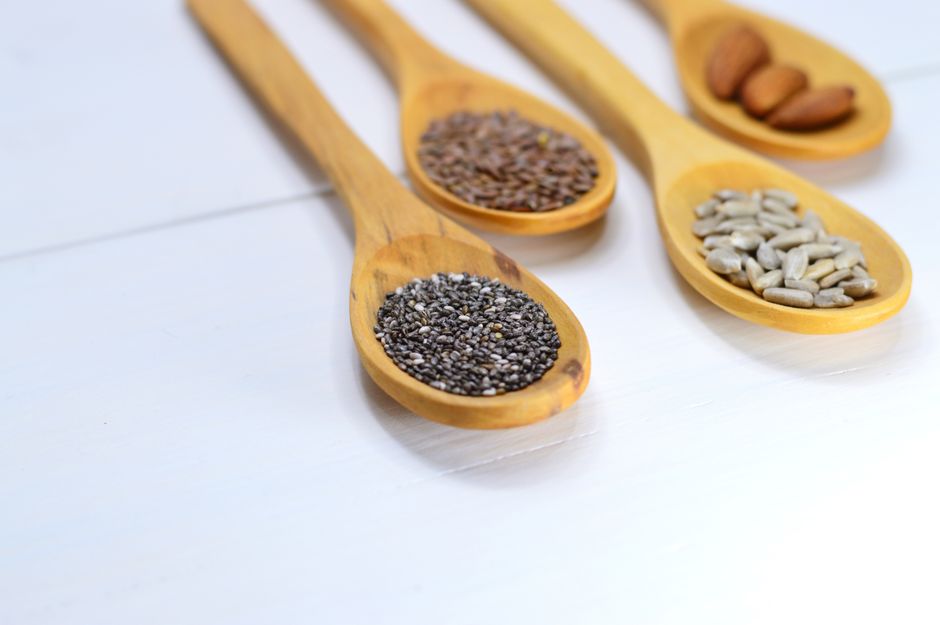
Chia seeds and flax seeds are both good sources of fiber and healthy fat, and both can fit into a weight loss plan. Neither one burns fat or speeds up your metabolism. The better choice for weight loss is the one you will actually use consistently, because the two seeds are close enough in calories and fiber that the difference between them is small.
That is the honest answer. There is no head-to-head evidence showing one seed produces more weight loss than the other. What matters more is how you use them, how much you eat, and what the rest of your diet looks like.
How Do Chia Seeds and Flax Seeds Compare Nutritionally?
The two seeds are nutritionally similar, with a few real differences worth knowing.
Both are high in fiber and rich in alpha-linolenic acid, a plant-based omega-3 fat. Both provide protein and minerals. The table below uses standard USDA nutrient data for a one-ounce (about 28 gram) serving of each seed.
| Nutrient (per 1 oz / 28 g) | Chia seeds | Flax seeds (ground) |
|---|---|---|
| Calories | About 138 | About 150 |
| Total fat | About 8.7 g | About 11.8 g |
| Dietary fiber | About 9.8 g | About 7.7 g |
| Protein | About 4.7 g | About 5.1 g |
| Omega-3 (ALA) | Lower | Higher |
The calorie gap is small. A difference of roughly a dozen calories per serving will not decide whether you lose weight. Fiber is where chia edges ahead slightly, and flax is the stronger source of omega-3 fat.
One detail people miss: whole flax seeds often pass through your digestive tract intact. Your body cannot absorb the nutrients inside a seed it never breaks down. Ground flaxseed, sometimes called flax meal, is what you want if you are eating flax for its fiber and fat. Chia seeds do not have this problem. They can be eaten whole.
Do Chia Seeds Help With Weight Loss?
Chia seeds can support weight loss mainly by helping you feel full, which may lead you to eat less at your next meal. That is a real effect, but it is modest.
When chia seeds meet liquid, they absorb water and form a gel. This expands in your stomach and slows how quickly food empties into your small intestine. The result is a longer feeling of fullness. Chia also delivers a meaningful dose of fiber per serving, and higher fiber intake is consistently linked with better appetite control and lower body weight in large population studies.
What the research does not show is chia as a weight loss driver on its own. Some small trials have looked at chia added to a reduced-calorie diet. Results have been mixed, and several found no meaningful difference in weight compared with a placebo. A review of the evidence reached a similar conclusion: chia may help slightly with appetite, but the data are not strong enough to promise weight loss from chia itself.
Practical use: a spoonful stirred into yogurt, oatmeal, or a smoothie adds bulk and fiber without much effort. Chia pudding made with milk or a milk alternative is another common option. Watch the calories in whatever you mix it with, since those often outweigh the seed itself.
Do Flax Seeds Help With Weight Loss?
Flax seeds work through the same basic mechanism as chia: fiber and fat that slow digestion and support fullness. The evidence for flax specifically is also limited but points in a similar direction.
Ground flaxseed is high in soluble fiber, which forms a gel in the gut. Some studies suggest ground flaxseed added to the diet may reduce appetite and support modest weight change, particularly when it replaces less filling foods. As with chia, the effect is small and depends heavily on the overall diet.
Flax has one advantage worth naming. It is one of the richest food sources of lignans, plant compounds that gut bacteria convert into other active compounds. Whether this translates into weight loss is not established. The research on lignans and body weight is early and not conclusive. It would be wrong to sell flax as a fat burner because of lignans.
Use ground flaxseed, not whole. Store it in the fridge or freezer, because the oils in ground flax go rancid faster than whole seeds. A tablespoon or two stirred into cereal, baked goods, or smoothies is a common way to use it.



Which Is Better for Weight Loss: Chia Seeds or Flax Seeds?
Chia seeds have a slight practical edge for weight loss because they are higher in fiber per serving, form a filling gel easily, and can be eaten whole without grinding. Flax is close behind and offers more omega-3 fat.
The gap between them is small enough that personal preference should decide. If you like chia pudding and it keeps you full until lunch, chia is the better choice for you. If you prefer flax stirred into oatmeal, flax wins. Adherence beats optimization almost every time when it comes to weight loss.
A few honest points that matter more than which seed you pick:
- Both seeds are calorie-dense. A small handful is roughly 140 to 150 calories. Portion size counts.
- Neither seed causes weight loss by itself. They support a calorie-controlled diet; they do not replace one.
- Fiber needs water. Increase fiber gradually and drink enough fluid, or you may end up bloated or constipated.
- Seeds are not a meal. Adding them on top of your usual diet without changing anything else is unlikely to produce weight loss.
If you are choosing based on the chia seeds or flax seeds better for weight loss question alone, chia has a small edge on fiber and convenience. That edge is not large enough to matter if you dislike chia.
How Should You Use These Seeds for Weight Loss?
The way you use the seeds matters more than which one you choose. A few approaches tend to work better than others.
Use them to replace something, not just add to it. Stirring chia into your usual breakfast adds calories. Swapping a sugary cereal for oatmeal with chia and fruit replaces calories with fiber and protein. The second approach supports weight loss; the first mostly adds calories.
Start small. A tablespoon is a reasonable starting amount. Jumping straight to several tablespoons a day can cause bloating and gas, especially if your diet was low in fiber to begin with. Increase gradually over a week or two.
Pair them with protein. Seeds alone are not a filling meal. Chia in Greek yogurt, or flax in a smoothie with protein, keeps you full longer than seeds mixed into juice or water.
Do not rely on seeds as a shortcut. Some popular cleanses and detox drinks use chia or flax and promise rapid results. No clinical evidence supports rapid weight loss from either seed. Weight loss from any food change is gradual, and the seeds are a small part of a larger picture that includes overall diet, activity, and sleep.
Are There Any Risks or Downsides?
Both seeds are generally well tolerated, but there are real cautions.
Chia seeds absorb a large amount of liquid. Eating a dry spoonful without enough fluid can cause them to swell in your esophagus, which has led to reported choking cases. Always mix chia with liquid or a moist food, and drink water with it. This matters most for people with swallowing difficulties.
Because both seeds are high in fiber, eating too much too fast can cause gas, bloating, and cramping. Increase slowly. People with certain digestive conditions, such as narrowing of the intestines, should talk to a doctor before adding large amounts of high-fiber seeds.
Flaxseed contains compounds that, in very large amounts, have raised concerns in some animal studies. Normal food amounts are not considered a concern for most people, but anyone taking blood thinners or preparing for surgery should check with a clinician before using flax supplements. Flax may also affect how some medications are absorbed, so timing matters if you take daily medication.
Neither seed is a substitute for medical care if you are trying to lose weight for health reasons. If you have a condition like diabetes, heart disease, or thyroid disease, talk to your doctor about your plan.
Frequently Asked Questions
Are chia seeds or flax seeds better for weight loss?
Chia seeds have a slight edge because they are higher in fiber and easier to use whole, but the difference is small. Either seed can support weight loss when it is part of a calorie-controlled diet.
How much chia or flax should I eat a day for weight loss?
There is no official recommended amount for weight loss. A common starting point is one to two tablespoons a day, increased gradually with plenty of water, but no clinical guideline sets a target dose for either seed.
Do chia seeds really keep you full?
Yes, chia seeds form a gel in the stomach that can slow digestion and support fullness. The effect is modest and works best when paired with protein and an overall balanced meal.
Should I use whole or ground flaxseed?
Use ground flaxseed, because whole seeds often pass through your body undigested and you miss much of the nutrition. Store ground flax in the fridge or freezer to keep it from going rancid.
