
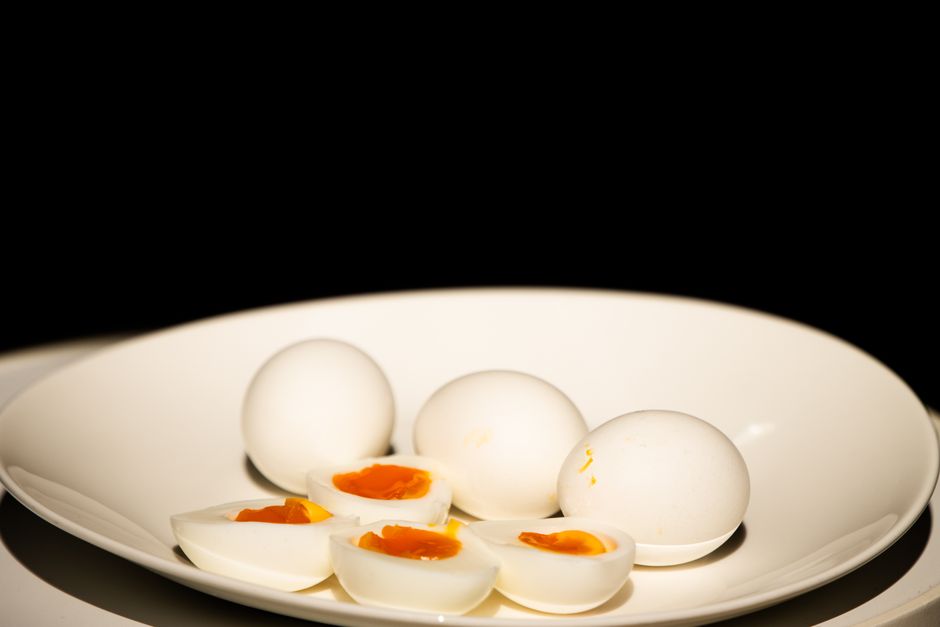
Drop a boiled egg into a bowl of cold water and two things can happen. It either sinks and lies flat on the bottom, or it bobs at the surface. That floating behavior is not random. It is a direct result of what has been happening inside the shell, and it is one of the oldest kitchen tests for egg freshness. A floating egg is an old egg, and an old egg is more likely to be a spoiled egg. A sinking egg is fresh and generally safe to eat.
Will Boiled Eggs Float?
Boiled eggs float only when they are old. Fresh eggs sink. This is true whether the egg is raw, hard-boiled, or soft-boiled, and the reason has nothing to do with cooking.
An eggshell is porous. It looks solid, but it is covered in thousands of tiny pores that let air and moisture pass through. When an egg is laid, it contains almost no air inside. Over time, moisture escapes through the shell and air moves in to take its place. That air collects in a pocket at the wide end of the egg, called the air cell.
The air cell grows every day the egg sits. A very fresh egg has a small air cell. A three-week-old egg has a much larger one. Once you boil the egg, the contents are sealed in place, but the air cell is still there. More air means lower density. Once the air cell gets big enough, the whole egg becomes lighter than water and rises to the top.
This is the same principle behind why a ping-pong ball floats and a golf ball does not. It is about how much air is trapped inside relative to the weight of the object.
Why Do Eggs Float When They Get Old?
The float test works because of a slow, unavoidable exchange between the egg and the air around it. Water evaporates out through the shell. Air seeps in. The egg gets lighter and the air pocket gets bigger at the same time.
Two things are happening at once, and both push the egg toward floating:
- The egg loses water weight as moisture escapes through the shell.
- The air cell expands, adding buoyant space inside the shell.
By the time an egg has been stored long enough for the air cell to grow large, the egg is also past its best quality. The yolk flattens, the white gets thinner and runnier, and the flavor fades. None of that means it is automatically unsafe, but it does mean the egg is old.
Refrigeration slows this process. Eggs left at room temperature age much faster than eggs kept cold. In the US, commercially sold eggs are usually washed and refrigerated, which is why the USDA advises keeping them refrigerated at home. In some other countries, eggs are sold unwashed and stored at room temperature, and they age on a different timeline.
Does a Floating Egg Mean It Is Bad?
Floating is a freshness signal, not a food safety verdict. It tells you the egg is old. It does not, by itself, prove the egg is spoiled.
This distinction matters because people often treat a floating egg as automatically dangerous. That is not quite right. An egg can float and still be perfectly safe to eat, especially if it was refrigerated the whole time. An egg can also sink and still be contaminated, though that is uncommon.
Age and spoilage are related but not identical. Most bacteria that cause egg spoilage enter through the shell after the egg is laid, often through cracks or pores. Refrigeration limits that growth. A large air cell is a sign of time passing, and time gives bacteria more opportunity, but the air cell itself is not the bacteria.
If you want to know whether a floating egg is actually spoiled, the float test will not tell you. Your nose will. A spoiled egg has a distinct, unpleasant sulfur smell, whether raw or cooked. If a boiled egg smells wrong when you peel it, throw it out. If it smells normal, the float test alone is not enough reason to discard it, though many food safety sources suggest erring on the side of caution with older eggs.





How Accurate Is the Egg Float Test?
The float test is a reasonable freshness indicator and a rough safety screen. It is not a laboratory test, and it has real limits.
What it does well:
- It reliably separates fresh eggs from old ones.
- It requires nothing but water and a bowl.
- It works on raw and boiled eggs alike.
What it does not do:
- It cannot detect Salmonella or other bacteria directly.
- It cannot tell you the exact age of an egg.
- It gives the same result for a three-week-old egg and a two-month-old egg.
Some food safety guidance treats a floating egg as a reason to discard it, on the logic that older eggs carry more risk. That is a cautious approach and a reasonable one, particularly for anyone pregnant, elderly, very young, or immunocompromised, since those groups face higher risk from foodborne illness. For a healthy adult, a floating egg that smells fine is usually not a crisis, but the safest move is still to cook eggs thoroughly and not rely on the float test as proof of safety.
What Does It Mean If a Boiled Egg Sinks?
A sinking boiled egg is fresh. It lies flat on the bottom of the bowl, which means the air cell is still small and the egg has not lost much moisture. That is the result you want.
There is a middle zone worth knowing. An egg that sinks but stands up on one end, with the wide end tilted upward, is somewhere in between. It is older than a flat-sinking egg but not old enough to float. It is usually fine to eat, especially if it has been refrigerated, but it is not at peak freshness.
So the full picture looks like this:
| Position in water | What it means |
|---|---|
| Lies flat on the bottom | Very fresh |
| Stands upright on the bottom | Older, still usually fine |
| Floats at the surface | Old, possibly spoiled |
This is one of the few kitchen tests that is genuinely simple and genuinely informative. It is not a myth. It is basic physics applied to a porous shell.
Does the Float Test Work the Same for Hard-Boiled Eggs?
Yes. Hard-boiling an egg does not change its density in a way that breaks the test. The air cell is still inside the shell, and the egg still floats or sinks based on how much air it holds.
One practical note: boiling does not reset the clock. A hard-boiled egg is only as fresh as the raw egg it came from. If you boil an old egg, you get an old hard-boiled egg. This is why the float test is useful before you boil, not just after.
Hard-boiled eggs also have their own storage rules that are separate from the float test. Once cooked, they should be refrigerated and eaten within about a week, according to USDA food safety guidance. That timeline is about bacterial growth on the cooked egg, not about the air cell. A hard-boiled egg can sink and still be too old to eat safely if it has been sitting out or left in the fridge too long.
Peeling is another clue. Fresh hard-boiled eggs are notoriously hard to peel because the inner membrane clings tightly to the shell. Older eggs peel more easily. That is a small consolation for an egg that is past its prime, but it is a real trade-off many cooks notice.
Should You Rely on the Float Test for Safety?
Use it as one signal among several, not as your only check. The float test is good at telling you how old an egg is. It is not designed to tell you whether that egg is safe.
If you want a more reliable safety picture, combine these:
- Check the date on the carton if you still have it.
- Smell the egg after cracking or peeling it.
- Look at the raw egg. A spoiled one often has a cloudy, discolored, or unusually runny white, or a yolk that breaks immediately.
- Keep eggs refrigerated and cook them thoroughly.
Thorough cooking is the most reliable safety step for eggs, because heat kills bacteria that may be present. The float test cannot do that. It only tells you about air.
There is one more point worth making, because it is often missed. The float test is more useful for raw eggs than for deciding whether a cooked egg is safe to eat. Once an egg is boiled, you have already committed to cooking it, and the smell and appearance checks become more practical. The float test is best used before you cook, as a quick way to sort fresh eggs from old ones.
Frequently Asked Questions
Will a boiled egg float if it is bad?
Not necessarily. A floating boiled egg is old, and old eggs are more likely to be spoiled, but floating alone does not prove spoilage. Smell and appearance are better indicators of whether an egg has actually gone bad.
Why do old eggs float when boiled?
Eggshells are porous, so moisture escapes and air enters over time, enlarging the air cell inside the wide end of the egg. More trapped air makes the egg less dense than water, so it rises to the surface.
Is it safe to eat a boiled egg that floats?
Many food safety sources advise discarding a floating egg as a precaution, especially for people at higher risk from foodborne illness. If the egg smells normal and has been refrigerated, the risk is lower, but the float test cannot confirm safety on its own.
Do fresh eggs sink or float?
Fresh eggs sink and lie flat on the bottom of the bowl because their air cell is still small. An egg that stands upright on the bottom is older but usually still fine to eat.
