
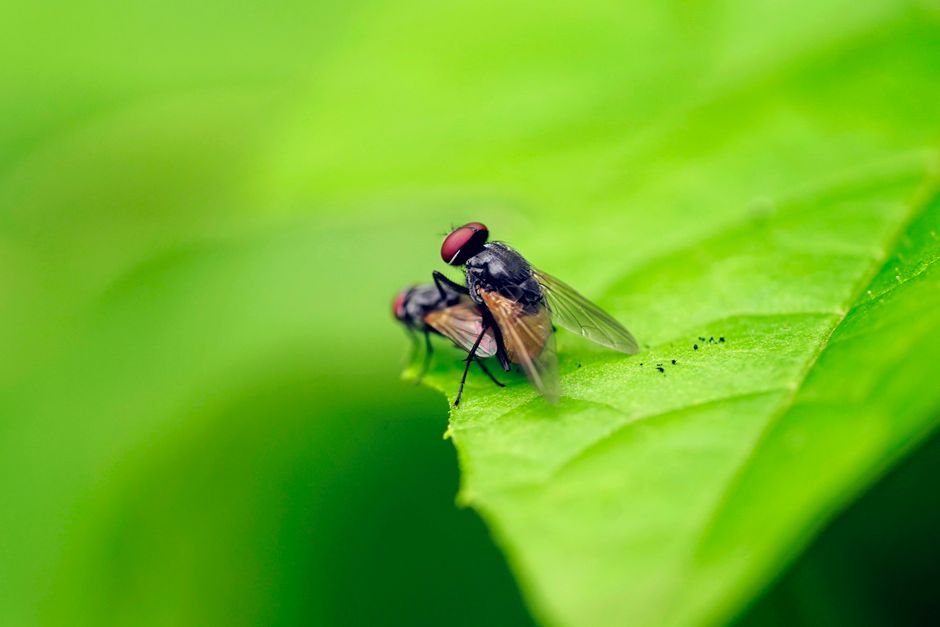
Not all flies bite. The ones that do are almost always female, and they are not trying to hurt you. They need a blood meal to develop their eggs, and the pain you feel is a direct result of how their mouthparts are built. Biting flies do not have a needle like a mosquito. They have blade-like mouthparts that slice into skin, and that cutting action is what registers as pain. The itch and swelling that follow come later, from your own immune system reacting to proteins in the fly’s saliva.
Why Do Flies Bite People And Why Does It Hurt?
Only a small fraction of fly species bite humans. House flies and fruit flies do not. The biters belong to families like Tabanidae (horse flies and deer flies), Stomoxys (stable flies), Simuliidae (black flies), and Ceratopogonidae (biting midges, often called no-see-ums).
The reason they bite is reproduction. Female biting flies require a blood meal to get the protein and iron needed for egg development. Males of most biting species do not bite at all — they feed on nectar or plant sugars. This is the same pattern seen in mosquitoes, and it explains why the flies landing on you in late summer are disproportionately female.
The pain has a mechanical explanation. Mosquitoes pierce skin with a fine proboscis, which is why many bites go unnoticed until the itch starts. Biting flies work differently. Horse flies and deer flies have mouthparts modified into cutting blades. They slice through the skin and then lap up the pooled blood. Black flies and biting midges tear tissue to create a small pool. This cutting and tearing damages nerve endings directly, which is why the bite is felt immediately rather than minutes later.
Some people notice that horse fly bites hurt far more than black fly bites. That tracks with body size. A larger fly needs a larger wound to feed efficiently, so the tissue damage is greater and more pain receptors are activated.
What Happens In Your Body After A Fly Bites You?
The fly injects saliva into the wound. That saliva contains anticoagulants and other compounds that keep blood flowing and suppress local clotting. Your immune system recognizes these proteins as foreign and responds.
This response is what produces the visible reaction. Mast cells in the skin release histamine, which dilates blood vessels and makes them leaky. The result is the red, raised, itchy bump — a wheal — that appears within minutes. Swelling and warmth follow. In sensitive people, a bite can produce a large local reaction several centimeters across that lasts for days.
The itching is not caused by the fly. It is caused by your own histamine release. This is why antihistamines can reduce the itch even though they do nothing to the fly itself. It also explains why some people react strongly to a bite and others barely notice one — immune sensitivity varies widely between individuals and tends to increase with repeated exposure.
One detail that often surprises people: a single fly can bite multiple times in a session if interrupted. Swatting at a horse fly and missing usually means it will land again nearby.
Which Flies Bite And What Do Their Bites Feel Like?
Different biting flies produce noticeably different sensations and reactions. Knowing which one bit you helps you predict how long the reaction will last.
- Horse flies and deer flies: Large, noisy, and persistent. The bite feels like a sharp sting or a jab. A red bump and localized swelling usually follow, sometimes with a small amount of bleeding at the site.
- Stable flies: Look similar to house flies but bite. The bite is painful and typically targets ankles and lower legs.
- Black flies: Small and dark. They often bite around the head, neck, and ears. The bite is painful at the moment, and itching can persist for days afterward.
- Biting midges: Tiny enough to pass through standard window screens. The bite is sharp, and the itch that follows can be intense and long-lasting.
- Sand flies: Small, hairy, and active at dusk and night. Their bites can leave small red bumps that may take weeks to fade.




Why Do Some Fly Bites Itch For Days?
Itch duration depends on how your immune system responds, not on how long the fly was attached. Most bites stop itching within a few days. Some last longer.
Repeated exposure changes the reaction. People who are bitten often — outdoor workers, campers, people living near water — sometimes develop a tolerance where bites produce less swelling and itching. Others develop the opposite: increasingly severe reactions with each exposure. Both patterns are documented in the medical literature on insect bite hypersensitivity.
Scratching makes it worse. Breaking the skin allows bacteria from your fingers or under your nails to enter, which can turn a simple bite into a skin infection. This is the most common complication of fly bites, and it is entirely preventable.
Do Fly Bites Carry Disease?
Yes, in some parts of the world. This is where the risk is real and worth understanding clearly.
Black flies in parts of Africa and Latin America transmit Onchocerca volvulus, the parasite that causes river blindness. Sand flies transmit Leishmania parasites, which cause leishmaniasis, a disease found in parts of the tropics, subtropics, and southern Europe. Horse flies can mechanically transmit certain bacteria and parasites, though this is uncommon.
In the United States and most of temperate North America, the disease risk from fly bites is low. The main concern is secondary bacterial infection from scratching, and in rare cases, allergic reactions to the saliva. Some people develop a condition called papular urticaria — clusters of itchy bumps that persist for weeks after bites.
There is one important caveat. Fly-borne disease risk is geographic and changes with local conditions. If you are traveling, check current public health guidance for your destination rather than relying on general assumptions about what flies carry.
How Do You Prevent Fly Bites?
Prevention comes down to reducing exposed skin and using repellents that are actually proven to work.
EPA-registered repellents containing DEET, picaridin, IR3535, or oil of lemon eucalyptus are the ones with the strongest evidence for effectiveness against biting flies and mosquitoes. Permethrin-treated clothing is another option — it kills or disables flies that land on the fabric. This is different from applying repellent to skin, and the two can be combined.
Physical barriers matter more with flies than with mosquitoes. Horse flies and deer flies are strong fliers and can bite through thin clothing. Light-colored, loose, long-sleeved clothing helps. So does avoiding peak activity times, which for many biting flies are the warm daylight hours.
Window screens with a fine mesh are needed to keep out biting midges, since standard screens have gaps large enough for them to pass through. Fans help too — biting flies are relatively weak fliers in moving air and tend to avoid windy conditions.
One thing that does not work: ultrasonic devices marketed to repel biting insects. The evidence for these is consistently negative in controlled studies.
What Should You Do After A Fly Bite?
Wash the area with soap and water. Apply a cold pack to reduce swelling. An oral antihistamine can help with itching, and a topical anti-itch cream may help as well. The goal is to stop the itch-scratch cycle before the skin breaks.
If the bite becomes increasingly painful, hot, or swollen after the first day or two, or if you see pus or red streaks spreading from the site, that suggests a bacterial infection and warrants medical evaluation. The same applies if you develop fever, chills, or feel generally unwell after a bite in a region where fly-borne disease occurs.
Most fly bites resolve on their own within a few days. The discomfort is real but temporary, and the main risk — infection from scratching — is one you can control directly.
Frequently Asked Questions
Why do flies bite humans in the first place?
Female biting flies need blood protein to develop their eggs. Males of most biting species do not bite at all and feed only on plant sugars.
Why does a fly bite hurt more than a mosquito bite?
Biting flies cut or tear the skin with blade-like mouthparts rather than piercing it with a fine needle. That tissue damage directly activates pain nerve endings, so the bite is felt immediately.
How long do fly bites usually last?
Most fly bites stop itching and fade within a few days. Reactions vary widely between people, and some individuals develop itchy bumps that persist for weeks.
Can fly bites make you sick?
In the US and most temperate regions, the main risk is a skin infection from scratching. In parts of the tropics, certain flies transmit parasites that cause serious disease.
