
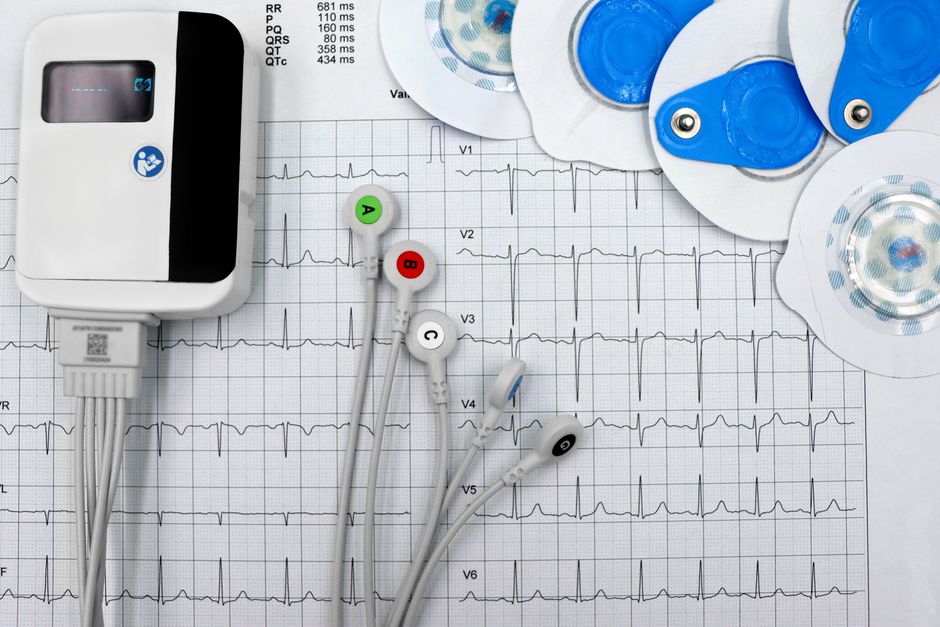
An ECG uses 12 leads, and they fall into two clear groups. The six limb leads (I, II, III, aVR, aVL, aVF) are unipolar, and the six chest leads (V1 through V6) are also unipolar. The three bipolar leads are I, II, and III, which are the only true bipolar leads on a standard ECG. Every other lead, including the augmented limb leads and all six precordial leads, is unipolar. That split is the foundation for understanding how an ECG machine records the heart’s electrical activity from different angles.
Which ECG Leads Are Bipolar and Which Are Unipolar?
Bipolar leads measure the voltage difference between two active electrodes. Unipolar leads measure the voltage at one exploring electrode against a common reference point.
On a standard 12-lead ECG, the breakdown is:
- Bipolar: Lead I, Lead II, Lead III (three leads)
- Unipolar: aVR, aVL, aVF (three augmented limb leads) and V1 through V6 (six chest leads)
That gives three bipolar leads and nine unipolar leads, for 12 total. The word “bipolar” is sometimes misapplied to the chest leads because they are recorded as pairs of electrodes on the body. That is not what bipolar means in ECG terminology. Bipolar refers to the recording circuit, not to how many electrodes touch the skin.
This distinction matters because it explains why the limb leads and chest leads look different on paper, why the augmented leads are “augmented,” and why Einthoven’s triangle works the way it does.
What Makes a Lead Bipolar?
A bipolar lead records the potential difference between two electrodes, each of which is actively contributing to the signal. Neither electrode is a neutral reference. The machine subtracts one from the other and displays the result.
Lead I, for example, records the difference between the right arm electrode and the left arm electrode. Lead II compares the right arm to the left leg. Lead III compares the left arm to the left leg. Each of these is a genuine two-electrode measurement.
This is why the limb leads are sometimes called the “standard” leads or Einthoven’s leads, after Willem Einthoven, who developed the string galvanometer and the triangle concept in the early 1900s. The three bipolar limb leads form the sides of Einthoven’s triangle, and they obey a fixed mathematical relationship: the voltage in Lead II equals the voltage in Lead I plus the voltage in Lead III. That relationship holds because the three leads are measuring the same electrical field from three fixed angles.
Bipolar leads are sensitive to the difference between two points. If both electrodes pick up the same interference (say, from muscle activity or electrical noise), that common signal cancels out. This is one reason bipolar leads can be relatively clean recordings.
What Makes a Lead Unipolar?
A unipolar lead records the voltage at a single exploring electrode relative to a reference that is, in principle, electrically neutral. In practice, that reference is built from other electrodes on the body.
The augmented limb leads (aVR, aVL, aVF) use the same three limb electrodes as the bipolar leads, but they measure each limb’s potential against the average of the other two. The “a” stands for augmented, because the machine scales up the small signal to make it readable on the tracing.
The chest leads V1 through V6 are also unipolar. Each one records the potential at a single electrode placed on the chest wall, referenced to a central terminal built from the limb electrodes. Wilson’s central terminal, as it is called, is the average of the right arm, left arm, and left leg potentials. It serves as the common reference for the precordial leads.
Unipolar leads are described as “looking at” the heart from one direction, with the reference acting as a fixed zero point. That is a simplification, but it captures the practical difference: bipolar leads compare two active sites, while unipolar leads compare one active site to a constructed reference.





Why Are the Chest Leads Unipolar Even Though They Use Two Electrodes?
This is where many people get confused. A chest lead like V2 is recorded using the V2 electrode on the chest and a reference terminal built from the limb electrodes. Two electrical connections are involved, so it looks like a pair. But the reference terminal is not treated as an active measuring electrode. It is a constructed zero point.
The defining feature of a bipolar lead is that both electrodes are active sensing sites whose difference is being measured. In a unipolar chest lead, only the chest electrode is the exploring electrode. The other connection is a reference. That makes the lead unipolar by definition, regardless of how many wires are involved.
The same logic applies to the augmented limb leads. aVR uses the right arm electrode as the exploring electrode and the average of the left arm and left leg as the reference. The right arm is active; the reference is constructed. So aVR is unipolar.
How the Two Types Differ in Practice
The practical differences show up in what each lead is good at showing.
| Feature | Bipolar leads (I, II, III) | Unipolar leads (aVR, aVL, aVF, V1–V6) |
|---|---|---|
| Electrodes involved | Two active electrodes | One exploring electrode plus a reference |
| Number on standard ECG | 3 | 9 |
| Typical use | Frontal plane axis, limb lead relationships | Augmented limb views; chest wall views of the heart |
| Reference point | None (both active) | Constructed (Wilson’s central terminal or limb average) |
The bipolar limb leads are especially useful for assessing the frontal plane axis and for confirming the mathematical relationships that let you check a tracing for consistency. The augmented limb leads provide additional frontal plane views that fill in angles the standard three leads do not cover well. The chest leads give a horizontal plane view, which is why they are essential for detecting changes in the anterior, lateral, and inferior walls of the heart.
One non-obvious point: the augmented leads are not simply “extra” leads. They carry information that the standard three limb leads cannot provide on their own, because they look at the heart from angles that the three sides of Einthoven’s triangle do not directly measure. That is why a complete 12-lead ECG includes all of them.
Does the Bipolar or Unipolar Label Affect How You Read an ECG?
The label itself does not change how you interpret a tracing, but it does explain the underlying geometry.
When you look at a 12-lead ECG, you are seeing the same electrical event from 12 different vantage points. The bipolar leads and unipolar leads are simply two ways of constructing those vantage points. Knowing which is which helps you understand why Lead II often looks like a combination of Lead I and Lead III, why aVR is normally negative, and why the chest leads progress from a mostly negative complex in V1 to a mostly positive complex in V6 in a normal heart.
It also helps you avoid a common error. Some people assume that because the chest leads use two electrodes, they must be bipolar. They are not. The distinction is about the recording circuit, not the number of electrodes touching the body. Once that clicks, the whole 12-lead layout makes more sense.
For readers who want to go deeper into how the leads are placed and what each one shows, the HBmag library covers ECG fundamentals in plain language.
Do the Terms Bipolar and Unipolar Apply to Other Medical Tests?
Yes, and the meaning is similar. In electrophysiology and in some nerve conduction studies, bipolar and unipolar refer to whether a recording compares two active sites or one active site to a reference. In EEG, the same distinction applies to montages. The principle is consistent: bipolar means two active electrodes; unipolar means one active electrode against a reference.
That consistency is useful. Once you understand why the ECG limb leads are bipolar and the chest leads are unipolar, the same logic transfers to other electrical recordings in medicine.
Frequently Asked Questions
Which ECG leads are bipolar?
Leads I, II, and III are the three bipolar leads on a standard ECG. Each one measures the voltage difference between two active limb electrodes.
Are V1 through V6 bipolar or unipolar?
V1 through V6 are unipolar. Each chest lead records one exploring electrode against Wilson’s central terminal, which serves as a constructed reference.
Are the augmented limb leads bipolar?
No, aVR, aVL, and aVF are unipolar. Each measures one limb electrode against the average of the other two limb electrodes.
How many bipolar leads are on a 12-lead ECG?
There are three bipolar leads and nine unipolar leads on a standard 12-lead ECG. The three bipolar leads are I, II, and III.
