
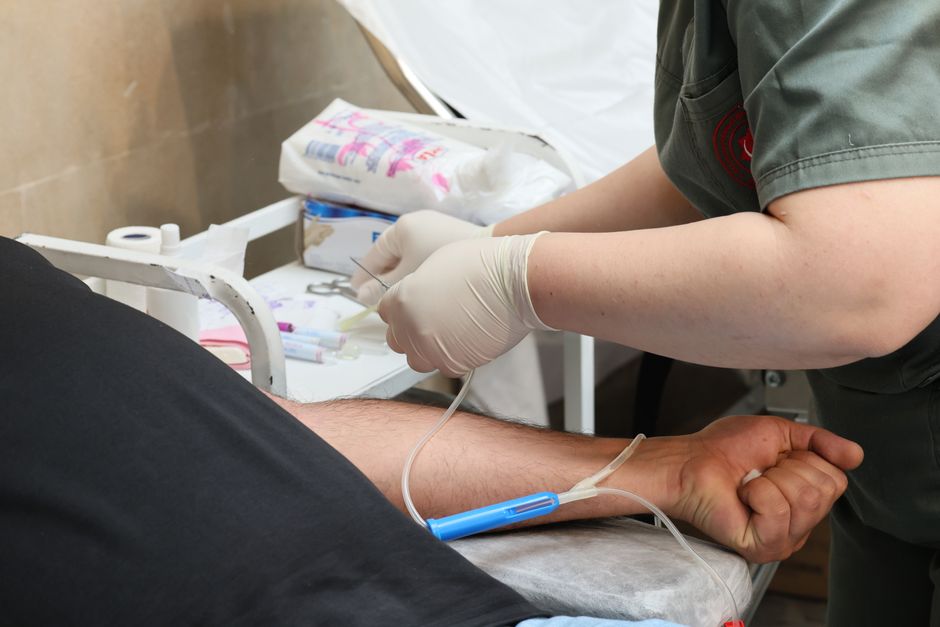
Your blood donation begins a journey that most donors never see. Within minutes of leaving your arm, the blood is separated into components, tested for infectious diseases, typed for blood group, and stored under strict conditions. From there it is distributed to hospitals and transfused into a patient who needs it — often within days, sometimes within hours.
The whole process is more complex than most people realize. It involves careful labeling, refrigeration, screening, and matching. Each step exists to protect two people: the donor and the recipient.
What Happens to Your Blood Right After You Donate?
The moment the needle comes out, your donation stops being “your blood” in a practical sense. It becomes a unit of product with a unique identification number.
Staff label the bag with a barcode tied to your donor record. That number follows the unit through every step. This matters because if a problem is found later — an abnormal test result, for example — the blood bank can trace the unit back to you and, if needed, quarantine it before it reaches anyone.
Most whole blood donations are not stored as whole blood. They are separated into components: red cells, plasma, and platelets. This is done because most patients need only one specific component. A trauma patient bleeding heavily may need red cells. A cancer patient with low platelets may need platelets. A patient with a clotting disorder may need plasma. Splitting one donation into parts lets it help more than one person.
Each component has its own storage requirements. Red cells are kept cold. Plasma is frozen. Platelets are stored at room temperature and have a much shorter shelf life than the other two.
How Is Donated Blood Tested Before It Reaches a Patient?
Every unit is tested for a standard panel of infectious diseases. In the United States, this typically includes HIV, hepatitis B, hepatitis C, syphilis, and — depending on the collection center — other agents such as West Nile virus or Zika virus where relevant.
Samples from your donation also go to a lab for blood typing. Your ABO group (A, B, AB, or O) and your Rh factor (positive or negative) are confirmed. This is why you may hear your blood type explained as “O positive” or “A negative.”
Testing does not happen instantly. Depending on the lab and the tests involved, results may take a day or longer. During that window, the unit is held. It is not released to a hospital until the infectious disease tests come back clear and the blood type is confirmed.
Some donations are also tested for unexpected antibodies. These are immune proteins that could react against a patient’s blood. If any are found, the unit may be set aside for special use or not used at all.
Where Did My Blood Donation Go From Vein To Patient?
After testing and processing, your donation sits in a blood bank inventory. From there, a hospital requests specific units based on what its patients need. A trauma center may need O negative red cells on short notice. A dialysis unit may need red cells for anemic patients. A cancer ward may need platelets.
When a request comes in, a technician matches the unit to the patient. This matching is not random. It depends on blood type compatibility and, in some cases, on whether the patient has antibodies that rule out certain donors.
The unit is then transported to the hospital, often in a temperature-controlled cooler. Once it arrives, it is crossmatched — a final check that the donor blood and the patient’s blood will not react badly together. Only after that check does the transfusion begin.
Some units are shipped between regions. If one area has a surplus and another has a shortage, blood banks coordinate transfers. This is one reason a donation in one state can end up helping a patient hundreds of miles away.





How Long Does Donated Blood Last?
Storage time depends on the component.
- Red blood cells are typically stored for up to 42 days under refrigeration.
- Platelets have a much shorter shelf life — often around 5 to 7 days.
- Plasma can be frozen and stored for up to a year in many cases.
That short platelet window is one reason blood centers constantly need donors. Platelets cannot be stockpiled the way red cells can. If donations slow down, platelet supplies can run low within days.
Red cells near the end of their storage window are still used. They are simply prioritized for patients who can receive them safely. Some hospitals use older units for elective procedures and reserve fresher units for specific cases.
What Happens If a Test Comes Back Positive?
If a screening test is reactive — meaning it flags something — the unit is not released. It is quarantined and typically discarded.
You would then be contacted by the blood center. A reactive screening test does not automatically mean you have an infection. Screening tests are designed to be sensitive, which means they can sometimes flag people who are not actually infected. This is called a false positive.
Follow-up testing is usually done to confirm or rule out the finding. This can take time and may involve a different type of test that looks for the organism or virus directly. If the follow-up is negative, you may be able to donate again. If it is positive, you would be referred for medical care and may be deferred from donating in the future.
This is one of the less visible parts of the donation process. It protects patients, but it also sometimes creates anxiety for donors who receive a notification. Understanding that a reactive test is not the same as a diagnosis can help.
Why Is Blood Typing So Important in Transfusion?
Blood type compatibility is not optional. Giving a patient the wrong ABO type can trigger a severe immune reaction that may be life-threatening.
The ABO system is based on antigens — markers on the surface of red blood cells. Type A has A antigens, type B has B antigens, type AB has both, and type O has neither. Your plasma contains antibodies against the antigens you do not have. So a type A person has antibodies against B, and a type O person has antibodies against both A and B.
If a type A patient receives type B blood, those antibodies can attack the donor cells. This is why crossmatching exists. It is a final safety check before transfusion.
Rh factor adds another layer. A person who is Rh negative can develop antibodies against Rh positive blood if exposed to it. This matters most in pregnancy, where Rh incompatibility between mother and fetus can cause serious problems. In transfusion, Rh matching is standard practice.
| Blood Type | Can Receive Red Cells From | Can Donate Red Cells To |
|---|---|---|
| O negative | O negative | All types |
| O positive | O positive, O negative | All positive types |
| A positive | A positive, A negative, O positive, O negative | A positive, AB positive |
| B positive | B positive, B negative, O positive, O negative | B positive, AB positive |
| AB positive | All types | AB positive |
O negative red cells are sometimes called the universal donor type because they can be given to almost anyone. That is why O negative blood is often in high demand, especially in emergencies when there is no time to check a patient’s type.
How Does Donated Blood Reach the Right Patient?
Hospitals do not keep large stockpiles of every blood type. Instead, they rely on blood centers to supply what they need, when they need it.
A hospital places an order based on its current inventory and expected demand. The blood center pulls the requested units, confirms they are still within their storage window, and ships them. For planned surgeries, this can be scheduled. For trauma, it happens under pressure.
Some hospitals use a system where O negative or type-specific red cells are issued before the full crossmatch is complete. This is done when a patient is bleeding severely and waiting is not an option. The crossmatch is completed afterward as a safety check.
Once transfused, the unit is documented in the patient’s medical record. The blood center is notified that the unit was used. This closes the loop and helps track inventory.
What Happens to Blood That Is Not Used?
Not every unit gets transfused. Some expire before they can be used. Others are discarded because of a positive test result or a problem found during processing.
Expired red cells are not transfused, but they are not always wasted. Some are used for research or for manufacturing certain medical products. Plasma that is not used for transfusion may be sent for further processing into medications.
The rate of waste varies. Blood centers work to minimize it by managing inventory carefully and shipping units where they are most likely to be used. Still, some loss is unavoidable given the short shelf life of certain components.
Frequently Asked Questions
How long does it take for donated blood to be used?
It varies. Some units are transfused within days, while others may be stored for weeks before use. Platelets are typically used much faster because they have a short shelf life.
Can I find out where my blood donation went?
Some blood centers notify donors when their donation is used, but this is not universal. Privacy rules and logistics often prevent tracking a specific unit to a specific patient.
Is donated blood ever given to the donor?
No. Donations are not reserved for the donor. If you need a transfusion later, you would receive blood from the general supply.
What happens if my blood type is rare?
Rare blood types may be frozen for long-term storage or flagged for special matching. Some centers maintain registries of rare donors who can be called on when needed.
