
Papaya enzyme supplements are usually taken with meals, not before them. The enzymes they contain — mainly papain and chymopapain — are digestive enzymes, and their intended job is to help break down food while it sits in your stomach. Taking them on an empty stomach sends them into an environment where there is nothing to digest.
That said, “with meals” is a practical convention, not a rule backed by strong clinical trials. The evidence that papaya enzyme supplements improve digestion at all is limited. What follows is an honest look at what these enzymes do, what the research actually shows, and how timing fits into it.
When To Take Papaya Enzyme Before Or With Meals?
Take papaya enzyme with a meal — ideally near the start of eating or partway through. The reasoning is straightforward physiology. Your stomach produces acid and begins mechanical and chemical digestion as soon as food arrives. Enzymes taken alongside food have a substrate to work on.
Papain is a protease, meaning it breaks down proteins. In a test tube it digests protein efficiently. In your stomach, the picture is more complicated. Stomach acid has a pH of roughly 1.5 to 3.5, and papain’s activity drops at very low pH, though it is not fully destroyed. Some papain remains active across a range of pH values, which is part of why it has been studied as a digestive aid.
Timing before a meal is sometimes suggested for people taking enzymes for reasons other than digestion. Some clinicians recommend proteolytic enzymes away from food for other purposes. That is a different use case from digestive support, and the evidence for those other uses is weaker still. For the common “help me digest this meal” goal, with food is the sensible choice.
What “with meals” means in practice
Most supplement labels direct you to take the tablet or capsule with food or immediately after eating. If a product gives its own instructions, follow those. There is no established clinical guideline that specifies an exact number of minutes before or after eating for papaya enzyme. Anyone who tells you there is a precise window is going beyond the evidence.
What Does Papaya Enzyme Actually Do?
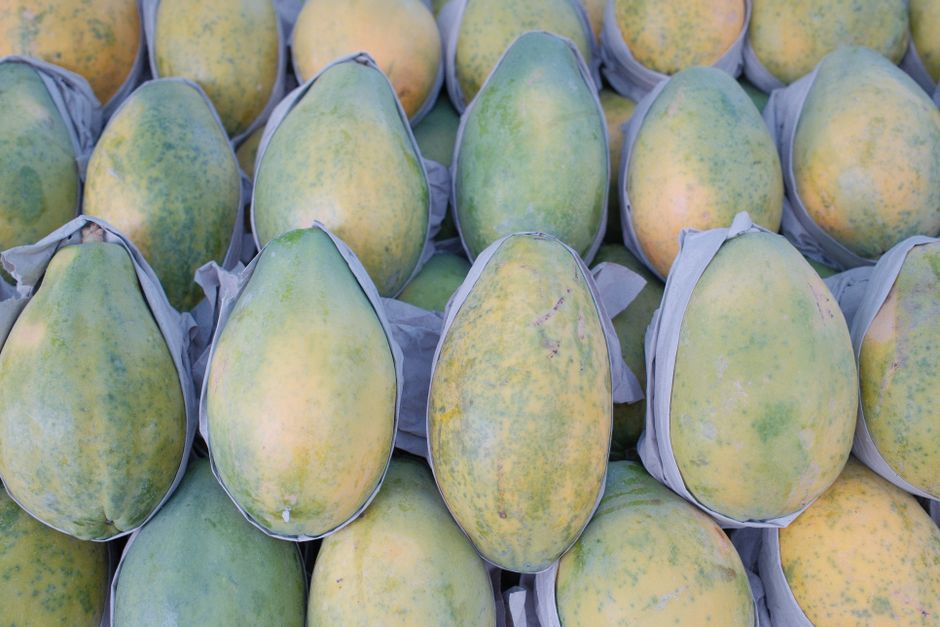
Papaya fruit and its latex contain papain, a protein-splitting enzyme. Unripe papaya is a traditional meat tenderizer for the same reason — papain breaks protein strands apart. That action is real and well documented in food science.
The leap from “papain digests protein in a dish” to “papaya enzyme pills improve your digestion” is where the evidence thins out. Your body already produces powerful proteases — pepsin in the stomach and trypsin and chymotrypsin from the pancreas. A supplement adds a small amount of enzyme activity on top of a system that is usually working well.
Some studies suggest papain and other plant enzymes can survive stomach acid to some degree and remain active in the gut. The amounts and the practical effect on digestion in healthy people are not well established. No large, high-quality human trials confirm that papaya enzyme supplements meaningfully improve digestion in people without a diagnosed digestive disorder.
This matters. A logical mechanism is not the same as proven benefit. Papain breaking down protein is established. Papaya enzyme supplements reducing bloating, gas, or discomfort in real people is not established to the same standard.
Does Timing Before a Meal Change Anything?
Taking papaya enzyme before a meal does not give it a meaningful head start. Enzymes do not “prepare” your stomach. They act on food when food is present. Swallowed before eating, they simply wait in the stomach until the meal arrives — or pass through.
There is one reason some people take enzymes before eating: to reduce the chance of stomach upset from the supplement itself. Some users report mild nausea or stomach discomfort from enzyme products, and taking them with food can soften that. If a product’s label says to take it with a meal, that instruction may reflect both digestive intent and tolerability.
For a supplement marketed as a digestive aid, the timing question is secondary to a bigger one: does it work for you, and is it appropriate for you to take at all? Timing cannot rescue a product that does not deliver a benefit.





Who Should Be Careful With Papaya Enzyme?
Papaya enzyme is not risk-free for everyone. People with a latex allergy should be cautious. Papain is a known cross-reactive allergen for some people with latex allergy, because the proteins are related. Reactions have been documented. If you have a latex allergy, talk to a clinician before using papaya enzyme.
Papaya also contains a substance called benzyl isothiocyanate, concentrated more in unripe fruit and seeds. Very high intakes of papaya seed or unripe papaya have been a concern in pregnancy in some traditional contexts, and pregnant women are often advised to avoid unripe papaya and papaya seed products. The evidence is not strong enough to make firm claims about supplement doses, but the cautious position is to avoid papaya enzyme supplements during pregnancy unless a clinician approves.
People with a known allergy to papaya itself should not take papaya enzyme. Anyone on blood-thinning medication should check with a clinician, because papain’s effects on platelets and clotting have been raised as a theoretical concern, though human evidence is limited.
For children and infants, no clinical guidelines currently exist for papaya enzyme supplements. Do not give them without medical advice.
Papaya Enzyme vs. Other Digestive Aids
Papaya enzyme is one of several plant and animal enzymes sold for digestion. The table below compares the common types by what they target and how well their digestive use is supported.
| Enzyme source | Main action | Digestive use supported by strong human trials? |
|---|---|---|
| Papain (papaya) | Breaks down protein | No — limited evidence |
| Bromelain (pineapple) | Breaks down protein | No — limited evidence for digestion |
| Lactase | Breaks down lactose (milk sugar) | Yes — for lactose intolerance |
| Pancreatic enzymes (prescription) | Break down fat, protein, carbohydrate | Yes — for pancreatic insufficiency, by prescription |
The contrast is instructive. Lactase has solid evidence for helping people with lactose intolerance digest dairy. Prescription pancreatic enzymes are proven therapy for people whose pancreas does not make enough enzymes. Papaya enzyme sits in a much weaker evidence category. That does not mean it does nothing. It means the proof is not there yet.
How to Use Papaya Enzyme Sensibly
If you decide to try papaya enzyme, a few practical points keep you grounded.
- Take it with a meal, following the product label if it gives specific directions.
- Start with the labeled serving size. Do not assume more is better; there is no evidence that higher doses improve results.
- Watch for reactions — rash, itching, mouth tingling, or stomach upset — and stop if they occur.
- Tell your clinician you are taking it, especially if you take blood thinners or have a latex allergy.
- Do not use it to self-treat ongoing digestive symptoms. Persistent bloating, pain, or changes in bowel habits deserve a medical evaluation.
One clarification worth keeping in mind: “papaya enzyme” on a label can mean different things. Some products contain papain alone. Others blend papain with bromelain, amylase, lipase, or probiotics. The evidence for one does not automatically transfer to the blend. Read the ingredient list rather than assuming.
Do You Need a Papaya Enzyme Supplement at All?
Most healthy people do not. A functioning digestive system handles a normal diet without help. The strongest case for any digestive enzyme supplement is a specific, identified problem — like lactose intolerance for lactase. For general “digestive support,” the honest position is that the benefit is unproven.
If your goal is comfortable digestion, the levers with better evidence are ordinary ones: eat slowly, chew well, keep portions moderate, and pay attention to which foods trigger symptoms. Those steps do not come in a bottle, but they rest on more than marketing.
Papaya enzyme is not harmful for most people when taken as directed, but “not harmful” and “helpful” are different claims. The timing question — before or with meals — has a practical answer: with meals. The bigger question of whether it does what you hope is one the research has not settled.
Frequently Asked Questions
Should papaya enzyme be taken before or after food?
Take it with food, not before. The enzymes need food present to act on, and most labels direct you to take the product with or right after a meal.
Can you take papaya enzyme on an empty stomach?
You can, but there is little reason to if you are using it as a digestive aid. On an empty stomach there is no food for the enzymes to break down, and some people find it causes mild stomach discomfort.
Is papaya enzyme safe for everyone?
No. People with a latex or papaya allergy should avoid it, and pregnant women are generally advised against papaya seed and unripe papaya products. No clinical guidelines exist for children or infants.
Does papaya enzyme actually help digestion?
The evidence is limited. Papain breaks down protein in the lab, but no large human trials confirm that papaya enzyme supplements meaningfully improve digestion in healthy people.
