
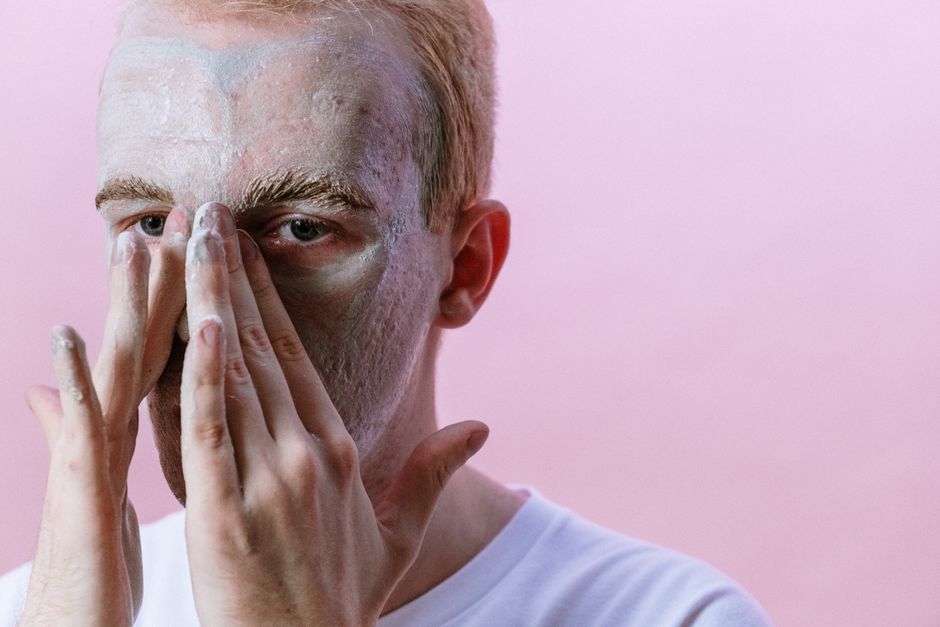
Acne spot treatments belong on clean, dry skin at the start of your skincare routine, before moisturizer and sunscreen. Applying a spot treatment after heavy creams or oils can dilute the active ingredient or block it from reaching the pore. For most people, the simplest and most effective time is right after cleansing, in the evening, on the single blemish — not across the whole face.
When To Apply Acne Spot Treatment In Your Routine
The order of your routine decides how well a spot treatment works. Active ingredients need direct contact with the skin to do their job. If you layer moisturizer or facial oil first, that barrier sits between the medication and the pore.
Here is the sequence that makes sense for most people:
- Cleanse with a gentle, non-stripping face wash.
- Pat skin dry and wait a minute or two. Damp skin can increase irritation from strong actives.
- Apply a thin layer of spot treatment only on the blemish.
- Wait a few minutes for it to absorb.
- Follow with a light moisturizer over the whole face.
- In the morning, sunscreen last, always.
The wait time matters more than most people think. Benzoyl peroxide and salicylic acid both work best on dry skin. Applying them to a wet face increases the chance of redness and peeling without improving results.
Evenings are usually the better choice for spot treatment. Some actives make skin more sensitive to sunlight. This is well documented for retinoids and is a general caution for exfoliating acids. If you use a spot treatment in the morning, sunscreen becomes non-negotiable, not optional.
Should You Apply Spot Treatment Before or After Moisturizer?
Before moisturizer. This is the standard order in dermatology for a simple reason: moisturizer is designed to sit on top of the skin and reduce water loss. That same quality can limit how much of an active ingredient reaches the pore.
There is one exception worth knowing. If a spot treatment causes significant dryness or peeling, some clinicians suggest applying moisturizer first as a buffer, then the spot treatment on top. This reduces irritation, but it may also reduce how well the active works. It is a trade-off, not a free upgrade.
Thick ointments and heavy facial oils are the worst things to apply before a spot treatment. They can physically seal the active ingredient away from the skin. If you use a facial oil, keep it as the last step at night, well after your spot treatment has absorbed.
How Long Should You Leave Spot Treatment On?
Most over-the-counter spot treatments are leave-on products. You apply them and do not rinse. That is different from a mask or a cleanser, which you wash off after a set time.
Read the label on your specific product. Some stronger formulas, particularly those containing higher concentrations of salicylic acid or prescription-strength ingredients, come with instructions to use them a certain number of times per week. Following those instructions matters. More is not better with acne actives.
There is no benefit to leaving a spot treatment on longer than directed. The active ingredient does its work within a certain window. After that, it is just sitting on your skin, and for some ingredients that means ongoing irritation.


What Ingredients Belong in a Spot Treatment?
The evidence base differs a lot between ingredients. Some are well studied. Others are mostly marketing.
Benzoyl peroxide has decades of research behind it and is considered effective for inflammatory acne. It kills acne bacteria and helps clear the pore. The main drawbacks are dryness, peeling, and bleaching of fabrics and hair.
Salicylic acid is a beta-hydroxy acid that helps unclog pores. It is generally better suited to blackheads and whiteheads than to deep, inflamed cysts. It tends to be gentler than benzoyl peroxide for many people.
Adapalene is a retinoid available over the counter in some countries. It has a solid evidence base for acne, but it is not really a spot treatment. It works across the whole area over weeks, not on a single pimple overnight.
Sulfur has a long history of use and some evidence for mild acne. It is often recommended for people who cannot tolerate benzoyl peroxide.
Ingredients like tea tree oil have some supporting studies, but the evidence is weaker and formulations vary widely. Many “spot treatment” products on shelves contain soothing ingredients like aloe or niacinamide with little to no acne-fighting active. Those may calm redness, but they are not treating the cause.
Can You Use Spot Treatment With Other Acne Products?
Yes, but layering too many actives is one of the most common ways people make their acne worse. Irritation from overuse can look a lot like an acne flare, which leads people to apply even more product. The cycle is hard to break.
A few combinations to think about:
- Benzoyl peroxide and salicylic acid together can be very drying. Many people do better using one in the morning and the other at night, or alternating days.
- Retinoids and strong exfoliating acids at the same time increase the risk of irritation. Spacing them out is usually wiser.
- Prescription acne medications should be discussed with your clinician before adding anything over the counter.
If your skin is stinging, peeling, or red beyond the blemish itself, that is a signal to pull back. Reduce how often you use the product, not how much you use.
Common Mistakes With Acne Spot Treatment
The biggest mistake is applying spot treatment to the whole face. These products are concentrated for a reason. Using them everywhere increases irritation and does not prevent new pimples from forming elsewhere.
The second mistake is picking at the blemish before applying treatment. This breaks the skin and raises the risk of scarring and infection. A spot treatment cannot undo damage from squeezing.
The third mistake is expecting overnight results. Inflammatory pimples typically take several days to improve, and that timeline varies from person to person. A spot treatment can reduce redness and size, but it is not a switch you flip.
One point that gets lost: spot treatments handle individual pimples. They do not treat the underlying process that causes acne. If you are getting new blemishes regularly, a whole-face routine or a visit to a clinician will do more than any single spot product.
When to See a Doctor Instead
Spot treatments are for the occasional pimple. They are not the right tool for moderate to severe acne, deep painful cysts, or acne that is leaving marks and scars.
See a clinician if:
- You have deep, painful nodules or cysts.
- Over-the-counter products have not helped after a reasonable trial.
- Acne is causing scarring or significant distress.
- You are noticing signs of hormonal acne, such as breakouts along the jawline that flare with your cycle.
Prescription treatments, including topical retinoids, oral antibiotics, and in some cases isotretinoin, are far more effective for moderate to severe acne than any spot product. This is one area where the evidence is clear and long-standing.
Frequently Asked Questions
Should I apply spot treatment before or after moisturizer?
Apply it before moisturizer so the active ingredient reaches the skin directly. If the product irritates your skin badly, some clinicians suggest moisturizer first as a buffer, though this may reduce how well it works.
Can I use acne spot treatment every day?
It depends on the ingredient and your skin. Follow the product label, and if you notice stinging, peeling, or spreading redness, use it less often rather than more.
Does spot treatment work overnight?
No. Most inflammatory pimples take several days to improve, and results vary by person and by product. Spot treatments can reduce size and redness but rarely clear a pimple in one night.
Can I put spot treatment on my whole face?
No. Spot treatments are concentrated for use on individual blemishes, and applying them everywhere raises the risk of irritation. For widespread acne, a whole-face routine or a clinician’s guidance is the better path.
