
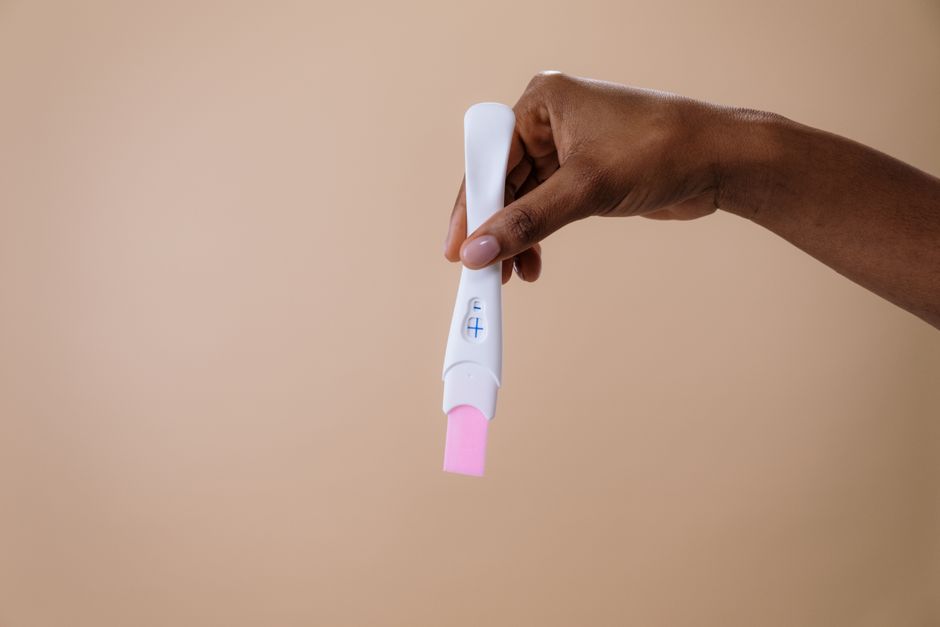
A pregnancy test turns positive when there is enough human chorionic gonadotropin (hCG) in your urine or blood for the test to detect it. In a typical pregnancy, hCG becomes detectable in urine around 10 to 14 days after ovulation — roughly the time of a missed period. Blood tests can detect hCG a few days earlier, sometimes as soon as 6 to 8 days after ovulation.
When Does Pregnancy Test Positive After Conception?
The short answer: not immediately. There is a gap between the moment of conception and the moment a test can detect it, and that gap is biology, not test quality.
Here is the sequence. An egg is released during ovulation. If sperm meets it, fertilization usually happens within about 24 hours. The fertilized egg then travels down the fallopian tube and implants into the uterine lining. Implantation typically occurs 6 to 12 days after ovulation, most commonly around 8 to 10 days.
Only after implantation does the developing embryo begin producing hCG. That hormone is what pregnancy tests detect. Before implantation, there is no hCG to find — no test on the market can turn positive during that window.
Once implantation happens, hCG levels rise quickly in early pregnancy, roughly doubling every 48 to 72 hours in the first weeks. That rapid rise is why a test that reads negative at 8 days past ovulation might read positive just two or three days later.
How Early Can You Test for Pregnancy?
Most home urine tests are designed to detect hCG at concentrations around 20 to 25 mIU/mL, though sensitivity varies by brand. Some advertise sensitivity as low as 10 mIU/mL.
In practice, this means a home urine test can sometimes detect pregnancy a few days before a missed period — but “sometimes” is doing real work in that sentence. Testing too early is the most common reason for a false negative.
Blood tests are more sensitive. A quantitative blood test can detect very low levels of hCG, and a qualitative blood test can confirm pregnancy slightly earlier than urine tests. These are ordered by a healthcare provider, not bought at a pharmacy.
The chart below shows the general timeline:
| Days After Ovulation | What’s Happening | Urine Test | Blood Test |
|---|---|---|---|
| 0–1 | Ovulation and possible fertilization | Negative | Negative |
| 6–12 | Implantation occurs | Usually negative | May detect |
| 10–14 | hCG rising | May detect | Usually detects |
| 14+ (missed period) | hCG higher | Usually detects | Detects |
These ranges are general. Individual pregnancies vary, and timing depends on when ovulation actually occurred — which is not always when you think it did.
Why Do Some Tests Turn Positive Earlier Than Others?
Two things determine how early a test can turn positive: the test’s sensitivity and the concentration of hCG in your urine at the time you test.
Sensitivity is measured in mIU/mL. A test that detects 10 mIU/mL will turn positive earlier than one that detects 25 mIU/mL, assuming the same hCG level. But sensitivity on the box does not always translate to earlier detection in real life, because urine concentration varies.
Urine hCG concentration depends on several factors:
- How diluted your urine is. Drinking a lot of water before testing can lower hCG concentration below the detection threshold.
- Time of day. First-morning urine is typically the most concentrated, which is why testing first thing is often recommended for early testing.
- How much hCG your body is producing. This varies between pregnancies and between individuals.
- When implantation occurred. A later implantation means hCG starts rising later.
Digital tests work the same way as line tests — they detect hCG — but they interpret the result electronically. They are not inherently more sensitive than a standard line test with the same detection threshold.





How Accurate Are Home Pregnancy Tests?
When used correctly on or after the day of a missed period, home pregnancy tests are generally reported to be about 99% accurate at detecting pregnancy. That figure comes from manufacturer data and clinical studies of tests used as directed.
Accuracy drops when you test too early. A test used several days before a missed period may miss a pregnancy that a test used a few days later would catch. This is not a flaw in the test — it is a timing issue.
Other factors that can affect accuracy:
- Using an expired test
- Not following the instructions exactly (timing, dipping, reading window)
- Reading the result after the recommended time window, which can produce an evaporation line that looks like a faint positive
- Certain medications, particularly fertility drugs containing hCG, which can cause a false positive
If you get a negative result but still suspect you are pregnant, wait a few days and test again. If you get a positive result, contact a healthcare provider to confirm and begin prenatal care.
What If You Test Positive Very Early?
A positive test very early — before a missed period — is possible, but it comes with a caveat. Early pregnancy loss is common, and many pregnancies that test positive very early do not continue. Research suggests that a significant proportion of early pregnancies are lost before or around the time of a missed period, often without the person knowing they were pregnant.
This does not mean an early positive is “false.” It means the test detected hCG, which is real. What happens next depends on whether the pregnancy continues to develop.
If you test positive early, a healthcare provider can monitor hCG levels over time. In a healthy early pregnancy, hCG typically rises in a predictable pattern. A level that rises slowly or falls can indicate a problem, but only a provider can interpret this correctly.
Can You Get a Positive Test Without Being Pregnant?
False positives are rare but possible. The most common cause is recent use of fertility medications that contain hCG, such as certain injectable fertility drugs. These can leave enough hCG in your system to trigger a positive test.
Other rare causes include:
- Certain medical conditions that produce hCG, including some types of tumors
- Chemical pregnancy — a very early miscarriage that briefly produces hCG
- Testing error, such as reading a test after the valid time window
If you get a positive test and are not sure it is accurate, a blood test ordered by a healthcare provider can confirm. Blood tests are not affected by the same variables as urine tests.
When Should You See a Healthcare Provider?
If you get a positive pregnancy test, contact a healthcare provider. They can confirm the pregnancy, estimate how far along you are, and discuss next steps. Early prenatal care is associated with better outcomes for both parent and baby.
If you get a negative test but your period is late and you have pregnancy symptoms, wait a few days and test again. If you continue to test negative but still have symptoms, see a provider. There are other reasons for a missed period besides pregnancy.
If you are trying to conceive and have questions about timing or fertility, a provider can help. Home tests are useful tools, but they are not a substitute for clinical evaluation when something does not add up.
Frequently Asked Questions
How many days after ovulation can I test positive?
Most home urine tests turn positive around 10 to 14 days after ovulation, which is roughly the time of a missed period. Blood tests can detect hCG slightly earlier, sometimes 6 to 8 days after ovulation.
Can I test positive 5 days after ovulation?
It is very unlikely. Implantation usually happens 6 to 12 days after ovulation, and hCG is not produced until after implantation occurs. Testing at 5 days past ovulation is almost always too early.
Why did I test negative then positive a few days later?
Your hCG level was likely below the test’s detection threshold at the first test. As hCG rises in early pregnancy, it can cross that threshold within a few days, turning a later test positive.
Are digital pregnancy tests more accurate than line tests?
Not necessarily. Both detect hCG, and accuracy depends mainly on test sensitivity and how closely you follow the instructions. A digital test may be easier to read, but it is not inherently more sensitive than a line test with the same detection threshold.
