
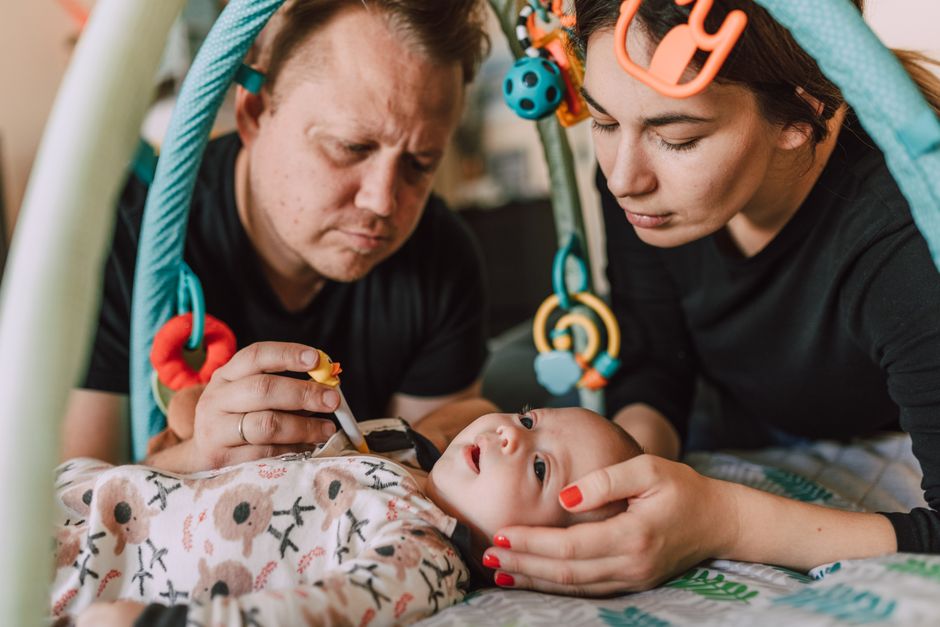
Most newborns lose a significant amount of their hair between 2 and 4 months of age. This is a completely normal part of infant development. The hair falls out because of shifting hormones, not because of anything you did or did not do. It happens to nearly every baby, whether they are born with a full head of hair or none at all.
Why Do Newborns Lose Their Hair?
Your baby grows hair while inside the womb. That first hair is called lanugo when it is the fine, soft body hair, but the hair on the scalp is also part of the early hair cycle. During pregnancy, high levels of maternal hormones circulate through the placenta and into the baby. Those hormones stimulate the baby’s hair follicles to stay in a growing phase.
After birth, those maternal hormones drop quickly. When that hormonal support disappears, the baby’s hair follicles shift into a resting phase. Then, around 2 to 4 months of age, that resting hair falls out to make room for new, permanent hair. This is a natural shedding process. It mirrors what happens to many women who experience temporary hair shedding after pregnancy, just on a smaller scale.
It is important to understand that the hair loss is not caused by friction. Many parents worry that rubbing against the crib mattress or a car seat caused the bald spots. While friction can contribute to a patchy appearance, the primary driver is the hormonal shift. The hair would fall out regardless of how the baby sleeps or sits.
When Exactly Does Newborn Hair Fall Out?
The timing varies from baby to baby. However, the most common window is between 8 and 16 weeks of age. Some babies start shedding earlier, around 6 weeks. Others do not lose their hair until 5 or 6 months. A few babies lose very little hair at all.
The pattern of loss also varies. Some babies lose hair evenly across the whole scalp. This can look like gradual thinning. Other babies lose hair in patches, often at the back of the head where they spend the most time lying down. Many babies develop a bald ring around the back of the scalp. This is sometimes called cradle baldness, but it is not a medical problem.
Parents often notice the hair coming out on clothing, bedding, or in the bath. It can look like a lot of hair, but it is rarely as much as it appears. The new hair is growing in at the same time the old hair is falling out. This means the scalp is never truly bare for long.
What Does the New Hair Look Like?
The hair that grows in after the shedding is often completely different from the birth hair. A baby born with dark, straight hair may grow light, curly hair. A baby born with red hair may grow brown hair. This surprises many parents.
This change happens because the hair follicles reset. The texture, color, and thickness of the new hair are determined by genetics, but they may not match the baby’s appearance at birth. The hair follicle is still maturing. It can take until a child is 2 years old for the final hair texture to establish itself.
The new hair may also grow in unevenly. Some babies look like they have a mullet or a receding hairline for a few months. This is normal. The hairline often fills in gradually. Some babies develop a prominent widow’s peak that later disappears. None of these patterns indicate a health problem.




Is Hair Loss in Newborns Ever a Concern?
In the vast majority of cases, newborn hair loss requires no treatment and no investigation. However, there are a few signs that warrant a conversation with a pediatrician. If your baby develops bald patches that are completely smooth and round, this could indicate a fungal infection called ringworm. This is uncommon in newborns but possible.
If the hair loss continues past 6 months without any new growth, it is worth mentioning at a well-child visit. If your baby loses hair in patches along with redness, scaling, or crusting on the scalp, that may indicate a skin condition that needs evaluation. If the hair loss happens suddenly and in clumps, that is also worth a check.
Hair loss accompanied by other symptoms is more concerning. If your baby is not gaining weight, is unusually lethargic, or has skin changes elsewhere on the body, seek medical advice. In rare cases, hair loss can be linked to thyroid issues or nutritional deficiencies. These are rare in healthy, full-term infants who are feeding well.
Parents should never use over-the-counter hair growth products on a baby. No shampoo, oil, or supplement has been proven to accelerate newborn hair growth. These products are not tested for infant safety and can irritate a baby’s sensitive scalp.
What Can Parents Do During the Shedding Phase?
There is no way to prevent newborn hair loss. It is a biological process, not a condition. You do not need to do anything. The hair will regrow on its own timeline.
You can, however, care for the scalp gently. Wash the baby’s hair with a mild baby shampoo no more than two or three times per week. Avoid vigorous scrubbing. Use a soft brush or a wide-tooth comb if you want to style the hair. Never pull or tug at loose hairs.
If your baby has cradle cap, which is a common scaly scalp condition, you can gently massage a small amount of baby oil into the scalp and then brush it out after a few minutes. Always rinse thoroughly afterward. Some pediatricians recommend a mild dandruff shampoo for stubborn cases, but only under medical guidance.
Do not use hats to cover bald spots unless the weather requires it. Babies do not lose body heat through the scalp more than anywhere else. Keeping the scalp uncovered allows air to circulate and keeps the area dry.
How Long Until the Hair Looks Normal?
Most babies have a full, even head of hair by their first birthday. For some, it takes until 18 months. The timeline depends on genetics. Some families have babies who are bald until age 2 and then suddenly grow thick hair. Others have babies with full hair at 6 months.
The new hair grows slowly. On average, hair grows about half an inch per month. This means it takes several months for the new hair to become noticeable. Patience is the only real strategy.
It is also normal for the hair to fall out again later. Toddlers often experience a second, milder shedding phase between 12 and 24 months. This is also hormonal and is not a cause for concern.
Frequently Asked Questions
When do newborns lose their hair?
Most newborns lose their hair between 2 and 4 months of age. This is caused by dropping maternal hormones after birth.
Is it normal for a newborn to go bald?
Yes, complete baldness in a newborn is normal. The hair falls out to make room for new, permanent hair that grows in over the following months.
Does rubbing on the crib cause newborn hair loss?
Friction can worsen patchiness but is not the main cause. The primary cause is the hormonal shift after birth.
When should I worry about my baby’s hair loss?
See a doctor if hair loss continues past 6 months with no regrowth, or if it comes with redness, scaling, or other symptoms. Isolated hair loss without other signs is almost always normal.
