
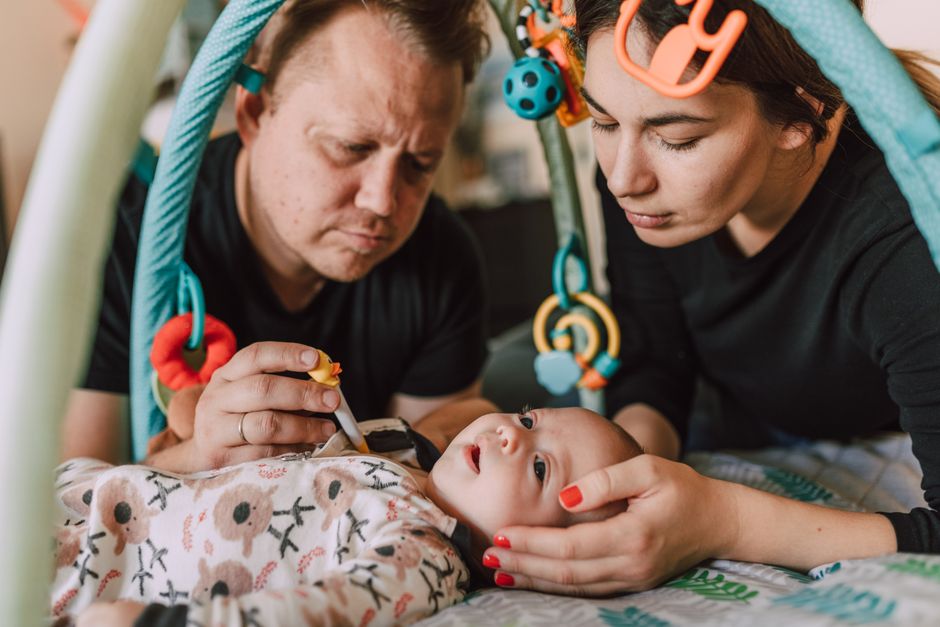
Your baby was born with a soft head of hair, and now it is thinning, patchy, or gone. This is normal, and it happens to a large share of babies. Newborn hair loss is driven by hormones and the natural hair growth cycle, not by anything you did or failed to do. The hair almost always grows back.
Most of the shedding you notice in the first few months is not hair “falling out” in the way adults lose hair. It is a normal transition. Hair that formed before birth was never meant to stay. Understanding why makes the process far less worrying.
Why Do Newborns Lose Their Hair? Science Explained
Babies are born with hair follicles that are already in different stages of the hair growth cycle. Some are actively growing, some are resting, and some are ready to shed. After birth, hormonal changes trigger many of those resting follicles to release their hair at roughly the same time. The result is visible thinning or patches over the first few months.
Two things are happening at once. First, hormone levels shift. Before birth, a baby is exposed to maternal hormones that can keep hair follicles in a growing phase. After delivery, those hormone levels drop. Without that signal, many follicles shift into a resting phase and then shed. Second, the hair growth cycle itself is resetting. Every person’s hair cycles through growth, transition, rest, and shedding phases, and a newborn’s cycle is simply syncing up for the first time.
This is the same basic mechanism behind the heavy hair shedding many women notice a few months after giving birth. The trigger is different, but the pattern is similar: a hormonal change pushes a large number of follicles to shed around the same time.
What the shedding actually looks like
Hair loss in newborns usually shows up in a few recognizable ways. It can be a gradual thinning all over the scalp. It can be more obvious at the temples and the back of the head. It can also appear as rubbing-related bald patches, which are covered in a separate section below.
The timing tends to follow a loose pattern. Some babies lose hair within the first few weeks. Others keep their newborn hair for several months before it thins. There is wide normal variation, and the exact timing does not indicate a problem.
Is Newborn Hair Loss Normal?
Yes. Hair loss in the first several months is a normal part of development for many babies. It is not a sign of illness, poor nutrition, or a scalp problem in most cases.
Newborn hair is often different from the hair that eventually grows in. The first hair can be finer, a different color, or a different texture than what comes later. This is because the hair that forms in the womb is replaced by a new generation of hair as the follicles mature. Parents are sometimes surprised when their baby’s dark newborn hair is replaced by lighter hair, or vice versa. That change is expected.
What is not typical is hair loss accompanied by other symptoms. If shedding comes with a rash, scaling, redness, crusting, or signs of discomfort, that is a reason to check with a pediatric clinician. Hair loss on its own, without other symptoms, is usually just the normal cycle playing out.
When hair loss is part of a medical condition
Some conditions can cause hair loss in infants, and they look different from ordinary newborn shedding. These are uncommon, but worth knowing about so you can raise concerns with a doctor.
- Ringworm of the scalp, a fungal infection, can cause patches of hair loss with scaling or broken hairs. It needs medical treatment.
- Alopecia areata, an autoimmune condition, can cause smooth round bald patches. It can affect infants, though it is not common at this age.
- Nutritional deficiencies, such as low iron or zinc, can contribute to hair thinning. These are diagnosed by a clinician, not guessed at home.
- Some genetic and hormonal conditions can affect hair growth. These typically come with other signs and are identified by a doctor.
None of these should be assumed. Ordinary newborn shedding is far more common than any of them. The point is simply that hair loss with additional symptoms deserves a professional look.
Why Does My Baby’s Hair Rub Off at the Back of the Head?
The bald patch at the back of the head is one of the most common patterns parents notice, and it has a simple mechanical explanation. Babies spend a lot of time on their backs, and they turn their heads side to side. That repeated friction against a mattress, sheet, or car seat can wear away hair in the area that presses against the surface.
This is sometimes called friction or position-related hair loss. It is not caused by the baby sleeping on the back being harmful. In fact, placing babies on their backs to sleep is the recommended safe sleep position and is important for reducing the risk of sudden infant death syndrome. The hair loss is a cosmetic side effect of a practice that protects the baby.
As your baby starts to sit up, roll over, and spend more time off the back of the head, the friction decreases. Hair in that area typically grows back once the pressure and rubbing stop. There is no need to change sleep position to prevent this.
Why the back-of-head patch can look worse before it gets better
Around the same time friction is wearing away hair at the back, the normal hormonal shedding may be thinning hair elsewhere. The two effects can overlap. That combination can make the back-of-head patch look larger or more noticeable than either cause alone would produce.
This overlap is why some parents feel like their baby is losing hair everywhere at once. It is usually two normal processes happening at the same time, not a sign that something is wrong.




How Long Does Newborn Hair Loss Last?
Most newborn hair shedding happens within the first few months of life. The exact window varies from baby to baby. Some lose hair early, some later, and some barely lose any at all.
New hair usually starts to grow in as the shedding phase ends. The first real growth of a baby’s more permanent hair often becomes visible somewhere between the middle of the first year and the toddler months. The hair that comes in may be a different color or texture than the newborn hair it replaces.
Full, thick hair can take longer. Many toddlers still have fine or sparse hair well past their first birthday, and this is within the range of normal. Hair density and texture continue to change through early childhood.
If hair loss is still ongoing and significant well beyond the first year, or if it is accompanied by other symptoms, that is a reasonable time to ask a pediatric clinician about it.
What Can Parents Do About Newborn Hair Loss?
There is no treatment that speeds up normal newborn hair loss, because it is not a problem to fix. The most useful thing parents can do is avoid products and practices marketed to “restore” or “thicken” baby hair. These claims are not supported by evidence, and some products are not appropriate for infant skin.
A few gentle habits support scalp health without trying to change the natural process.
- Wash the scalp gently with a mild baby shampoo. You do not need to wash daily.
- Avoid tight hats, headbands, or hairstyles that pull on the scalp.
- Keep the scalp clean and dry, and watch for any rash, scaling, or crusting.
- Give your baby supervised tummy time, which reduces time spent pressing on the back of the head.
Tummy time is worth mentioning for two reasons. It reduces friction on the back of the head, and it supports general motor development. It should always be supervised and done while the baby is awake.
What not to do
Do not apply oils, creams, or home remedies to a baby’s scalp unless a clinician recommends them. Do not use adult hair products on an infant. And do not shave a baby’s head in the belief that it will make hair grow back thicker. That idea is a myth. Shaving does not change the number, thickness, or growth rate of hair follicles. It only removes the hair that is already there, and the new hair that grows in will have the same characteristics as before.
When Should You Talk to a Doctor About Baby Hair Loss?
Most newborn hair loss does not need medical attention. Certain signs do warrant a call to your pediatric clinician. These include hair loss with a rash, scaling, redness, or crusting on the scalp, patches of broken hairs, or bald spots that are smooth and round.
Other reasons to check in include hair loss that continues well past the first year, hair loss along with poor weight gain, lethargy, or other signs of illness, or hair loss that seems to bother your baby. Trust your instincts. If something looks different from ordinary shedding, it is reasonable to ask.
Bringing it up does not mean something is wrong. It means you noticed something and want it checked. That is exactly what well-child visits are for.
Frequently Asked Questions
Is it normal for a newborn to lose hair?
Yes, hair loss in the first few months is normal for many babies. It is usually caused by shifting hormone levels and the natural reset of the hair growth cycle after birth, not by illness.
How long does newborn hair loss last?
Most shedding happens within the first few months of life, though the exact timing varies. New hair typically begins growing in as the shedding phase ends.
Does shaving a baby’s head make hair grow back thicker?
No. Shaving removes existing hair but does not change the number, thickness, or growth rate of the follicles. The hair that grows back has the same characteristics as before.
When should I worry about my baby’s hair loss?
Talk to a pediatric clinician if hair loss comes with a rash, scaling, crusting, or broken hairs, or if it continues well past the first year. Hair loss on its own without other symptoms is usually normal.
