
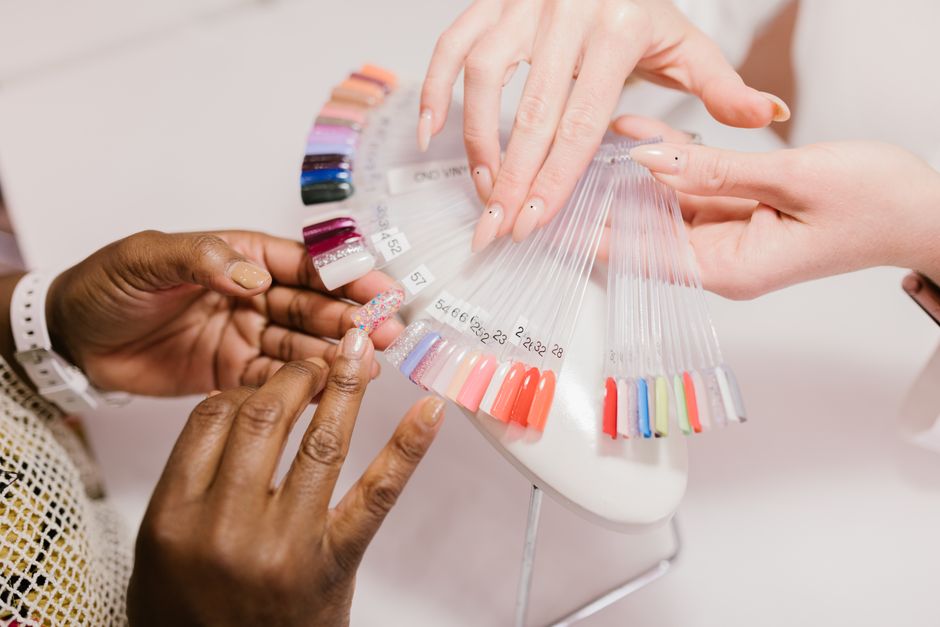
Nail salons use two kinds of ultraviolet light for gel manicures: fluorescent UV lamps, which emit mostly UVA light, and LED lamps, which emit a narrower band of UVA light. Both cure gel polish. The real difference is speed, bulb life, and how much UV energy reaches your skin — not whether one is “safe” and the other is not.
If you have ever sat with your hands under a small lamp and wondered what it is actually doing, the answer is simple: it triggers a chemical reaction that hardens gel polish. UV and LED lamps both do this. They just do it differently.
What UV light do nail salons use UV vs LED?
Traditional UV nail lamps use fluorescent bulbs that emit broadband UVA light, typically in the range of about 340 to 400 nanometers. LED nail lamps emit a narrower slice of UVA, usually around 365 to 405 nanometers. Both fall in the UVA part of the spectrum, which is the longer-wavelength, lower-energy portion of ultraviolet light.
Neither type is a tanning bed. The output is low, the exposure is short, and the light is aimed at a small area of skin. But UVA is UVA. It penetrates the skin and can cause damage with enough cumulative exposure.
The key point people miss: this is not UV versus no UV. It is UV from a fluorescent bulb versus UV from a light-emitting diode. Both are ultraviolet.
How does each type of lamp cure gel polish?
Gel polish contains photoinitiators — molecules that absorb light at specific wavelengths and start a chain reaction. That reaction links the liquid monomers into a hard polymer network. This is called curing, and it cannot happen without the right light.
Traditional UV lamps produce a broad spectrum of UVA. That broad output can activate a range of photoinitiators, which is one reason older gel formulas were designed for these lamps.
LED lamps produce a narrow, concentrated band of UVA. Modern gel formulas are built around that specific wavelength. The result is a faster cure, because the lamp delivers more usable light energy in less time.
Here is the part that trips people up. A gel polish made for a UV lamp may not cure properly under an LED lamp, and the reverse is also true. The photoinitiators have to match the wavelength. This is why some salons still keep both types on hand.
Is LED better than UV for nail lamps?
LED lamps are faster and last longer, but “better” depends on what you mean. For curing speed, LED wins clearly. For compatibility, it depends on the polish. For skin exposure, the difference is smaller than most people assume.
Some research suggests LED lamps can deliver a higher intensity of UVA in a shorter time, while fluorescent UV lamps deliver lower intensity over a longer time. The total UV dose to your hands may end up in a similar range. That is not a reason to panic. It is a reason to stop thinking of LED as automatically safer.
LED lamps do have practical advantages:
- Faster cure times, often under a minute per coat
- Bulbs that do not need frequent replacement
- More consistent output over the life of the lamp
- Lower heat output in some designs
Fluorescent UV lamps tend to be cheaper to buy but need bulb changes, and their output can fade over time. A weak lamp means undercured gel, which peels, chips, and can trap moisture against the nail.



How much UV exposure do you actually get?
The UV dose from a single gel manicure is low compared with a session in a tanning bed. Studies that measured nail lamp output have generally found the exposure per manicure to be a small fraction of what a tanning bed delivers.
That said, “low” is not “zero.” UVA exposure is cumulative over your lifetime. Regular gel manicures — every two to three weeks for years — add up. The evidence on whether this level of exposure meaningfully raises skin cancer risk on the hands is limited and not settled.
What is well established: UVA damages skin. It contributes to photoaging, and it plays a role in skin cancer risk with enough exposure. The question is whether nail lamps deliver enough to matter for most people. The honest answer is that no large study has confirmed a clear cancer link from nail lamps alone, and no study has ruled one out either.
Some case reports have described skin changes on the hands of people with heavy, long-term gel manicure habits. Case reports are not proof of cause. They are signals that prompted more research, not conclusions.
Does UV nail light cause skin cancer?
There is no confirmed link between occasional gel manicures and skin cancer. The concern is theoretical and based on the known biology of UVA, not on strong human data from nail lamps specifically.
This is a place where a lot of online content overstates things in both directions. Some sources claim nail lamps are completely harmless. Others claim they are a serious cancer risk. Neither position is well supported by the evidence.
What the evidence supports:
- UVA is a known contributor to skin damage and skin cancer risk with sufficient exposure
- Nail lamps emit UVA, but at low levels per use
- Repeated use over many years increases cumulative exposure
- No large human study has confirmed nail lamps cause skin cancer
People at higher baseline risk — those with a history of skin cancer, fair skin, or photosensitivity conditions — may reasonably choose to limit exposure. That is a personal risk decision, not a proven medical requirement.
Can you reduce UV exposure during a gel manicure?
You can lower the UV reaching your skin without skipping the manicure. The most practical step is wearing fingerless UV-protective gloves, which cover the hand and leave the nails exposed. These are widely available and are used in some salons.
Other options:
- Apply broad-spectrum sunscreen to your hands about 15 to 20 minutes before your appointment
- Ask whether the salon uses an LED lamp, which may mean shorter total exposure time
- Take breaks between gel manicures rather than keeping them continuously
- Choose regular polish if you want to avoid UV entirely
Sunscreen on the hands is not perfect here. The lamp sits close to the skin, and people often wipe or rest their hands in ways that remove it. Gloves tend to be more reliable. Neither method has been tested in large trials specifically for nail lamp exposure, so treat them as reasonable precautions rather than proven protections.
One clarification worth making: the UV risk is to your skin, not your nails. Gel polish itself and the curing process do not damage the nail plate through UV. Nail damage from gel manicures usually comes from the removal process — filing, acetone, and peeling — not the lamp.
What about LED lamps marketed as UV-free?
Some products are marketed as “UV-free” LED lamps. In most cases this is misleading. LED nail lamps that cure standard gel polish emit UVA light. That is ultraviolet light. Calling it UV-free is a marketing claim, not a scientific one.
There are lamps that use different curing chemistry or visible light, but those require matching polish systems and are not the standard salon setup. If a lamp cures traditional gel polish, it is almost certainly emitting UV.
If a product claims to be UV-free and also cures any gel polish, that claim deserves scrutiny. No study has confirmed that combination works the way the marketing suggests.
The bottom line on UV vs LED nail lamps
Both UV and LED nail lamps use ultraviolet light to cure gel polish. LED is faster and more durable. UV fluorescent lamps are cheaper and still common. Neither is UV-free, and neither is proven to cause cancer from typical salon use.
The exposure per manicure is low, but it is not nothing, and it adds up with frequent, long-term use. If you get gel manicures regularly, gloves or sunscreen on your hands are reasonable steps. If you have a personal or family history of skin cancer, talk with a dermatologist about your own risk rather than relying on general claims online.
Frequently Asked Questions
Do nail salons use UV or LED lamps?
Many salons use LED lamps because they cure faster, but plenty still use traditional fluorescent UV lamps. Some keep both because certain gel formulas only cure under one type.
Is LED nail light safer than UV?
Not necessarily. LED lamps still emit UVA light, just in a narrower wavelength range. The total UV dose to your hands may be similar to a UV lamp because LED delivers higher intensity in less time.
Can gel manicures cause skin cancer?
No large human study has confirmed that nail lamps cause skin cancer. UVA exposure is a known skin cancer risk factor, but the low dose from occasional manicures has not been shown to raise risk on its own.
How can I protect my hands during a gel manicure?
Fingerless UV-protective gloves are the most practical option because they cover the skin and leave the nails exposed. Broad-spectrum sunscreen on the hands can help too, though it may rub off during the appointment.
