
What Muscles Does Walking Work in Your Lower Body?
Your lower body does most of the work when you walk. Each step requires a chain of muscles firing in sequence.
Your glutes (buttocks) are the largest muscles involved. They extend your hip and push your body forward. Many people have weak glutes from sitting all day. Walking helps wake them up.
Your quadriceps (front thighs) straighten your knee as your leg swings forward. They also help control your descent when you walk downhill.
Your hamstrings (back thighs) bend your knee and help pull your leg backward. They work with your glutes to drive you forward.
Your calves push off the ground at the end of each step. Your tibialis anterior (shin muscle) lifts your toes so you don’t trip.
Research shows that walking on flat ground activates these muscles at a moderate level. Walking uphill shifts more work to your glutes and calves. Walking downhill puts more demand on your quadriceps and shins.
Does Walking Work Your Core Muscles?
Yes, but not the way crunches do. Walking requires your core to stabilize your torso against the movement of your legs and arms.
Your transverse abdominis (deep core muscle) engages with each step. It helps maintain posture and prevents your pelvis from tilting too far forward.
Your obliques (side abs) fire to control rotation. When your right leg swings forward, your left oblique engages to keep your torso from twisting too much.
Your erector spinae (lower back muscles) hold your spine upright. Weak lower back muscles often lead to poor walking posture and pain.
A 2021 study found that walking at a brisk pace increased core muscle activation by roughly 30 percent compared to slow walking. But walking alone will not give you a six-pack. It builds endurance in your core, not size.
How Does Walking Speed Change Which Muscles You Work?
Speed matters a lot. Slow walking and brisk walking recruit muscles differently.
| Walking Speed | Primary Muscles Used | Intensity Level |
|—————|———————|—————–|
| Slow (under 2 mph) | Calves, hip flexors | Low |
| Moderate (2-3 mph) | Glutes, quads, hamstrings | Moderate |
| Brisk (3-4 mph) | Glutes, calves, core | Moderate to high |
| Power walking (4+ mph) | Glutes, hamstrings, arms, core | High |
At slow speeds, your hip flexors do more lifting of your leg. At brisk speeds, your glutes and hamstrings become the main drivers. Your arms also swing more, which activates your shoulders and upper back.
Power walking with exaggerated arm motion can engage your latissimus dorsi (back wings) and pectorals (chest) slightly. But do not expect arm swinging alone to build upper body muscle.


What Muscles Does Walking Work in Your Upper Body?
Walking is not an upper body workout. But your upper body does participate.
Your shoulders move with each arm swing. The deltoids and rotator cuff muscles stabilize your shoulder joint.
Your upper back muscles, including the rhomboids and trapezius, help keep your shoulders back. If you walk hunched forward, these muscles barely activate.
Your chest muscles engage slightly when your arms cross in front of your body during the swing.
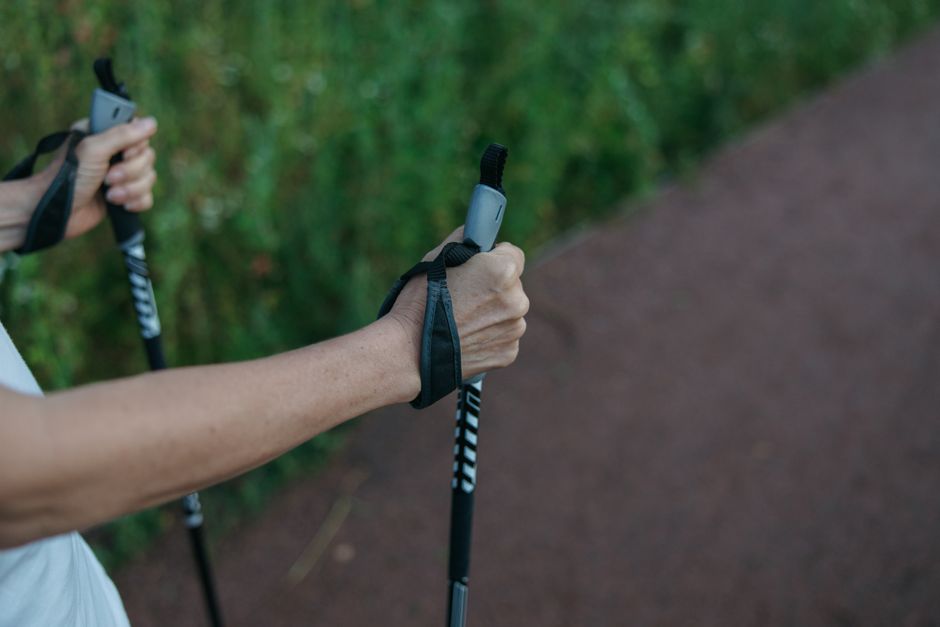
Some people report that walking with poles (Nordic walking) significantly increases upper body muscle use. Current research suggests Nordic walking activates the triceps and latissimus dorsi about 15-20 percent more than regular walking. But regular walking alone does not strengthen your upper body.
What Are Common Misconceptions About Walking and Muscle?
Many viral claims about walking are overblown. Here is what the evidence actually shows.
Walking does not build visible muscle. Walking builds muscular endurance, not size. To grow muscle, you need resistance that challenges the muscle to near failure. Walking does not provide that. If you want bigger legs or glutes, you need weights or hill sprints.
Walking does not spot-reduce fat. You cannot walk off belly fat by working your abs. Fat loss happens systemically. Walking burns calories, which helps overall fat loss. Where your body loses fat first is genetic.
Walking does not fix poor posture automatically. It can help if you walk with good form. But many people walk with rounded shoulders and a forward head. That reinforces bad posture. You have to be intentional.
Walking on an incline does not build muscle like stair climbing. Incline walking activates your glutes and calves more than flat walking. But stair climbing requires more knee lift and single-leg strength. They are different exercises.
How to Maximize Muscle Activation While Walking
You can change how much your muscles work without changing your route.
Walk with good posture. Stand tall with your shoulders back and down. Engage your core by pulling your belly button slightly toward your spine. Look forward, not down at your feet.
Increase your speed. Brisk walking (3-4 mph) roughly doubles glute activation compared to slow walking. If you cannot walk faster, take shorter quicker steps.
Add hills. Walking uphill increases glute and calf activation by 30-50 percent compared to flat ground. Walking downhill works your quads and shins more.
Use intervals. Alternate 1 minute of fast walking with 2 minutes of moderate walking. This pattern increases overall muscle recruitment and calorie burn.
Swing your arms. Bend your elbows at 90 degrees and swing them naturally. This engages your shoulders and upper back slightly more.
Try Nordic walking poles. As of 2026, current research suggests Nordic walking increases upper body muscle activation by 15-25 percent compared to regular walking. It also reduces pressure on your knees.
Wear the right shoes. Walking shoes with good support let your foot strike naturally. Flat shoes with no support can change your gait and reduce muscle activation in your glutes.
Frequently Asked Questions
Does walking work your glutes enough to make them stronger?
Walking activates your glutes but not enough to significantly strengthen or grow them. For stronger glutes, add hill walking, stair climbing, or resistance exercises like squats.
Can walking replace leg day at the gym?
No. Walking builds endurance in your leg muscles but does not provide enough resistance to build size or strength. Leg day with weights targets muscles differently and more intensely.
Does walking work your abs?
Walking engages your deep core muscles for stabilization but does not work your abs like crunches or planks. You will not build visible abdominal muscles from walking alone.
How long do you need to walk to see muscle changes?
Walking consistently for 30-45 minutes most days can improve muscle endurance and tone within 4-8 weeks. Visible muscle growth is unlikely without added resistance.
