
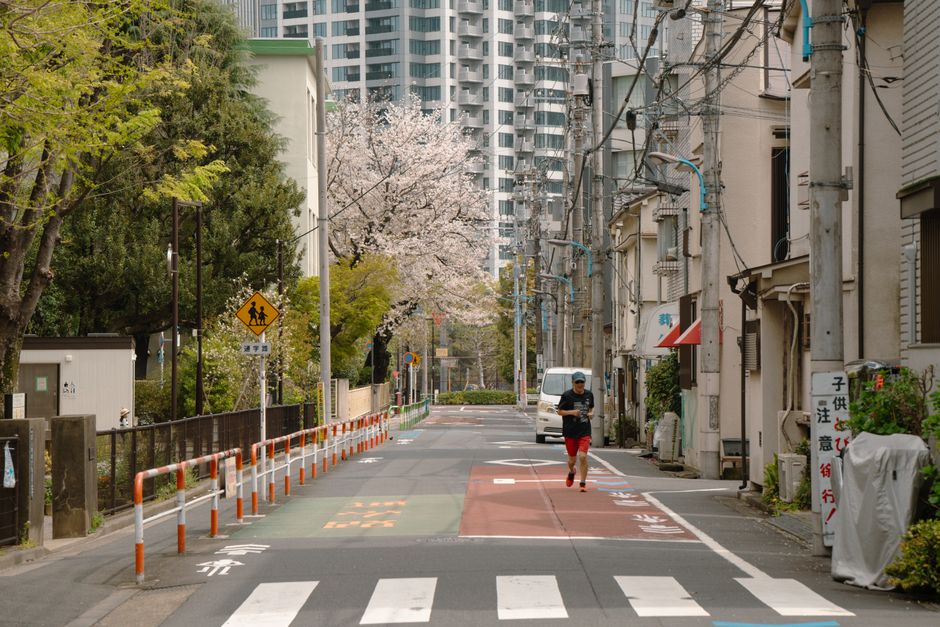
Japanese Walking, also known as Nihon Kenko Hoko, is a structured walking method developed by Japanese orthopedic surgeon Dr. Kiyoshi Oiwa. It focuses on walking with a straight spine, driving movement from the hips rather than the legs, and engaging the core muscles with each step. Unlike casual walking or power walking, this technique treats walking as a full-body exercise with specific rules for posture and movement.
What Is Japanese Walking?
Japanese Walking is a specific technique, not a general cultural practice. Dr. Oiwa developed it after observing that many of his patients walked with poor posture and uneven weight distribution. He designed a method that uses the body’s natural alignment to reduce strain on joints and improve walking efficiency.
The core principles of Japanese Walking include:
- Straight spine: The head, shoulders, and hips align vertically. You walk as if being gently pulled upward from the crown of your head.
- Hip-driven movement: The hips lead each step. The legs follow the hips rather than the hips following the legs.
- Core engagement: The abdominal and lower back muscles stay lightly activated throughout the walk.
- Natural arm swing: Arms swing from the shoulders, not the elbows. The motion is relaxed and unrestricted.
- Heel-to-toe roll: The foot lands on the heel and rolls smoothly through to the toes.
This technique is taught in Japan through workshops, classes, and instructional materials. It has gained international attention as people look for low-impact ways to improve posture and movement quality.
What Is the History of Japanese Walking?
Dr. Kiyoshi Oiwa, an orthopedic surgeon practicing in Japan, developed Nihon Kenko Hoko in the late 20th century. His clinical work involved treating patients with joint pain, back problems, and mobility issues. He noticed a pattern: many patients walked in ways that placed unnecessary stress on their knees, hips, and spine.
Oiwa studied human gait biomechanics and combined his observations with principles of body alignment. The result was a walking method designed to distribute force evenly through the body and reduce impact on individual joints.
The technique has been taught in Japan for decades. It appears in health programs for older adults, workplace wellness initiatives, and even some physical therapy settings. Outside Japan, interest in the method grew as part of a broader curiosity about Japanese health practices.
How Does Japanese Walking Differ From Regular Walking?
Most people walk in a way that their body has adapted to over years of habit. This often includes a slight forward lean, limited hip movement, and a foot strike that may be heavy or uneven. Japanese Walking deliberately changes each of these patterns.
| Feature | Regular Walking | Japanese Walking |
|---|---|---|
| Spine position | Often slightly curved or forward | Straight and aligned |
| Movement origin | Legs and feet | Hips and core |
| Foot strike | Variable heel, midfoot, or flat | Controlled heel-to-toe roll |
| Arm swing | Often from the elbows | From the shoulders, relaxed |
| Core engagement | Minimal to none | Active throughout |
| Pace | Any pace | Moderate, controlled |
The key difference is intentionality. Japanese Walking requires you to think about each component of your stride. It is not a natural walking style you can adopt without practice. Most people need instruction and repetition to learn the correct form.





What Does the Research Say About Japanese Walking?
The evidence on Nihon Kenko Hoko specifically is limited. Most studies come from Japan and involve small groups of participants. Some research suggests that practicing the technique may improve gait symmetry, reduce lower back pain, and increase hip mobility. However, large clinical trials have not been conducted, and the findings are not definitive.
What is better established is the general biomechanical principle behind the method. Walking with a straight spine and active hip engagement reduces compressive forces on the lower back and distributes load more evenly through the joints. Physical therapists and movement specialists often recommend similar postural cues regardless of whether they specifically teach Japanese Walking.
Dr. Oiwa himself has published on the technique, but independent research remains sparse. No major medical organization has issued guidelines endorsing Japanese Walking over other forms of walking. The method is best understood as a well-reasoned approach to walking posture that has some supporting evidence but not the level of proof expected for a clinical treatment.
How Do You Practice Japanese Walking?
Learning the technique takes practice. Here is a basic outline:
- Stand tall: Align your head, shoulders, and hips. Imagine a string pulling the crown of your head upward. Your chin stays level.
- Engage your core: Gently tighten your abdominal muscles. Do not hold your breath.
- Step with your hips: Shift your weight to one hip, then let that hip move forward to initiate the step. Your leg follows.
- Roll through the foot: Land on your heel. Roll forward through the arch to the toes. Push off with your toes.
- Let your arms swing naturally: Arms swing from the shoulders. Keep your shoulders relaxed.
- Keep your head level: Do not bob up and down. Your head should stay at the same height with each step.
Start with short sessions of five to ten minutes. Focus on form rather than distance or speed. Many people find it helpful to watch video demonstrations or work with an instructor trained in the method.
Walking on a flat, even surface is best when learning. As you become comfortable with the technique, you can apply it to outdoor walking on various terrain.
Is Japanese Walking the Same as Forest Bathing?
No. These are two distinct practices that are sometimes confused.
Forest bathing, or Shinrin-yoku, is a Japanese practice of mindful immersion in a forest environment. It involves walking slowly, paying attention to the senses, and being present in nature. The focus is on mental and emotional well-being rather than on specific walking mechanics.
Japanese Walking is a structured physical technique focused on posture and movement. You can practice it anywhere — on a sidewalk, in a hallway, or on a track. It does not require nature or mindfulness, though you could combine the two.
The confusion likely arises because both practices originate from Japan and involve walking. But their purposes and methods are different. Forest bathing is about sensory experience. Japanese Walking is about how you move your body.
Who Might Benefit From Japanese Walking?
The technique may be useful for several groups of people, though individual results vary.
People who sit for long hours often develop tight hips and a forward-leaning posture. Japanese Walking encourages hip mobility and spinal alignment that counteracts these effects.
Older adults may find the method helpful for improving gait stability and reducing fall risk. The emphasis on controlled, deliberate movement aligns with principles taught in fall prevention programs.
Individuals with chronic lower back pain sometimes benefit from improved walking mechanics. Reducing excessive lumbar curve and engaging the core can take pressure off the spine. However, anyone with persistent pain should consult a healthcare provider before starting a new movement practice.
Athletes and fitness enthusiasts may use the technique to improve movement efficiency and reduce injury risk during walking or running.
The method is not a treatment for any medical condition. It is a movement practice. For people without underlying joint or spine problems, it is generally safe. Anyone with existing injuries or chronic conditions should check with a doctor or physical therapist first.
What Are the Limitations of Japanese Walking?
No single walking method is right for everyone. Japanese Walking requires conscious effort and practice. It is not a spontaneous, natural walking style. Some people find the postural demands difficult to maintain for long periods.
The evidence base is small. While the biomechanical logic is sound, the technique has not been rigorously tested against other walking methods in large trials. Claims about weight loss, pain relief, or long-term health improvements are not well supported by independent research.
It is also worth noting that Japanese Walking is a commercialized method. Dr. Oiwa’s books, DVDs, and training programs are sold worldwide. This does not mean the technique lacks value, but it means the information you find online and in marketing materials may emphasize benefits over limitations.
Finally, the technique may not be appropriate for people with certain orthopedic conditions, such as severe arthritis, hip replacements, or spinal fusions. A physical therapist or medical professional can help determine whether the method is suitable for your specific situation.
Frequently Asked Questions
What is Japanese Walking?
Japanese Walking, or Nihon Kenko Hoko, is a walking method developed by Dr. Kiyoshi Oiwa that emphasizes a straight spine, hip-driven movement, and core engagement.
How do you do Japanese Walking?
Stand tall with your head, shoulders, and hips aligned, engage your core, and initiate each step by moving your hip forward while rolling your foot from heel to toe.
What are the benefits of Japanese Walking?
Some evidence suggests it may improve posture, reduce lower back strain, and increase hip mobility, but large clinical trials confirming these benefits are lacking.
Is Japanese Walking the same as forest bathing?
No, forest bathing is a mindfulness practice focused on sensory immersion in nature, while Japanese Walking is a structured physical technique focused on movement mechanics.
