

Push-ups are a staple exercise for a reason: they work a large portion of your upper body and core in a single movement. The primary muscles targeted are the chest (pectoralis major), the front of the shoulders (anterior deltoids), and the back of the upper arms (triceps). However, push-ups are not just an upper-body exercise; they also require significant engagement from your core and legs to keep your body in a straight, rigid line.
What Muscle Do Push Ups Work Most?
The chest is the main muscle group doing the heavy lifting during a standard push-up. The pectoralis major, a large fan-shaped muscle covering the upper chest, is responsible for bringing your arms together across your body, a motion called horizontal adduction. This is the primary action when you lower your chest toward the floor and push yourself back up.
The triceps brachii, located on the back of your upper arm, is the second major player. It is responsible for straightening your elbow, which is the driving force that extends your arms and lifts your body away from the ground. The front portion of your deltoid, the shoulder muscle, also works hard to assist in this pushing motion.
The degree to which each muscle is activated changes based on your hand position. A wider hand placement shifts more of the workload to the chest muscles. A narrower hand placement, where your hands are closer together, forces your triceps to work harder.
What Other Muscles Are Engaged During a Push-Up?
While the chest, shoulders, and triceps are the primary movers, a push-up is a compound exercise. This means it involves multiple joints and muscle groups working together to complete the movement. Several other muscles throughout your body act as stabilizers to keep you balanced and maintain proper form.
The muscles that stabilize your body during a push-up are critical for preventing injury and maximizing the effectiveness of the exercise:
- Core muscles: Your rectus abdominis (six-pack muscles), obliques, and transverse abdominis work isometrically to keep your spine neutral and prevent your hips from sagging or piking.
- Lower back: The erector spinae muscles along your spine also contract to maintain a straight line from your head to your heels.
- Legs and glutes: Your quadriceps and gluteal muscles contract to keep your legs straight and anchor your lower body. This engagement is essential for maintaining the rigid plank position.
- Serratus anterior: This muscle runs along your ribcage and helps to stabilize your shoulder blades against your ribs. It plays an important role in healthy shoulder function during pushing movements.
Think of your body as a single unit. If your core and legs are not engaged, your form will break down, and the exercise becomes less effective and potentially unsafe for your lower back.
How Do Different Push-Up Variations Change the Muscle Focus?
Changing the angle of your body or the position of your hands can shift the emphasis of the exercise. This allows you to target specific muscles more directly or make the movement easier or harder without needing any equipment.
Here is a breakdown of how some common variations alter the muscle focus:
- Incline push-ups: Performed with your hands on an elevated surface like a bench or counter. This makes the exercise easier and places slightly less emphasis on the lower chest, shifting more focus to the shoulders.
- Decline push-ups: Performed with your feet elevated on a bench or step. This increases the difficulty and shifts more of the workload to the upper chest and shoulders.
- Wide-grip push-ups: Hands placed wider than shoulder-width. This increases the activation of the chest muscles and reduces the range of motion for the triceps.
- Diamond push-ups: Hands placed close together under your chest, forming a diamond shape with your thumbs and index fingers. This variation significantly increases triceps activation compared to a standard push-up.
- Pike push-ups: Starting in a downward dog position with your hips high, you lower the top of your head toward the floor. This variation heavily targets the shoulders (deltoids) and is a good bodyweight approximation for an overhead press.
If you are looking to build overall upper body strength, mastering the standard push-up is the most effective starting point. Once you can perform 20 to 25 repetitions with perfect form, you can begin incorporating variations to continue challenging your muscles.
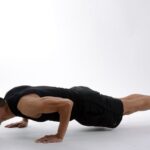




What Is the Correct Push-Up Form?
Proper form is the most important factor for getting the benefits of push-ups and avoiding injury. Performing a push-up with poor form can reduce muscle activation and put unnecessary strain on your shoulders and lower back.
Follow these steps for a correct standard push-up:
- Start in a plank position: Place your hands slightly wider than shoulder-width apart, with your fingers pointing forward. Your body should form a straight line from your head to your heels.
- Engage your core and glutes: Squeeze your abdominal muscles and glutes to lock your body into a rigid position. Avoid letting your hips sag or stick up in the air.
- Lower your body: Bend your elbows and lower your chest toward the floor. Keep your elbows at roughly a 45-degree angle from your torso, not flared straight out to your sides. Lower yourself until your chest is just above the ground or until your elbows reach about a 90-degree angle.
- Push back up: Press through your palms and push your body back up to the starting position until your arms are fully extended.
If you cannot perform a full push-up with this form, start with incline push-ups on a stable counter or bench. This allows you to build the necessary strength while maintaining a safe and effective movement pattern.
Can Push-Ups Build Significant Muscle?
Yes, push-ups can build muscle, especially for beginners or those returning to exercise after a break. The principle of muscle growth, known as progressive overload, states that muscles grow when they are challenged with increasing amounts of resistance or volume over time.
For a beginner, a standard push-up provides a significant challenge to the chest, shoulders, and triceps. As you get stronger, you need to increase the difficulty to continue seeing muscle growth. This is where variations become essential. Research on resistance training shows that muscle growth can be achieved with a wide range of rep schemes, not just the often-cited 8-12 rep range. Performing a challenging set of push-ups to near failure, whether that is 10 reps or 40 reps, can be a sufficient stimulus for muscle protein synthesis.
However, for more advanced lifters, push-ups alone may not be enough to build substantial additional muscle mass. The body adapts to the load, and bodyweight exercises have a ceiling for resistance. To continue building significant chest and triceps size, most people will eventually need to add external resistance, such as a weighted vest or a barbell bench press. Push-ups remain a valuable exercise at any level, but they function best as one part of a comprehensive training program rather than the sole method for advanced muscle growth.
Frequently Asked Questions
How many push-ups should I do a day?
There is no single correct number; it depends on your current fitness level and recovery ability. A good starting goal is to perform 3 sets of as many quality repetitions as you can manage, aiming to reach or approach muscular fatigue on the last set.
Do push-ups work the lower chest?
Yes, the entire pectoralis major muscle, which includes the lower portion, is activated during a standard push-up. However, performing decline push-ups with your feet elevated increases the activation of the lower chest fibers.
Will push-ups give me a bigger chest?
Yes, push-ups can increase chest muscle size, particularly if you are new to strength training. To continue seeing growth, you must progressively make the exercise harder by adding reps, slowing down the tempo, or performing more difficult variations like decline or weighted push-ups.
Do push-ups work the biceps?
Push-ups are a pushing exercise, so they primarily work the chest, shoulders, and triceps. The biceps, which are on the front of the upper arm, act as a minor stabilizer but are not a primary mover and will not experience significant growth from push-ups alone.
