
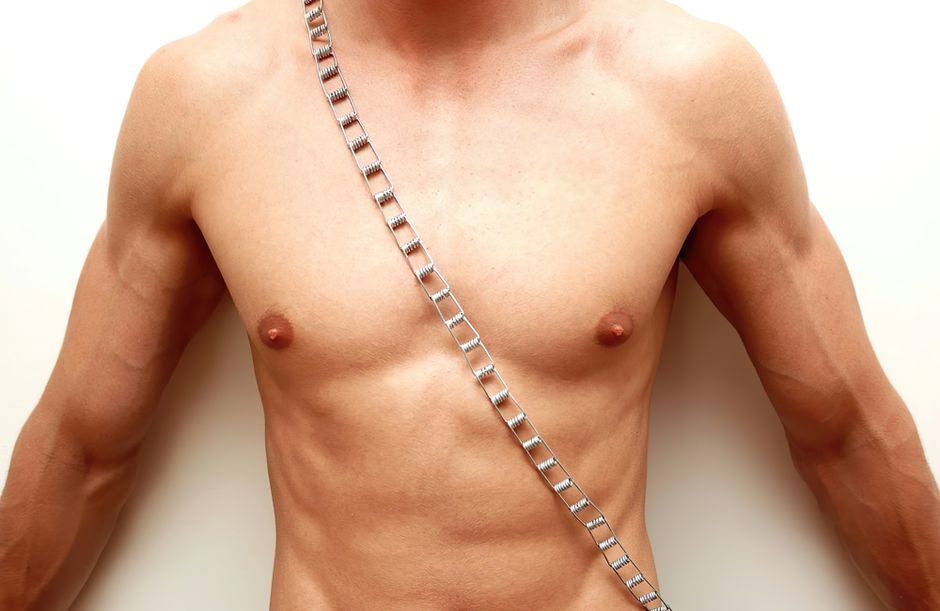
Pectus excavatum is a chest wall deformity in which the breastbone, or sternum, is pushed inward toward the spine. This creates a sunken or “funnel” appearance in the center of the chest. It is the most common congenital chest wall abnormality, present from birth in most cases but often becoming more noticeable during the adolescent growth spurt.
The condition occurs in roughly 1 in 400 to 1 in 1,000 births, and it affects boys more often than girls. Many people with pectus excavatum have no symptoms beyond the appearance of their chest. Others experience breathing difficulty during exercise, chest discomfort, or concerns about body image. The severity varies widely, from a mild dip that is barely noticeable to a deep indentation that presses against the heart and lungs.
What Is Pectus Excavatum?
Pectus excavatum is a structural difference in the chest wall. The cartilage that connects the ribs to the sternum grows abnormally, pulling the sternum backward. This is not a disease of the bone itself. The sternum is typically normal. The problem lies in the costal cartilage — the flexible tissue that links the ribs to the breastbone.
The condition is usually visible at birth or within the first few years of life. In many children, it becomes more pronounced during the rapid growth spurt of puberty, when the chest wall grows unevenly. The depth and symmetry of the indentation can vary significantly from person to person.
Pectus excavatum is sometimes called “funnel chest” or “sunken chest.” It is distinct from pectus carinatum, or “pigeon chest,” where the sternum protrudes outward instead of inward. These are different conditions with different treatment approaches.
Most cases are considered cosmetic or mild. However, a subset of people — particularly those with deeper indentations — can experience real physical effects. The sternum can compress the heart and reduce the space available for the lungs to expand. This does not mean the heart or lungs are diseased. It means their mechanical environment is altered.
What Causes Pectus Excavatum?
The exact cause is not fully understood. Research points to abnormal overgrowth of the costal cartilage, but why this happens remains an area of active study. The condition is not caused by anything a parent did or did not do during pregnancy.
There is a genetic component. Pectus excavatum runs in families, and having a close relative with the condition increases the likelihood. However, no single gene has been identified as responsible. It appears to be multifactorial, meaning multiple genetic and possibly environmental factors contribute.
In a minority of cases, pectus excavatum occurs alongside other conditions. These include Marfan syndrome, a connective tissue disorder, and scoliosis, a curvature of the spine. When pectus excavatum appears with other physical findings, a doctor may evaluate for underlying syndromes. This is not common, but it is worth noting because it affects how the condition is managed.
Some people assume pectus excavatum is caused by poor posture or childhood injury. Neither is supported by evidence. The deformity is structural and developmental, not behavioral.
What Are the Symptoms of Pectus Excavatum?
Many people with pectus excavatum have no symptoms at all. The condition is often noticed visually before any physical complaint arises. When symptoms do occur, they tend to fall into three categories: breathing, heart-related, and psychological.
Breathing difficulty during exercise is the most common physical complaint. People may feel short of breath sooner than expected during physical activity. This happens because the indented sternum can reduce the volume of the chest cavity, limiting how much the lungs can expand. It does not mean the lungs are damaged. It means they have less room to work with.
Some people report chest pain or tightness. This is usually mild and may be related to the pressure of the sternum on surrounding structures or to muscle strain from altered posture. Severe chest pain is not typical and should be evaluated by a doctor for other causes.
Heart-related symptoms are less common but can occur with deeper indentations. The sternum can press against the heart, potentially affecting its function. In severe cases, this may lead to palpitations, reduced exercise tolerance, or changes visible on an echocardiogram. These findings do not necessarily mean the heart is failing. They mean its mechanical environment is altered, and a cardiologist can assess whether this matters clinically.
The psychological impact should not be dismissed. Adolescents and adults with visible chest differences often report body image concerns, social anxiety, and reduced quality of life. These are real effects. They are not vanity. Research consistently shows that body image distress related to chest wall deformities can be significant and warrants attention.





How Is Pectus Excavatum Diagnosed?
Diagnosis is usually straightforward and begins with a physical examination. A doctor can often see and feel the indentation. They may measure the depth of the defect and assess its symmetry.
Imaging is used to evaluate severity and impact on internal organs. A chest X-ray can show the position of the sternum and heart. A CT scan or MRI may be ordered to measure the Haller index, a ratio that compares the width of the chest to the distance between the sternum and spine. A Haller index above 3.2 is generally considered severe, though this threshold is a guide, not an absolute rule.
Pulmonary function tests may be done to see how well the lungs are working. An echocardiogram can check heart function and look for compression. These tests help determine whether the condition is purely cosmetic or has functional consequences.
In children, the condition is often first noticed by a pediatrician during a routine well-child visit. In adults, it may be identified incidentally during imaging for another reason or when someone seeks evaluation for exercise intolerance or body image concerns.
What Treatment Options Exist for Pectus Excavatum?
Treatment depends on severity, symptoms, and personal goals. Not everyone needs treatment. Many people with mild pectus excavatum live full, active lives without intervention.
For those who do seek treatment, options fall into two main categories: surgical and non-surgical.
Surgical options include the Nuss procedure and the Ravitch procedure. The Nuss procedure involves inserting a curved metal bar behind the sternum to push it outward. The bar stays in place for about two to three years and is then removed. The Ravitch procedure is more invasive and involves removing abnormal cartilage and reshaping the chest wall. Both are major surgeries with risks including infection, bar displacement, and recurrence. They are typically reserved for people with significant functional impairment or severe body image distress.
Non-surgical options include the vacuum bell, a device that uses suction to gradually lift the sternum. It is most effective in younger patients with flexible chest walls and milder deformities. It requires consistent use over months to years. Evidence for its effectiveness is growing but not as robust as for surgery. Some clinicians recommend it; others are skeptical. It is not a guaranteed fix.
Physical therapy and exercise can help improve posture and core strength, which may reduce some symptoms. They do not correct the deformity itself. However, they can be valuable for overall function and comfort.
For people who choose not to pursue treatment, regular monitoring may be recommended, especially during growth spurts. This allows a doctor to track any changes and address concerns as they arise.
Does Pectus Excavatum Affect Long-Term Health?
For most people with mild pectus excavatum, long-term health is not significantly affected. Life expectancy is generally normal. The condition does not typically progress to cause heart or lung failure.
For those with more severe indentations, the picture is more nuanced. Some studies suggest that severe pectus excavatum can reduce exercise capacity and, in rare cases, contribute to heart rhythm issues or valve problems. However, these outcomes are not inevitable. Many people with even moderate deformities remain asymptomatic throughout life.
The evidence on long-term cardiovascular outcomes is mixed. Some research indicates that surgical correction can improve exercise tolerance and heart function, but not all studies show consistent benefits. The decision to pursue surgery should be based on individual symptoms and evaluation, not on a fear of future problems that may never materialize.
Mental health is a real consideration. Body image concerns can persist into adulthood and affect relationships, career choices, and overall quality of life. Addressing these concerns — whether through counseling, peer support, or treatment — is a legitimate part of managing the condition.
Living With Pectus Excavatum
Most people with pectus excavatum do not need to change their lives dramatically. They play sports, work, and engage in daily activities without limitation. For those who do experience symptoms, the key is to get an accurate assessment and make informed choices.
It helps to understand that pectus excavatum is not a sign of weakness or poor health. It is a structural variation. It does not define a person’s capabilities. Many athletes, public figures, and everyday people have the condition and lead active, fulfilling lives.
If you or your child has pectus excavatum, the first step is a conversation with a doctor who can evaluate severity and discuss options. Not every case needs treatment. But every case deserves an honest assessment and a clear understanding of what the condition means for that individual.
Frequently Asked Questions
Is pectus excavatum serious?
For most people, it is a cosmetic concern with no serious health effects. In severe cases, it can compress the heart and lungs, leading to exercise intolerance or other symptoms that warrant medical evaluation.
Can pectus excavatum be fixed without surgery?
A vacuum bell device can gradually lift the sternum in some younger patients with flexible chest walls. It requires consistent use and does not work for everyone, and evidence for its effectiveness is less established than for surgery.
Does pectus excavatum get worse with age?
It often becomes more noticeable during the adolescent growth spurt. After growth stops, it typically stabilizes. In some adults, age-related changes in the chest wall may make it appear slightly more pronounced.
Can I exercise with pectus excavatum?
Yes. Most people with pectus excavatum can and should exercise. If you experience shortness of breath or chest pain during activity, talk to your doctor about evaluation and any necessary precautions.
