
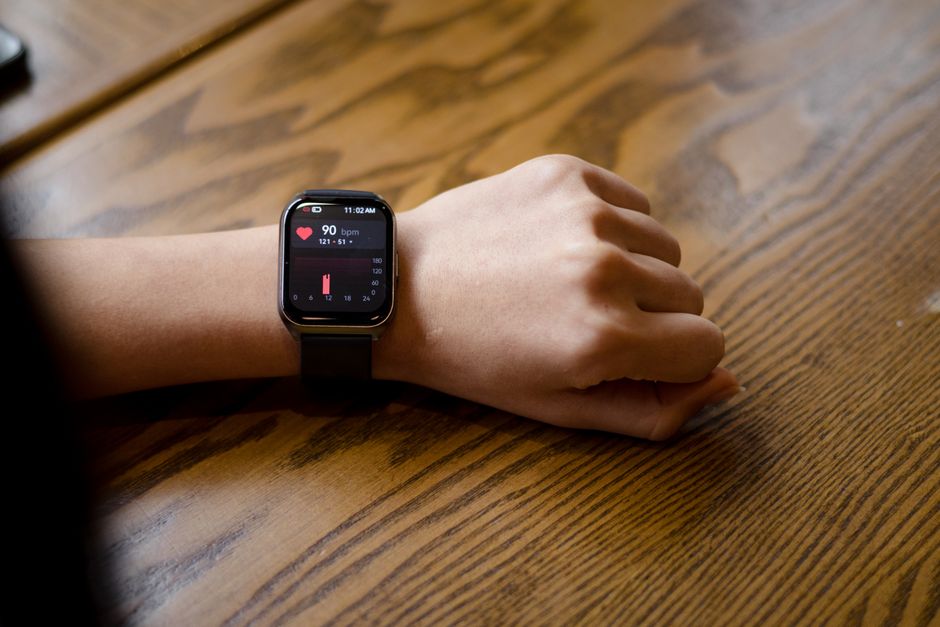
Your fat burning heart rate is the exercise intensity where your body gets the largest share of its energy from fat rather than carbohydrates. For most adults, that falls somewhere between 60% and 70% of your maximum heart rate. A common way to estimate your maximum heart rate is to subtract your age from 220.
That is the short answer. The longer answer is more interesting, because the idea of a single “fat burning zone” is one of the most misunderstood concepts in fitness.
What Does “Fat Burning Heart Rate” Actually Mean?
Your body burns a mix of fat and carbohydrate for fuel at almost every intensity. There is no switch that turns fat burning on or off.
At rest and during easy movement, fat supplies most of your energy. As you work harder, your body shifts toward carbohydrate because it can be broken down faster to meet rising demand. The “fat burning zone” refers to the intensity range where fat still contributes the largest percentage of your total energy use.
Percentage is the key word here. At low intensity you burn a higher percentage of fat, but you burn fewer total calories. At higher intensity you burn a lower percentage of fat, but far more total calories overall. Both matter for body composition, and the second one is often underestimated.
How Do I Calculate My Fat Burning Heart Rate?
You need two numbers: your maximum heart rate and your resting heart rate. The standard estimate for maximum heart rate is 220 minus your age.
From there, the fat burning range is generally described as 60% to 70% of that maximum. Here is what that looks like across a few ages using the 220-minus-age formula:
| Age | Estimated Max Heart Rate | 60-70% Range (beats per minute) |
|---|---|---|
| 35 | 185 | 111-130 |
| 45 | 175 | 105-123 |
| 55 | 165 | 99-116 |
| 65 | 155 | 93-109 |
Treat these as rough guides, not precise targets. The 220-minus-age formula has a real margin of error. Research has consistently found that it can be off by 10 to 12 beats per minute for many people, and the error tends to be larger at the extremes of age. Your true maximum may sit well above or below the estimate.
A more individualized approach uses the Karvonen formula, which factors in your resting heart rate:
- Step 1: Measure your resting heart rate first thing in the morning, before getting out of bed.
- Step 2: Subtract your resting rate from your estimated maximum to get your heart rate reserve.
- Step 3: Multiply that reserve by 0.6 and by 0.7 to get your low and high percentages.
- Step 4: Add your resting heart rate back to each number.
This method tends to be more accurate for people who are fit or who have a low resting heart rate, because it accounts for how much your heart rate can actually rise.
Why the “Fat Burning Zone” Is Overhyped
The fat burning zone exists. What does not hold up is the idea that training only in this zone is the best way to lose body fat.
When researchers compare exercise programs, higher-intensity training generally produces equal or greater fat loss than lower-intensity training for the same amount of time. The reason is simple arithmetic. Higher intensity burns more total calories, and a smaller percentage of a larger number can still be a bigger number than a larger percentage of a smaller one.
There is a second factor at play. After higher-intensity exercise, your body continues to burn slightly more calories for a period of recovery. This effect is real but modest, and it is easy to overstate. It is not the main reason high-intensity work helps with fat loss. Total energy expenditure is.
There is one more thing worth knowing. The percentage of energy coming from fat during exercise does not directly predict how much body fat you lose over weeks or months. Fat loss comes down to total energy balance over time, not the fuel mix during a single workout.




Should I Train in the Fat Burning Zone or Not?
Both approaches have a place, and the best choice depends on your goals, your fitness level, and what you will actually stick with.
Lower-intensity training in the 60-70% range has genuine advantages:
- It is easier to sustain for long sessions, which builds aerobic base and endurance.
- It places less stress on joints, muscles, and the heart, which matters if you are new to exercise or recovering.
- It allows for more weekly training volume without excessive fatigue.
- It is comfortable enough to do while carrying on a conversation.
Higher-intensity training has its own strengths:
- It burns more calories per minute.
- It improves cardiovascular fitness and blood sugar control more efficiently in less time.
- It can be more time-efficient for people with busy schedules.
For most healthy adults, a mix works well. Easy sessions build your base. Harder sessions push your fitness. Neither one is wasted, and neither one alone is magic.
How Do I Know Which Zone I Am In Without a Monitor?
You do not need a heart rate monitor to gauge intensity. Your body gives clear signals.
The talk test is a reliable, low-tech method. If you can speak in full sentences comfortably, you are likely in the lower to moderate range, near the fat burning zone. If you can only manage a few words before needing a breath, you are working harder. If you cannot speak at all, you are near your limit.
Perceived effort is another guide. On a scale of 1 to 10, the fat burning zone usually feels like a 4 to 6. You are breathing deeper than at rest but not gasping. You could hold the pace for a while.
Wearable monitors can help, but they are not perfect. Wrist-based optical sensors can lag or misread during certain activities, and they are less accurate during rapid changes in intensity. Chest straps tend to be more reliable. If a monitor reading does not match how you feel, trust how you feel.
Does the Fat Burning Zone Change With Fitness?
Yes. As you get fitter, your body becomes more efficient at using fat, and it does so at higher intensities than before.
Trained endurance athletes can draw heavily on fat at intensities that would leave an untrained person breathless. This is one reason the fixed 60-70% range is a starting point rather than a permanent rule. Your zones shift as your fitness changes.
This also means the fat burning zone is not a fixed target you graduate past. It moves with you. Rechecking your resting heart rate every few months, or simply paying attention to how your usual pace feels, can tell you whether your zones have shifted.
What Matters More Than Hitting a Specific Number?
Consistency beats precision. A workout done at a slightly “wrong” heart rate is far better than a workout skipped because you could not hit an exact target.
For fat loss specifically, the bigger levers are total activity, overall calorie intake, sleep, and stress. Heart rate zones are a tool for structuring training, not a guarantee of results on their own. No heart rate range can outwork a consistent energy surplus.
If you have a heart condition, take medications that affect heart rate, or are new to vigorous exercise, talk with a clinician before pushing into higher intensities. Some medications, including certain blood pressure drugs, lower heart rate and make standard formulas less accurate for you. In that case, perceived effort is often a better guide than a calculated number.
Frequently Asked Questions
What is a good fat burning heart rate for my age?
A common estimate is 60% to 70% of your maximum heart rate, where maximum is roughly 220 minus your age. For a 45-year-old, that is about 105 to 123 beats per minute, though individual variation is significant.
Is the fat burning zone better for weight loss?
Not necessarily. Higher-intensity exercise typically burns more total calories and produces equal or greater fat loss for the same time, so the fat burning zone is not superior for weight loss.
How long should I stay in my fat burning heart rate?
There is no single recommended duration, and it depends on your fitness and goals. Standard physical activity guidance for adults is at least 150 minutes of moderate-intensity activity per week, which can be split up however works for you.
Can I burn fat without reaching my fat burning heart rate?
Yes. Your body uses fat for fuel at rest and during light activity, so fat burning happens outside any specific zone. Fat loss ultimately depends on total energy balance over time.
