
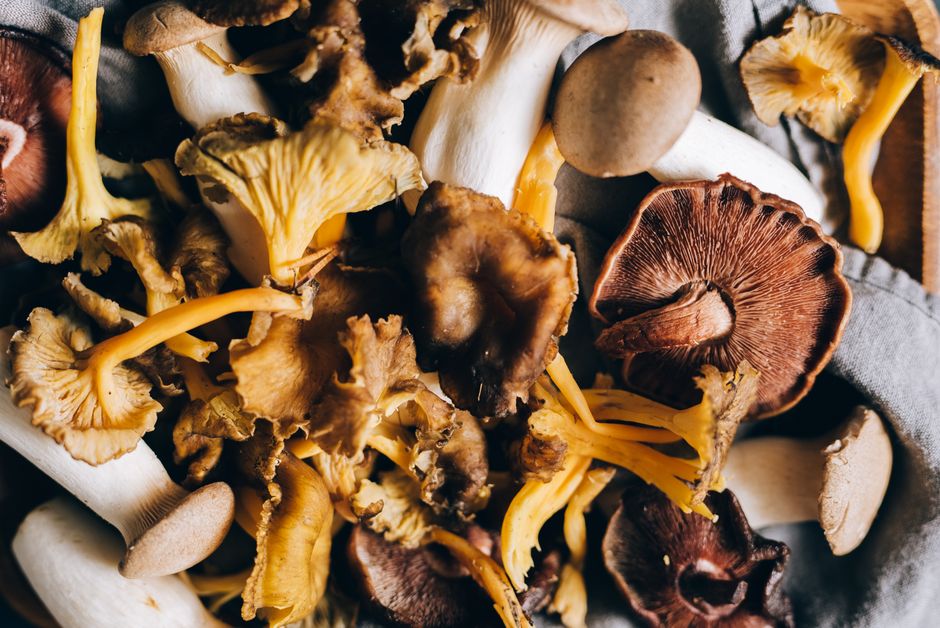
King trumpet mushrooms are the thick-stemmed, meaty mushrooms you may see labeled as king oyster mushrooms. They are a good source of dietary fiber, several B vitamins, and minerals like potassium and copper, and they provide a small amount of protein for a vegetable. What sets them apart in the kitchen is their texture — sliced and seared, the stems hold a firm, almost scallop-like bite that most mushrooms cannot match.
They are not a medicinal mushroom in the way reishi or turkey tail are studied. Their value is nutritional and culinary. They are low in calories, low in fat, and easy to cook in ways that fit a normal diet.
What Is King Trumpet Mushroom Good For Nutrition Health?
King trumpet mushrooms contribute useful amounts of fiber, B vitamins, and minerals while adding very few calories. A cup of raw sliced mushroom is roughly 30 to 40 calories, with almost no fat and a small amount of protein.
The fiber matters. Mushrooms contain both soluble and insoluble fiber, and the soluble portion includes beta-glucans — a type of polysaccharide found in the cell walls of many fungi. Beta-glucans from oats and barley have well-documented effects on cholesterol. The beta-glucans in mushrooms are structurally similar but have not been studied in king trumpet mushrooms with the same rigor, so it would be wrong to claim the same cholesterol-lowering effect. What is fair to say is that the fiber content supports normal digestion and contributes to satiety.
The B vitamins present include niacin, riboflavin, and pantothenic acid. These support energy metabolism — meaning the chemical reactions that convert food into usable energy — not energy in the sense of a stimulant effect. That distinction gets blurred constantly in supplement marketing.
Potassium is present in meaningful amounts. Potassium helps counterbalance sodium and plays a role in blood pressure regulation. The exact potassium content varies with growing conditions, so treat any single number as approximate.
One practical point: mushrooms are roughly 90 percent water by weight. That means the nutrient density looks modest per 100 grams, but you are also eating very few calories. The trade-off is favorable.
Are King Trumpet Mushrooms the Same as King Oyster Mushrooms?
Yes. King trumpet and king oyster are two common names for the same species, Pleurotus eryngii. It belongs to the same genus as oyster mushrooms, which is why the names overlap.
The confusion comes from marketing. Different retailers pick whichever name sounds better on a label. Some stores sell them as “eringi,” which is the Japanese name. All three refer to the same mushroom.
This matters when you are following a recipe or comparing prices. You are not choosing between two products. You are looking at the same product under different labels.
What Nutrients Do King Trumpet Mushrooms Actually Contain?
The table below reflects typical values for raw king trumpet mushrooms. Growing conditions, substrate, and freshness all shift these numbers, so treat them as general ranges rather than fixed figures.
| Nutrient | Typical Amount (per 100 g raw) | What It Does |
|---|---|---|
| Calories | ~30–40 kcal | Very low energy density |
| Protein | ~2–3 g | Small but real plant protein |
| Total fat | <0.5 g | Negligible |
| Carbohydrate | ~6–7 g | Includes fiber |
| Fiber | ~2–3 g | Digestion, satiety |
| Potassium | ~300–400 mg | Blood pressure balance |
| Niacin (B3) | ~3–4 mg | Energy metabolism |
| Riboflavin (B2) | ~0.2 mg | Energy metabolism |
| Copper | ~0.1–0.2 mg | Iron metabolism, connective tissue |
Two things stand out. First, the protein content is low compared to beans, lentils, or tofu. Calling king trumpet mushrooms a protein source overstates the case. They contribute protein, but they are not a protein food.
Second, the mineral content is sensitive to how the mushroom was grown. Mushrooms absorb minerals from their growing substrate, which is why the same species can vary between producers. This is not a flaw — it is normal biology.





Do King Trumpet Mushrooms Have Any Proven Health Benefits?
No large human trials have confirmed specific health benefits from eating king trumpet mushrooms. This is the honest position, and it deserves to be stated plainly.
What exists is a mix of laboratory work and studies on mushroom compounds in general. Some research suggests that beta-glucans from fungi can influence immune markers in laboratory settings. Whether that translates into measurable health outcomes in people eating mushrooms as food is not established.
Some studies indicate that regular mushroom consumption as part of a diet is associated with favorable health markers. But association is not causation. People who eat more mushrooms may also eat more vegetables overall, exercise more, or smoke less. Researchers try to control for these factors, but they cannot eliminate them entirely.
What is well established is simpler. Replacing a portion of meat with mushrooms reduces the calorie and saturated fat content of a meal. That is a real effect, and it does not require any special claim about the mushroom itself.
Be skeptical of any product that describes king trumpet mushrooms as an immune booster, a cancer fighter, or a cognitive enhancer. Those claims are not supported by clinical evidence in humans. If a supplement bottle makes them, the bottle is selling hope, not data.
How Should You Cook King Trumpet Mushrooms to Get the Most From Them?
Cooking affects both texture and nutrient availability. The firm stem is the reason this mushroom works so well for high-heat cooking.
Slice the stems into thick rounds or lengthwise planks. Sear them in a dry pan first to release moisture, then add oil. This produces browning rather than steaming. The caps are more delicate and cook faster.
A few practical points:
- Mushrooms release water when heated. Salting too early draws out more moisture and prevents browning.
- Some nutrients, including certain B vitamins, are sensitive to prolonged high heat. Shorter cooking times preserve more of them.
- Mushrooms are best stored in a paper bag in the refrigerator. Plastic traps moisture and speeds spoilage.
- Never eat them raw in large amounts. Raw mushrooms contain small amounts of compounds that cooking breaks down, and raw chitin is harder to digest.
One clarification worth making: the idea that cooking mushrooms destroys all their nutrients is overstated. Some loss occurs, but cooking also breaks down cell walls, which can make certain compounds more available for absorption. The net effect is not as one-sided as the raw-food argument suggests.
Who Should Be Careful With King Trumpet Mushrooms?
Most people can eat king trumpet mushrooms without issue. There are a few situations where caution is reasonable.
People with a known mushroom allergy should avoid them. Mushroom allergies are uncommon but real, and reactions can range from mild skin irritation to more serious responses.
Anyone with kidney disease should talk to their doctor about potassium intake. King trumpet mushrooms are not especially high in potassium compared to bananas or potatoes, but if you have been told to restrict potassium, that conversation matters more than the specific food.
People taking blood thinners should keep their vitamin K intake steady. Mushrooms are not a major vitamin K source, but any change in diet that shifts vitamin K intake can affect how some blood thinners work. This is a conversation for your prescriber, not a reason to avoid mushrooms.
People with gout have historically been told to limit mushrooms because they contain purines. The evidence for restricting purine-rich vegetables in gout is weak, and current thinking focuses more on alcohol, sugary drinks, and meat. If you have gout, ask your doctor rather than cutting foods based on old advice.
Foraging is a separate issue. King trumpet mushrooms are cultivated commercially and widely available. Do not forage for wild mushrooms unless you are trained to identify them. Several toxic species resemble edible ones, and mushroom poisoning can be life-threatening.
Frequently Asked Questions
Are king trumpet mushrooms healthy?
They are a low-calorie food that provides fiber, B vitamins, and minerals like potassium and copper. They are a useful addition to a balanced diet, but they are not a medicinal food with proven disease-fighting effects.
How much protein is in king trumpet mushrooms?
Roughly 2 to 3 grams of protein per 100 grams raw, which is low compared to beans, lentils, or tofu. They contribute protein but should not be counted as a primary protein source.
Can you eat king trumpet mushrooms raw?
They are generally cooked before eating, and cooking is recommended. Raw mushrooms contain small amounts of compounds that heat breaks down, and raw chitin is harder to digest.
Are king trumpet mushrooms the same as king oyster mushrooms?
Yes, they are the same species, Pleurotus eryngii. King trumpet, king oyster, and eringi are all names for the same mushroom.
