
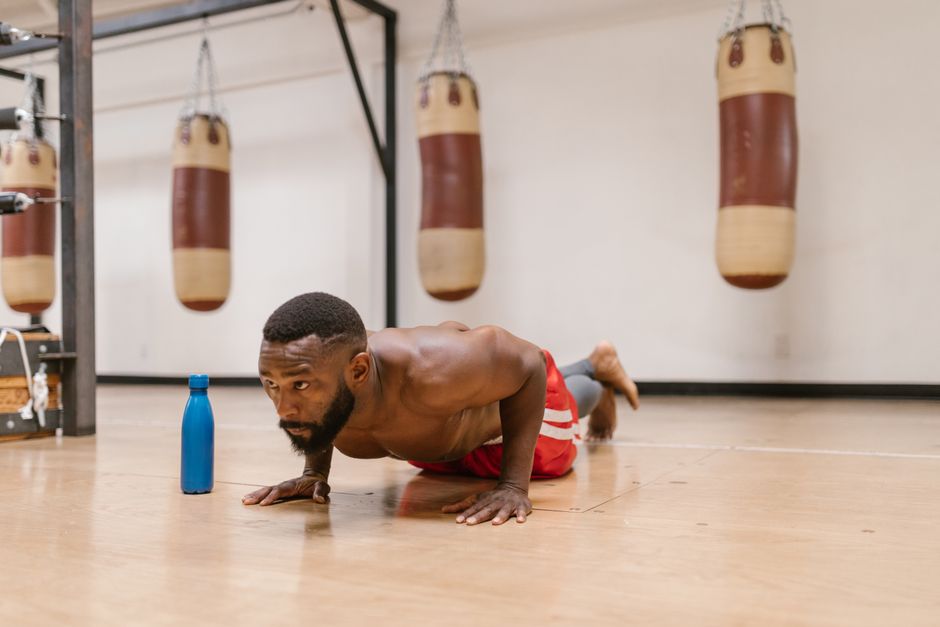
An up down exercise is any movement where your body moves between a higher position and a lower position in a controlled way. The most common version is the up down plank, where you start in a forearm plank and press up onto your hands, then lower back down. You can also do up down exercises on a step, a stair, or the floor.
These movements train your shoulders, core, arms, and legs at the same time. The up down plank is the version most people mean when they search this term, so that is the one this article covers in detail.
What Is An Up Down Exercise And How Do You Do It?
The up down plank is a plank variation where you alternate between your forearms and your hands. It builds shoulder stability and core strength while adding movement to a static hold.
Here is the basic sequence for the up down plank, sometimes called a plank up down or plank to push-up position:
- Start in a forearm plank. Elbows under shoulders, forearms flat on the floor, feet hip-width apart.
- Keep your hips level. Do not let them rock side to side.
- Press your right palm into the floor and straighten that arm until your hand is under your shoulder.
- Do the same with your left arm. You are now in a high plank.
- Lower your right forearm back to the floor, then your left. You are back in a forearm plank.
- Repeat, leading with the opposite arm each time.
The movement looks simple. It is not easy. Your core has to stop your hips from twisting every time one arm lifts. That anti-rotation work is the main reason people do this exercise.
What Muscles Does The Up Down Plank Work?
The up down plank works your core, shoulders, chest, triceps, and glutes. The exact demand shifts as you move between positions.
In the forearm position, your deep abdominal muscles and your glutes hold your spine and hips still. As you press up, your triceps and shoulder muscles take on more load. Your chest assists near the top. Your hip muscles work the whole time to keep your pelvis from dropping or rotating.
Research on plank variations using electromyography, which measures electrical activity in muscle, consistently shows that the abdominals are highly active during plank holds. Adding the up down movement increases the demand on the shoulder stabilizers compared with a standard plank. That is the main mechanical difference between the two.
How Do You Do An Up Down Exercise On A Step?
The step version is a different exercise with a different purpose. You step up onto a platform with one foot, bring the other foot up, then step back down. It trains your legs and your heart and lungs rather than your core.
To do it:
- Face a step, bench, or platform that is stable and at a height where your knee stays bent when your foot is on top.
- Place your whole foot on the step, not just your toes.
- Push through that foot and stand up tall on the step.
- Step down with control, leading with the same foot or alternating, depending on your goal.
- Keep your torso upright and avoid pushing off your back foot.
Step height matters. A step that is too high makes your knee travel forward and puts more load on the kneecap. A height where your knee bends to about a right angle at the top is a common starting point for most adults. If you have knee pain, start lower and build up.





Is The Up Down Plank Safe For Your Back And Wrists?
The up down plank is generally well tolerated, but it puts real load on your wrists and lower back. Form errors are the usual cause of discomfort, not the exercise itself.
The most common mistake is letting the hips sag or rotate. When your hips drop, your lower back arches and takes load it is not built to hold in that position. The fix is to brace your abs and squeeze your glutes before you move an arm. If you cannot keep your hips level, the exercise is too hard for now.
Wrist pressure is the other issue. Holding body weight on extended wrists can aggravate existing wrist problems. If your wrists bother you, you have options:
- Do the movement with your hands on dumbbells, which keeps your wrist in a neutral position.
- Do a knee version, which reduces the load through your arms.
- Skip the up down and hold a standard forearm plank instead.
If you have a shoulder injury, wrist injury, or ongoing low back pain, talk to a clinician or physical therapist before adding this movement. That is not a generic warning. The up down plank loads the shoulder joint and the lumbar spine directly.
Up Down Plank Vs Standard Plank: What Is The Difference?
Both exercises train the core. The difference is that the up down version adds movement and shifts load to the shoulders and arms.
| Feature | Standard Plank | Up Down Plank |
|---|---|---|
| Position | Static hold | Moving between two positions |
| Main demand | Core stability | Core stability plus shoulder and arm strength |
| Joint load | Low | Higher on wrists and shoulders |
| Difficulty | Easier | Harder |
| Best for | Building a base of core endurance | Adding a shoulder and stability challenge |
If you can hold a forearm plank with good form for a solid stretch of time, the up down version is a reasonable next step. If you cannot yet keep your hips level in a standard plank, adding movement will not help. Build the static hold first.
How Many Reps And Sets Should You Do?
There is no single official rep scheme for the up down plank. It is a bodyweight stability exercise, not a lift with a published prescription. General strength training guidance from major health and sports bodies recommends working each major muscle group a few times per week with enough rest between sessions.
A practical approach for most adults:
- Start with 2 to 3 sets of 5 to 8 reps per side.
- Rest 30 to 60 seconds between sets.
- Do it 2 to 3 times per week on non-consecutive days.
These numbers are a starting point, not a clinical guideline. The real signal is form. Stop a set when your hips start to twist or sag. Quality beats quantity here, and doing more sloppy reps does not build more strength.
One thing worth knowing: the up down plank is often marketed as a way to burn belly fat or get a six-pack. No exercise targets fat in a specific spot. Spot reduction is not supported by research. Core exercises build and strengthen the abdominal muscles, but visible abs come from overall body fat levels, which depend on diet and total activity, not on which exercise you pick.
Common Mistakes To Avoid
Most problems with the up down plank come down to a few fixable errors.
- Rushing. Speed makes your hips rock. Move slowly and stay controlled.
- Letting the hips sag. Brace your core and squeeze your glutes before each arm move.
- Wide feet. A wider stance is easier but less stable. Keep feet about hip-width apart.
- Holding your breath. Breathe steadily through the whole set.
- Leading with the same arm every time. Alternate sides so both shoulders share the work.
If you cannot keep your hips level, drop to your knees. The knee version trains the same muscles with less load. Progress to the full version when you can do the knee version with clean form.
Who Should Modify Or Skip This Exercise?
Some people should adjust the up down plank or choose a different exercise.
If you are pregnant, the up down plank may not be comfortable or appropriate, especially later in pregnancy, because of the pressure it puts on the abdominal wall. Ask your healthcare provider what core work is right for you. No single exercise guideline covers every pregnancy.
If you have high blood pressure that is not well controlled, holding your breath during hard core work can spike blood pressure. Breathe continuously and check with your doctor about what intensity is safe.
If you have a hernia, recent abdominal surgery, or diastasis recti, which is a separation of the abdominal muscles, get clearance before doing planks or up down movements. These conditions change how much load your core can safely handle.
For everyone else, the up down plank is a solid addition to a general strength routine. It is not a magic exercise. It is one useful tool among many, and it works best alongside regular cardio, other strength work, and a diet that supports your goals.
Frequently Asked Questions
What is an up down exercise?
An up down exercise moves your body between a higher and lower position with control. The most common version is the up down plank, which alternates between a forearm plank and a high plank.
How do you do an up down plank correctly?
Start in a forearm plank, press one hand then the other up to a high plank, then lower back to your forearms one arm at a time. Keep your hips level and alternate which arm leads.
What muscles does the up down plank work?
It works your core, shoulders, chest, triceps, and glutes. The shoulder and arm demand is higher than in a standard plank because you are moving your body weight through your arms.
Is the up down plank good for beginners?
It can be, but start with the knee version if you cannot keep your hips level in a full plank. Build a solid static plank first, then add the up down movement.
