
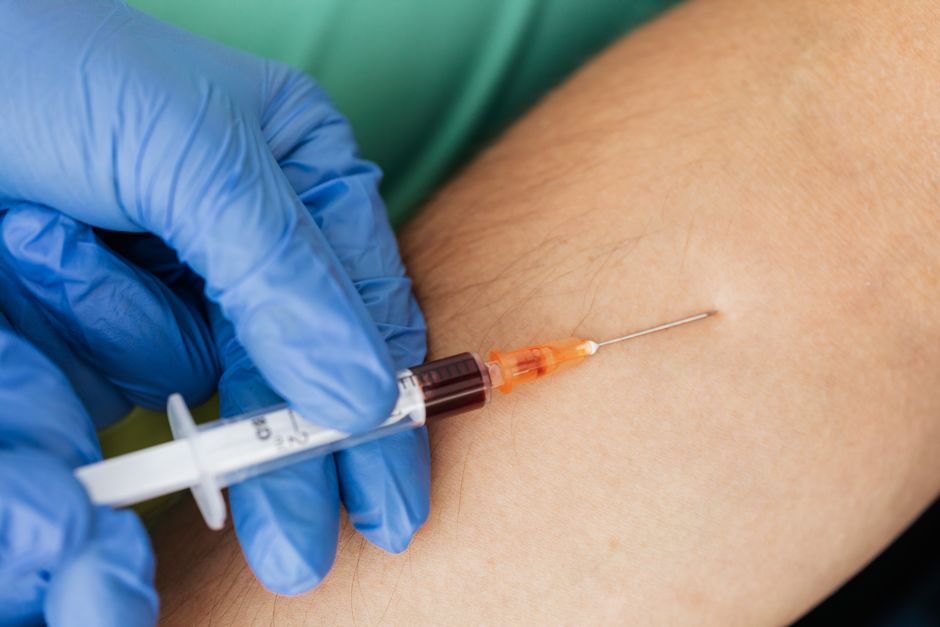
A rabies titer test is a blood test that measures the level of rabies virus-neutralizing antibodies in your blood. It does not tell you whether you are protected from rabies in any absolute sense. Instead, it gives a number that public health guidelines use to decide whether a vaccinated person still has adequate antibody protection or needs another dose. People who need it most often include veterinarians, animal control workers, laboratory staff who handle the virus, and some international travelers.
What Is A Rabies Titer Test And Who Needs One?
The test itself is straightforward. A blood sample is drawn and sent to a laboratory that performs a specific assay. The most widely used method is the rapid fluorescent focus inhibition test, usually shortened to RFFIT. Some labs use a similar test called the fluorescent antibody virus neutralization test, or FAVN.
Both tests measure the same thing: how well antibodies in your blood can neutralize live rabies virus in a laboratory dish. The result is reported as a titer, which is the highest dilution of your blood that still neutralizes the virus.
The World Health Organization and the US Centers for Disease Control and Prevention have long used a titer of 0.5 international units per milliliter as the threshold for adequate antibody response after vaccination. This is a well-established reference point, not a recent change. A result at or above 0.5 IU/mL is generally considered adequate in the context of a person who has already been vaccinated.
This threshold applies to vaccinated people. It does not apply to someone who has never received the rabies vaccine, and it does not replace wound care or post-exposure treatment after a possible exposure.
Who typically needs this test
- Veterinarians, veterinary technicians, and veterinary students in rabies-endemic areas
- Animal control officers and wildlife handlers
- Laboratory workers who culture or handle rabies virus
- Rabies vaccine manufacturing staff
- Some long-term international travelers and expatriates in high-risk regions
- People who received a full pre-exposure vaccine series and need periodic monitoring
The reason these groups get tested is practical. Rabies antibody levels can decline over time after vaccination. For most people, that decline does not mean they are unprotected, because the immune system retains memory cells that respond quickly to another dose. But for people at ongoing occupational risk, guidelines recommend periodic titer checks to confirm antibody levels are still adequate.
One clarification worth making: a titer below 0.5 IU/mL does not mean you have no protection. It means your circulating antibody level has dropped below the threshold used for monitoring. The standard response is a booster dose, not panic.
How Does The Rabies Titer Test Work?
The test is a functional assay, not a simple antibody count. That distinction matters.
Some blood tests just measure whether a specific antibody is present. The rabies titer test goes further. It mixes your blood serum with a known amount of live rabies virus and susceptible cells in a lab dish. If your antibodies are effective, they neutralize the virus and prevent it from infecting the cells. The lab then measures how much your serum had to be diluted before the virus broke through.
A higher titer means your antibodies are more concentrated and more effective at neutralizing the virus in that test system. A lower titer means the opposite.
This is why the test is considered a functional measure. It tests what your antibodies actually do, not just whether they exist.
The test requires a specialized laboratory. Not every hospital or clinic can run it. In the United States, a limited number of reference laboratories perform RFFIT or FAVN testing. This means results can take longer to come back than a routine blood test.
When Do You Need A Rabies Titer Test After Vaccination?
Timing depends on why you are being tested.
After a full pre-exposure rabies vaccine series, guidelines generally recommend checking a titer within a certain window to confirm the vaccine produced an adequate response. If the titer is at or above 0.5 IU/mL, that confirms a good response. If it is below, a booster dose is typically given.
For people with ongoing occupational risk, periodic monitoring is recommended. The exact interval varies. Some occupational health programs check every two years. Others check every six months to two years depending on the level of risk and the specific workplace guidelines being followed. There is no single universal schedule that applies to everyone.
If you are not in a high-risk group and received the vaccine for travel, your situation is different. Many travel medicine guidelines do not require routine titer monitoring for short-term travelers who completed a pre-exposure series. The decision depends on your destination, your planned activities, and how long you will be away.
After a possible rabies exposure, the situation changes completely. If you have been bitten or scratched by an animal that could carry rabies, you need medical evaluation immediately. A titer test is not the right first step. Post-exposure treatment should not be delayed to check antibody levels.


What Does The Result Mean?
The result is reported as a number in international units per milliliter. The widely used threshold is 0.5 IU/mL.
| Result | General interpretation |
|---|---|
| At or above 0.5 IU/mL | Adequate antibody response in a vaccinated person |
| Below 0.5 IU/mL | Below the monitoring threshold; a booster dose is usually recommended |
This table reflects the general framework used in public health and occupational medicine. Individual medical decisions should come from a clinician who knows your vaccination history and your risk level.
It is also worth understanding what the titer does not tell you. It does not measure cellular immunity, which is the part of the immune system that remembers the virus and mounts a rapid response on re-exposure. A person with a low circulating antibody level may still have strong immune memory. This is one reason the titer is a monitoring tool, not a definitive measure of protection.
How Is The Test Done And What Does It Cost?
The test requires a blood draw, usually from a vein in your arm. The sample is processed and sent to a reference laboratory. Results typically take one to three weeks depending on the laboratory and shipping logistics.
Cost varies widely. In the United States, rabies titer testing is often covered by employers for people in high-risk occupations. For individuals paying out of pocket, the cost can range from around one hundred dollars to several hundred dollars, depending on the laboratory and whether a physician visit is also required. There is no single standard price.
Some people order titer tests through travel clinics or occupational health providers. Others have them arranged through their employer’s health and safety program.
Why Is Rabies Titer Testing Important For High-Risk Workers?
Rabies is almost always fatal once symptoms appear. There is no treatment that reliably saves a person after clinical signs develop. This is why prevention is the entire strategy.
For people who work with animals or the virus itself, the vaccine is the primary protection. Titer monitoring is a secondary check that confirms the vaccine is still doing its job at the antibody level.
The goal is not to create anxiety about every low result. The goal is to catch declining antibody levels before an exposure happens, so a booster can be given in a controlled setting rather than in an emergency.
This is also why some employers require titer documentation before allowing certain work. It is a risk management step, not a sign that the vaccine failed.
What About Titer Testing For Travelers?
Travelers are a more complicated group. The decision to test depends on where you are going, what you will be doing, and how long you will be there.
People traveling to areas where rabies is common in dogs and where access to timely medical care may be limited sometimes receive pre-exposure vaccination. Whether they need a titer check afterward depends on the specific travel medicine guidance being followed and the nature of the trip.
For most short-term travelers who completed a pre-exposure series, routine titer testing is not universally required. If you are planning extended travel, work with animals abroad, or will be in remote areas, discuss titer testing with a travel medicine clinician before you go.
One point that is often misunderstood: even vaccinated travelers who are bitten need prompt wound care and usually additional vaccine doses. A titer test does not change that. Pre-exposure vaccination simplifies treatment and may improve outcomes, but it does not eliminate the need for post-exposure care.
Are There Limits To What A Titer Test Can Tell You?
Yes, and this is important to understand clearly.
The titer test measures one part of the immune response. It does not measure the full picture of immunity. A person can have a low titer and still be protected because of immune memory. A person can have an adequate titer and still need post-exposure treatment after a real exposure.
The test also varies somewhat between laboratories and assay methods. Results from different labs are not always directly comparable. This is why monitoring is usually done consistently through the same laboratory when possible.
The 0.5 IU/mL threshold is a widely used reference point, but it is not a magic line that separates complete protection from no protection. It is a practical benchmark that public health agencies and occupational health programs use to guide decisions about booster doses.
Understanding this helps prevent two common mistakes: assuming a low titer means you are unprotected, and assuming a high titer means you can ignore an exposure.
Frequently Asked Questions
What is a rabies titer test?
It is a blood test that measures how well antibodies in your blood neutralize rabies virus in a laboratory assay. Results are reported as a titer in international units per milliliter.
What titer level is considered protective?
A level of 0.5 IU/mL or higher is the widely used threshold for adequate antibody response in a vaccinated person. This threshold applies to monitoring after vaccination, not to unvaccinated people or to post-exposure decisions.
How often should you get a rabies titer test?
The recommended interval varies by occupation and risk level, and there is no single universal schedule. Many occupational health programs check every two years, while some high-risk roles may check more often.
Can you get rabies even if your titer is adequate?
An adequate titer indicates a good antibody response, but it does not guarantee protection against every possible exposure scenario. Anyone with a suspected rabies exposure needs immediate medical evaluation regardless of titer status.
