
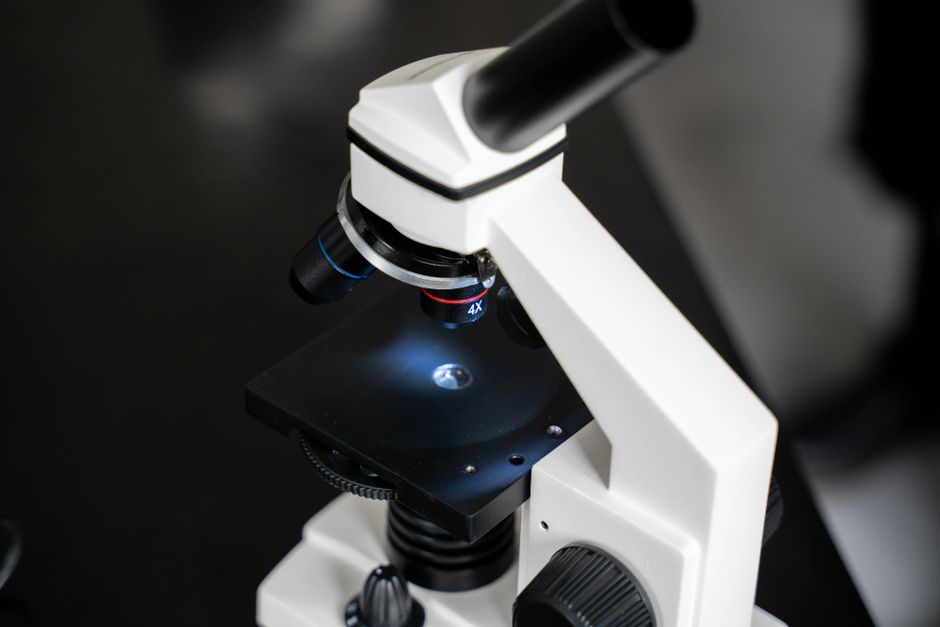
A parfocal objective is a microscope lens designed so that when you switch from one magnification to another, the sample stays in focus, or very close to it. In a parfocal system, only a slight turn of the fine focus knob is needed to sharpen the image after changing objectives. This is a standard feature on most modern laboratory microscopes, and it saves significant time when you are scanning samples at different magnifications.
How Does a Parfocal Objective Actually Work?
Parfocality is not an accident of design. It is an engineering specification. The microscope is built so that each objective lens has its focal plane at the same distance from the microscope stage. When you rotate the nosepiece to a new lens, the lens is already positioned at nearly the correct height to focus on the specimen.
The mechanical design uses a standardized tube length and a matched set of lenses. The lenses are machined and mounted so their parfocal distance—the distance from the objective’s shoulder to the focal plane—is identical across the set. Because of this, the image stays essentially sharp when you change magnification.
This is different from a parcentric system. Parcentric means the center of the field of view stays the same when you change objectives. Most microscopes are both parfocal and parcentric, but they are separate features. Parfocality keeps the focus, while parcentricity keeps the object centered.
Why Is Parfocality Important for You?
If you have ever used an older or cheaper microscope, you know the frustration. You find a great view at 10x, then rotate to 40x, and the image is a blurry mess. You spend a minute hunting with the coarse focus knob, possibly losing the area you were looking at entirely.
With a parfocal microscope, that problem mostly disappears. You switch from low to high power, and the image is already nearly sharp. You use only the fine focus knob to make a small adjustment. This is not just a convenience. It matters for your work.
When you are examining a blood smear or a tissue sample, you often switch between objectives repeatedly to move from overview to detail. A parfocal system lets you do that without losing your place. It keeps your attention on the sample, not on the mechanics of the instrument.
It is also important for your equipment. Constantly racking the coarse focus up and down puts wear on the gears. Parfocal objectives reduce that wear because you rarely need large focus adjustments.
Is Every Microscope Objective Parfocal?
No. Parfocality is a design choice, not a universal standard. Most quality compound microscopes from major manufacturers are parfocal. This includes most clinical, educational, and research microscopes.
However, not all objectives are parfocal with each other. If you mix objectives from different brands or even different series from the same brand, they may not be parfocal. The parfocal distance can differ between manufacturers. Some use a distance of 45 mm, while others use 60 mm or another standard.
If you buy a used microscope or add a single objective to an existing set, you cannot assume it will be parfocal with the others. You may need to adjust it. Many microscopes have adjustable stops or collars on the objectives that allow you to set the parfocal distance manually.
Also, some specialized objectives are not parfocal by design. For example, objectives used with certain water immersion or oil immersion techniques may have different working distances that prevent true parfocality across the entire set.





How Do You Use a Parfocal Microscope Correctly?
The correct technique assumes the system is parfocal. Start with the lowest power objective, usually 4x or 10x. Focus using the coarse adjustment knob until the image is sharp. Center the area you want to examine.
Then rotate the nosepiece to the next higher magnification. Do not touch the coarse focus knob. Look through the eyepieces and use only the fine focus knob to sharpen the image. In a well-adjusted parfocal microscope, this takes only a small turn.
If the image is far out of focus when you switch objectives, something is wrong. The objectives may not be parfocal with each other, or the microscope may need servicing. Do not force the coarse focus knob. Forcing it can damage the specimen slide or the lens.
This technique is especially important when using high magnification. At 100x with oil immersion, the working distance is extremely small. The lens nearly touches the slide. Using the coarse focus at this magnification can easily crack the slide or damage the lens. Parfocal objectives reduce the temptation to use coarse focus at high power.
What Is the Difference Between Parfocal and Fixed Focus?
These terms are sometimes confused. Fixed focus means the microscope is set to focus at a specific distance, usually for a specific eyepiece and objective combination. It does not change when you rotate the nosepiece. Fixed focus is common on simple or single-magnification microscopes.
Parfocal is different. It describes the relationship between multiple objectives. A parfocal set of objectives allows you to change magnification without a major refocus. A fixed focus microscope may have only one objective and no need for parfocality.
Some novice users expect a parfocal microscope to be completely sharp at every magnification with zero adjustment. That is not how it works. Parfocal means nearly in focus. You still need a small fine-focus adjustment. The goal is to minimize that adjustment, not eliminate it entirely.
Do You Need Parfocal Objectives for Home or Hobby Use?
For casual use, parfocality is convenient but not essential. If you are looking at pond water or cheek cells at one or two magnifications, you may not notice the difference. A single good objective can give you excellent images without any parfocal feature.
However, if you are serious about microscopy—whether for hobby, education, or clinical work—parfocal objectives are worth having. They make the workflow smoother. They reduce the risk of losing your target area. They also indicate a higher level of manufacturing quality.
Most microscopes sold for educational use, even at moderate prices, are parfocal. This is a standard expectation in the industry. If you are shopping for a microscope, check the specifications. Look for the word “parfocal” in the description. If it is not mentioned, ask the seller directly.
Be cautious with very cheap microscopes. Some budget models claim parfocality but do not deliver it consistently. The lenses may be parfocal at the factory but lose alignment with rough handling. If you buy a cheap microscope and find it is not parfocal, you may be able to adjust the objectives if they have adjustment collars.
How Do You Check If Your Microscope Is Parfocal?
You can test this yourself in a few minutes. Place a prepared slide on the stage. Start with the lowest power objective. Focus until the image is sharp. Note the position of the fine focus knob.
Rotate to the next objective. Do not touch the focus knobs. Look through the eyepieces. If the image is nearly sharp, the system is parfocal. If it is blurry, use the fine focus knob to sharpen it. Note how much you had to turn the knob.
A small adjustment—less than a half turn of the fine focus knob—is normal. A full turn or more suggests the objectives are not well matched. If the image is completely out of focus and requires the coarse knob, the system is not parfocal.
Repeat this test at each magnification level. A good parfocal set will behave consistently across all objectives. If one objective is out of line, it may be damaged or incorrectly mounted. Check that it is fully seated in the nosepiece.
Frequently Asked Questions
What does parfocal mean in simple terms?
Parfocal means the objectives on a microscope are designed so the sample stays in focus when you switch between them. You only need a tiny adjustment with the fine focus knob after changing magnification.
Are all microscope objectives parfocal?
No. Most quality compound microscopes are parfocal, but budget models and mixed-brand objective sets may not be. Check the specifications or test the microscope directly to confirm.
Why is my microscope not parfocal?
The objectives may have different parfocal distances, be from different manufacturers, or need adjustment. Some objectives have collars that let you set the parfocal distance manually to match the rest of the set.
Is parfocal the same as parcentric?
No. Parfocal keeps the focus when you change objectives. Parcentric keeps the center of the field of view the same. Most microscopes are both, but they are separate features.
