
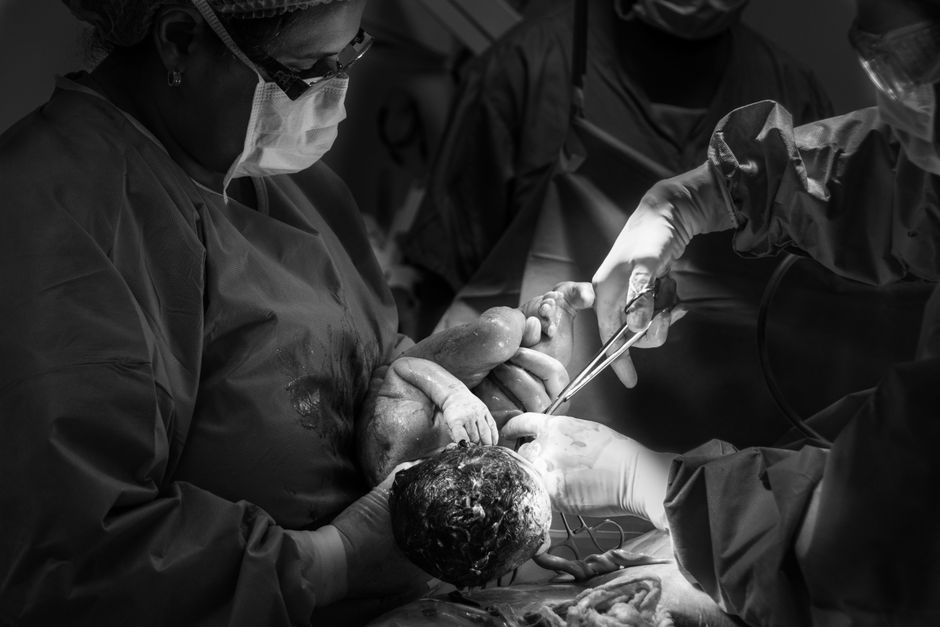
A Cesarean section, often called a C-section, is a surgical procedure to deliver a baby through incisions made in the mother’s abdomen and uterus. It is one of the most common surgeries performed in the United States, with the CDC reporting that nearly one in three births (32.1% in 2023) occurs this way. Unlike a vaginal birth, where the baby passes through the birth canal, a C-section allows the baby to be delivered through a controlled surgical opening.
Why Would Someone Need a Cesarean Section?
Some C-sections are planned well before labor begins. Others happen unexpectedly when complications arise during delivery. The decision is always medical, not elective in the sense of convenience, though some people do request them.
Common reasons for a planned C-section include the baby being in a breech position (feet or bottom first instead of head first), a placenta that covers the cervix (placenta previa), or carrying multiples like twins or triplets. A previous C-section can also lead to another one, though many women can attempt a vaginal birth after cesarean (VBAC).
Unplanned C-sections happen when labor stops progressing, the baby shows signs of distress (like a low heart rate), or the umbilical cord slips through the cervix before the baby (prolapsed cord). The American College of Obstetricians and Gynecologists (ACOG) notes that failure to progress is one of the most common reasons for an unplanned C-section.
It is important to understand that a C-section is not a sign of failure. It is a medical tool used when the risks of vaginal birth outweigh the benefits for mother or baby. Many women who have C-sections go on to have healthy babies and recoveries.
What Actually Happens During a Cesarean Section?
The procedure typically takes about 45 minutes, though the baby is usually delivered within the first 10 to 15 minutes. You are awake during the surgery, but you feel no pain from the incision.
You receive regional anesthesia, usually an epidural or spinal block, which numbs your body from the chest down. A screen is placed across your chest so you cannot see the surgery. The surgeon makes two incisions: one through the skin and one through the uterine wall. Most incisions are horizontal (a “bikini cut”) low on the abdomen. Vertical incisions are less common and used only in emergencies.
Once the incisions are made, the baby is gently guided out. The umbilical cord is clamped and cut, and the placenta is removed. Then the surgeon closes the uterus and abdominal layers with stitches or staples. You are usually able to hold your baby within minutes after the surgery is complete.
One thing many people do not realize: the baby is not “pulled out” forcefully. The surgeon gently lifts the baby through the opening. There is no suction or vacuum involved in a standard C-section.
What Is a Cesarean Section Recovery Like?
Recovery from a C-section is different from vaginal birth recovery. It is major abdominal surgery, and your body needs time to heal. Most women stay in the hospital for two to four days after the procedure.
Pain management is a key part of recovery. You will likely receive pain medication, often ibuprofen and acetaminophen, with stronger opioids reserved for severe pain. The CDC and ACOG both recommend using the lowest effective dose of opioids due to the risk of dependence. Walking as soon as possible — usually within 12 to 24 hours — helps prevent blood clots and speeds healing.
You cannot drive for at least two weeks, and you should avoid lifting anything heavier than your baby for about six weeks. The incision site needs to stay clean and dry. Signs of infection — redness, swelling, pus, or fever over 100.4°F — require immediate medical attention.
Full recovery takes six to eight weeks, though some women feel back to normal sooner. The uterus takes about six weeks to shrink back to its pre-pregnancy size. Internal healing continues for months after the external incision looks healed.




What Are the Risks and Side Effects of a Cesarean Section?
Like any major surgery, a C-section carries risks. It is important to know them so you can make an informed decision with your doctor. The risks are real, but they are also relatively rare for healthy women.
| Risk | How Common It Is | What It Means |
|---|---|---|
| Infection | 6-8% of C-sections | Infection can occur in the incision, uterus, or urinary tract. Antibiotics treat it. |
| Blood loss | Average 1000 mL vs 500 mL for vaginal birth | Heavier bleeding is normal but rarely requires a transfusion. |
| Blood clots | 0.1-0.2% | Clots in the legs or lungs are serious but preventable with early walking and blood thinners. |
| Injury to organs | Rare (under 1%) | Bladder or bowel injury can occur during surgery and is repaired immediately. |
| Reaction to anesthesia | Very rare | Nausea, headache, or allergic reactions are possible but managed by the anesthesia team. |
The baby also faces some risks. Research published in the journal Pediatrics has found that babies born by C-section are slightly more likely to have temporary breathing problems, especially if the surgery happens before 39 weeks. This is why elective C-sections are scheduled at 39 weeks or later unless there is a medical reason to deliver earlier.
Long-term, women who have C-sections have a higher risk of placenta problems in future pregnancies, such as placenta accreta (where the placenta grows too deeply into the uterine wall). The risk increases with each additional C-section.
What Does the Research Say About Cesarean Sections and Baby Health?
There has been a lot of discussion about how C-sections affect a baby’s microbiome — the collection of bacteria that colonizes the gut at birth. Babies born vaginally are exposed to bacteria from the mother’s birth canal. Babies born by C-section get their first bacteria from the mother’s skin and the hospital environment.
Some studies suggest this difference may be linked to slightly higher rates of asthma, allergies, and obesity in children born by C-section. However, the evidence is not strong enough to say that the C-section itself causes these conditions. The largest study on this topic, published in JAMA in 2019, analyzed data from over 1.8 million children and found that after adjusting for factors like mother’s age, weight, and health, the increased risk for asthma was small and may not be clinically significant.
What this means: if you need a C-section for a valid medical reason, do not worry about long-term health effects for your baby. The risks of not having a needed C-section — such as oxygen deprivation or birth injury — are far greater than any theoretical microbiome concern.
Some parents ask about “vaginal seeding,” where a swab of vaginal fluid is wiped on the baby’s mouth and skin after a C-section. As of 2026, ACOG does not recommend this practice because there is no proven benefit and there is a small risk of passing on infections. The safest approach is standard newborn care.
How Does a Cesarean Section Compare to Vaginal Birth?
This is not about which is “better.” It is about understanding the trade-offs. Every birth is different, and the right choice depends on your specific health situation.
Vaginal birth has a shorter hospital stay (one to two days), a faster recovery (most women feel back to normal in two to three weeks), and a lower risk of infection and blood clots. It also allows for immediate skin-to-skin contact and easier breastfeeding initiation. However, vaginal birth can cause perineal tearing, pelvic floor damage, and in rare cases, emergency interventions like forceps or vacuum.
C-section avoids the physical trauma of vaginal birth but introduces surgical risks. Recovery takes longer, and future pregnancies are affected by the uterine scar. Some women also report feeling less connected to the birth experience, though this is not universal.
One number worth knowing: the risk of severe maternal complications (like hemorrhage requiring transfusion or ICU admission) is about 2-3 times higher with C-section compared to vaginal birth, according to data from the CDC. But the absolute risk is still low — under 1% for healthy women.
If you are planning a vaginal birth but end up needing a C-section, that is not a failure. It is a medical decision made to keep you and your baby safe. Many women who have unplanned C-sections go on to have healthy babies and positive birth memories.
What to Avoid After a Cesarean Section
Recovery is straightforward if you follow a few key rules. The most common mistakes people make are doing too much too soon or ignoring warning signs.
- Do not lift anything heavier than your baby for at least six weeks. That includes grocery bags, toddlers, and heavy laundry baskets.
- Do not drive for at least two weeks or until you can stomp your foot hard on the brake pedal without pain. Opioid pain medication also makes driving illegal.
- Do not put anything in the vagina — no tampons, no douching, no intercourse — for at least six weeks. This reduces the risk of uterine infection.
- Do not ignore pain that gets worse instead of better. Increasing pain, redness, or discharge from the incision site needs a doctor’s evaluation.
- Do not skip follow-up appointments. Your doctor needs to check the incision, your blood pressure, and your mental health. Postpartum depression affects about 1 in 8 women, and C-section recovery can add extra stress.
Walking is encouraged. Rest is required. Listen to your body, not a calendar. Some women feel great at three weeks and overdo it, then pay for it with increased pain the next day.
Frequently Asked Questions
Can I have a vaginal birth after a previous C-section?
Yes, many women can attempt a vaginal birth after cesarean (VBAC). Success rates are about 60-80% for women with a low transverse incision and no other risk factors.
How long does it take to recover from a C-section?
Most women feel significantly better by four to six weeks. Full internal healing takes about six to eight weeks.
Does a C-section affect future fertility?
No, a C-section does not directly affect fertility. However, uterine scar tissue can slightly increase the risk of complications in future pregnancies.
Can I choose to have a C-section without a medical reason?
Yes, some women request a C-section for personal reasons. Your doctor will discuss the risks and benefits, and most will honor the request after informed consent.
