
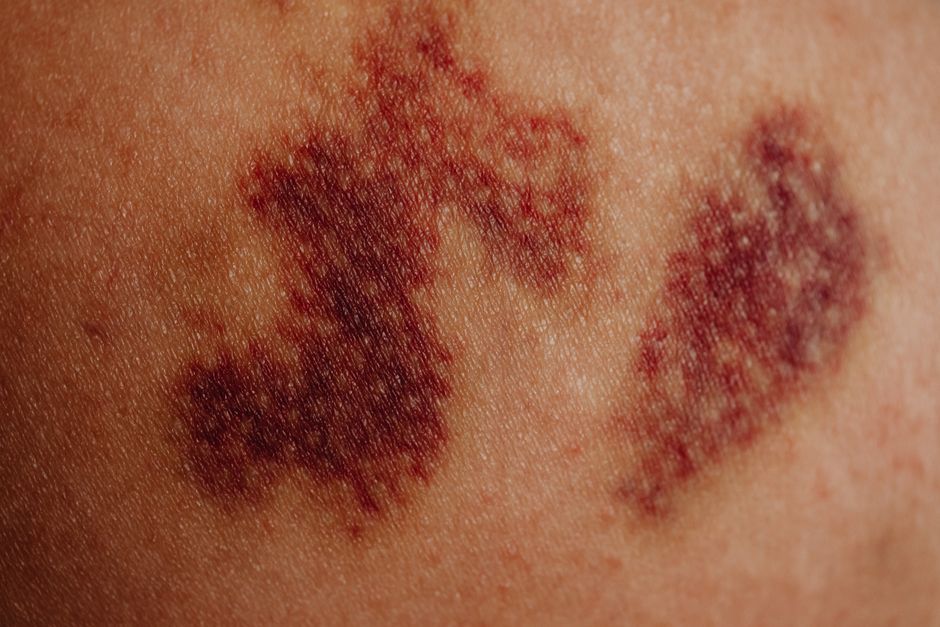
A cavernous hemangioma on the skin is a benign (non-cancerous) overgrowth of blood vessels that forms a soft, dome-shaped, bluish or purple lump. These growths are also called cavernous venous malformations. They are made up of large, dilated blood-filled spaces that give them a spongy texture. While they can look concerning, they are not a form of cancer and do not spread to other parts of the body.
What Causes A Cavernous Hemangioma To Form?
The exact cause is not fully understood. Most experts believe they develop due to a combination of genetic and developmental factors. These growths form when blood vessels in the skin do not develop normally during embryonic growth. This abnormal development leaves behind clusters of dilated vessels that fill with slow-moving blood.
Most cavernous hemangiomas are present at birth or appear shortly after. Some appear later in life, sometimes triggered by hormonal changes such as puberty or pregnancy. They are not caused by injury. A bump or bruise does not create a hemangioma, though trauma may draw attention to one that already exists.
Most cases occur without any family history. In rare instances, a genetic mutation plays a role. If you have multiple hemangiomas or a family history of vascular malformations, a doctor may recommend genetic testing to check for underlying conditions.
How Is A Cavernous Hemangioma Different From Other Skin Marks?
Many skin lesions look similar but behave very differently. It helps to know the basic differences.
- Strawberry hemangioma (infantile hemangioma): Bright red, raised, and appears in the first weeks of life. These grow rapidly then shrink on their own over years.
- Cherry angioma: Small, bright red, flat or slightly raised dots. They are common with aging and harmless.
- Port-wine stain: Flat, pink to purple birthmark that does not fade. It is a capillary malformation.
- Cavernous hemangioma: Deeper, bluish, soft, and compressible. It sits in the deeper layers of the skin and feels like a spongy mass.
The key distinction is depth and vessel size. Cavernous hemangiomas involve larger, deeper vessels than the superficial capillary lesions. Because they sit deeper, they appear blue or purple rather than bright red.
Only a dermatologist can tell these apart with certainty. An ultrasound or MRI can confirm the diagnosis if there is any doubt.
Are Cavernous Hemangiomas Dangerous?
Most cavernous hemangiomas on the skin are harmless. They grow slowly and cause no symptoms. Many people live with them for decades without any problem.
Complications are uncommon but possible. The most frequent issue is bleeding if the lesion is injured. Because the vessels are dilated and thin-walled, they can bleed more than normal skin when cut. Some people experience pain, especially if the lesion presses on a nerve.
Ulceration can occur, particularly in areas of friction like the waistband or bra line. This can cause discomfort and increase the risk of infection. In rare cases, a hemangioma inside the lesion can clot, causing it to become hard and tender.
When a cavernous hemangioma is located on the skin only, the risk of internal problems is very low. However, some people with skin lesions also have similar malformations in internal organs. If you have multiple skin lesions, especially along a nerve pathway, a doctor may check for internal involvement.





When Should You See A Doctor?
Any new or changing skin growth deserves a professional look. You should see a doctor if the lesion:
- Grows rapidly
- Changes color or texture
- Bleeds repeatedly
- Becomes painful or tender
- Ulcerates or forms a scab that does not heal
A dermatologist can examine the lesion and confirm it is benign. In most cases, a visual exam is enough. If the diagnosis is unclear, an ultrasound can show the blood flow pattern. An MRI provides more detail if the lesion is deep or complex.
Biopsy is rarely needed. When performed, it is done to rule out other conditions that mimic hemangiomas, such as certain soft tissue tumors. The procedure is simple and performed under local anesthesia.
What Are The Treatment Options?
Most cavernous hemangiomas need no treatment at all. Observation is the standard approach for asymptomatic lesions. A doctor will monitor the growth over time and intervene only if problems arise.
Treatment is considered when the lesion causes pain, bleeds, or affects appearance significantly. The main options include:
Laser therapy: Laser treatment can reduce the color and size of superficial vessels. It works best for flat, red lesions. For deeper cavernous hemangiomas, the laser may not penetrate deeply enough to be effective.
Surgical removal: Excision is the most definitive treatment. The surgeon removes the entire lesion and closes the skin. This is a straightforward procedure for small lesions. Larger ones may require more complex surgery, especially if they involve deeper structures.
Sclerotherapy: A solution is injected directly into the lesion. This causes the vessels to collapse and scar down, shrinking the hemangioma. Multiple sessions are often needed. This option is commonly used when surgery would be difficult or leave a poor scar.
Embolization: This is reserved for large or complex lesions. A radiologist blocks the blood supply to the lesion using tiny particles or coils. It is rarely needed for skin lesions alone.
No medication is approved specifically for cavernous hemangiomas on the skin. Some research has explored the use of beta-blockers for infantile hemangiomas, but these medications are not standard treatment for cavernous venous malformations in adults.
What Is The Outlook For Someone With A Cavernous Hemangioma?
The prognosis is excellent. Cavernous hemangiomas are benign and do not become cancerous. They do not spread to other organs. Most remain stable in size over time.
Spontaneous shrinkage is uncommon in adults. Unlike infantile hemangiomas, which often regress on their own, cavernous hemangiomas in adults typically persist. They may slowly enlarge over many years, but this is usually not a medical concern.
Quality of life is generally unaffected. The main issues are cosmetic and the small risk of bleeding from injury. For most people, the lesion is simply a physical feature that requires no action.
If treatment is chosen, the success rate is high. Surgical removal is curative in most cases. Recurrence is possible if the lesion is not completely removed, but this is uncommon. Sclerotherapy and laser therapy can improve appearance but may require repeat sessions.
Are There Any Home Remedies That Work?
No home remedy has been shown to shrink or remove a cavernous hemangioma. You may see claims about essential oils, herbal pastes, or compression. None of these have scientific evidence behind them.
Some of these remedies can cause harm. Applying irritating substances to a vascular lesion can damage the skin, cause ulceration, or trigger bleeding. If the lesion is injured, clean the area gently with soap and water and apply a clean bandage. See a doctor if bleeding does not stop or if signs of infection develop.
Compression garments are sometimes used in medical settings for larger venous malformations, but this is a clinical decision. Do not attempt to compress a lesion on your own without medical guidance.
Frequently Asked Questions
Can a cavernous hemangioma turn into cancer?
No. Cavernous hemangiomas are benign and do not become cancerous.
Do cavernous hemangiomas go away on their own?
In adults, they usually persist. They rarely shrink without treatment.
Is it safe to leave a cavernous hemangioma untreated?
Yes, for most people. If it causes no symptoms, observation is the standard approach.
Can a cavernous hemangioma bleed dangerously?
Bleeding can occur with injury, but it is usually controlled with direct pressure. Seek medical care if bleeding is heavy or persistent.
