

People swallow dead skin cells every day without noticing. Skin flakes from your lips, fingers, or the inside of your mouth mix with saliva and go down your throat constantly. Your digestive system handles them the same way it handles any other protein it encounters. There is no evidence that eating dead skin from your own body causes harm in healthy people.
The story changes when the skin comes from someone else, when it carries infectious organisms, or when a person deliberately eats large amounts of skin as part of a compulsive disorder. Those situations carry real medical risks. Understanding which one applies to you matters more than the general question of whether dead skin is “safe.”
What Happens If You Eat Dead Skin Health Risks?
Nothing unusual happens in the ordinary case. Dead skin cells are made mostly of keratin, a tough structural protein also found in hair and nails. Human digestive enzymes break down dietary protein, and keratin is no exception — though it is harder to digest than meat or eggs because of its tightly cross-linked structure.
Once swallowed, skin cells travel to the stomach, meet hydrochloric acid at a pH of roughly 1.5 to 3.5, and are broken apart. Whatever survives moves into the small intestine, where proteases finish the job. The amino acids are absorbed like any other protein source. Any indigestible fragments pass through the colon and leave in stool.
This is why biting your nails or chewing the skin around your fingers does not cause a digestive problem. The body treats it as a tiny, low-value protein snack and moves on.
Can You Actually Get Nutrients From Eating Skin?
No. The nutritional value is negligible, and framing dead skin as a protein source misunderstands how digestion works.
Keratin is rich in the amino acid cysteine, which forms strong disulfide bonds that make the protein hard to break down. Cooking helps, which is why keratin-rich foods like pig skin and chicken feet are eaten in many cultures. But those are cooked connective tissue from animals, not the microscopic flakes of your own epidermis.
The amount of skin a person might swallow from lip biting or finger chewing in a day is measured in milligrams. That contributes essentially nothing to daily protein needs. The average adult requires roughly 0.8 grams of protein per kilogram of body weight per day according to the Institute of Medicine’s Dietary Reference Intakes. Skin flakes do not meaningfully factor into that number.
When Does Eating Skin Become a Real Health Risk?
The risks come from three specific situations, not from the act of swallowing skin itself.
Infection from another person’s skin. Skin can carry bacteria, fungi, and viruses. Staphylococcus aureus, including MRSA, can live on skin surfaces. So can human papillomavirus, which causes warts, and various dermatophytes that cause fungal infections. Swallowing skin contaminated with these organisms does not guarantee infection — stomach acid kills many pathogens — but it is not a reliable barrier. Some viruses and bacteria survive the stomach, and the mouth and throat offer a direct route before acid ever plays a role.
Ingestion of harmful substances on the skin. Skin is a carrier. If a person’s hands touched contaminated soil, animal waste, or chemical residue, those substances travel with the skin flakes. This is the same mechanism behind hand-to-mouth transmission of intestinal parasites and bacteria like E. coli and Salmonella.
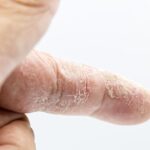
Compulsive skin eating. Dermatophagia is the medical term for compulsively biting and eating one’s own skin, usually around the fingers, lips, or inside the cheeks. It falls under the category of body-focused repetitive behaviors, alongside hair pulling and nail biting. In severe cases it causes bleeding, open wounds, and skin infections. It is also frequently linked to anxiety and, in some people, to obsessive-compulsive disorder.
The skin-eating itself is not the medical concern in dermatophagia. The tissue damage and the psychological distress are.




Is Eating Dead Skin a Sign of a Deficiency?
Sometimes. Pica is the persistent eating of non-food items, and it has documented associations with iron deficiency and zinc deficiency. The evidence is strongest for iron.
That said, pica typically involves substances like ice, dirt, clay, or paper — not skin specifically. There is no established clinical literature identifying skin-eating as a classic sign of any single nutrient deficiency. Some clinicians screen for iron and zinc status when a patient presents with pica-like behavior, but this is common practice rather than a firmly evidence-based protocol for skin eating in particular.
If someone is compulsively eating skin, the more likely underlying issue is a body-focused repetitive behavior or an anxiety-related condition, not a vitamin deficiency. Both possibilities can be evaluated at the same time.
What About Eating Your Own Dead Skin vs. Someone Else’s?
Your own skin carries your own bacteria. Your immune system has already been exposed to them. This is why licking a small cut on your own finger is generally low risk, while contact with a stranger’s skin carries more uncertainty.
The distinction matters most in these cases:
- Your own skin flakes, swallowed incidentally: essentially no risk in a healthy person
- Your own skin, if you have an active skin infection like impetigo or a fungal infection: possible spread of that infection to your mouth or gut
- Another person’s skin, especially if they have a skin infection: risk of acquiring bacteria, fungi, or viruses
- Skin from an animal, raw: risk of parasites and bacteria such as Salmonella and Campylobacter
Even with your own skin, broken or infected areas are different from healthy surface flakes. Open wounds are a portal for bacteria, and swallowing what comes off them is not the same as swallowing a dead cell from your arm.
Does the Stomach Acid Kill Everything on Dead Skin?
No. Stomach acid is a strong barrier, but it is not absolute.
Hydrochloric acid at normal stomach pH destroys many bacteria and viruses. But some pathogens are acid-resistant. Norovirus, for example, is notorious for surviving stomach acid and causing infection at very low doses. Mycobacterium tuberculosis can survive the stomach and cause intestinal disease. Certain parasites exist in cyst form and pass through the stomach unharmed.
This is why “the stomach kills germs” is an oversimplification. It reduces risk. It does not eliminate it.
Should You Be Worried About Swallowing Skin by Accident?
No. Incidental swallowing of dead skin is a normal part of daily life.
You shed roughly 500 million skin cells per day, according to estimates widely cited in dermatology. Many of those cells end up on your hands, and your hands touch your mouth constantly. You also swallow skin cells from the lining of your own mouth and throat continuously. This is not a health concern.
The concern arises only when skin eating becomes compulsive, when the skin is from an infected source, or when it is contaminated with something harmful. If you notice a pattern of compulsive skin biting or eating that causes bleeding, pain, or distress, that is worth discussing with a doctor or mental health professional. Body-focused repetitive behaviors respond to treatment, including habit reversal therapy and, in some cases, medication.
Frequently Asked Questions
Is eating dead skin bad for you?
In healthy people, occasionally swallowing dead skin from your own body is not harmful. The risks come from infected skin, another person’s skin, or compulsive skin eating that damages tissue.
Can you get sick from eating your own dead skin?
Rarely, and mainly if the skin is from an infected area. Your own healthy skin carries your own bacteria, which your immune system already recognizes.
What is it called when you eat your skin?
The compulsive habit is called dermatophagia. It is classified as a body-focused repetitive behavior and is often linked to anxiety or obsessive-compulsive symptoms.
Does eating skin mean you have a vitamin deficiency?
Not usually. Pica has documented links to iron and zinc deficiency, but skin eating specifically is not an established sign of any nutrient deficiency.
